Letter to Amna

TO: Amna Fatani
CC: Saudi Arabia

Although I have said that censorship does not work anymore, censorship is still a reality of our lives in this part of the world. Unfortunately, censorship by the government is not the only kind of censorship we have to endure and resist here. There is another, more difficult kind to deal with: social censorship.

In our deeply conservative and conformist society, any attempt to differentiate oneself is frowned upon if not outright rejected. You are expected required to think, talk and even look like everyone else. If you dare to to say or do anything that does not conform with the conventional wisdom, then you are simply asking for trouble. Not only your ideas will be ridiculed but you will also be personally attacked, and your parents will be blamed for not raising you well.

Now you think that’s bad? It gets ten times worse if you are a woman. Actually, you don’t even need to express a deviant opinion. Being a woman in itself can be enough for some people to denounce you, because to them women are secondary beings that should be kept in dark closets, away from the light of public life. I’m sure you’ve heard all that ‘jewel’ crap many times before.
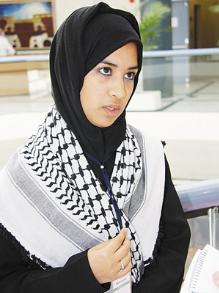
amna_fatanyThat’s why when Amna Fatani started a campaign to preserve heritage sites earlier this year, her father received hateful text messages telling him that he has no shame. Fatani appeared again in a local newspaper last week wearing a Palestinian keffiyeh during her participation at the Saudi-British Youth Forum in Jeddah. Again, she was faced with similar reactions. The first comment by a reader was: “let her cover herself up, and worry about her religion first.”

I’m sorry you had to go through this Amna, but if it’s any consolation, know that you are not alone. When AlArabiya.net published my interview with Reuters two years ago, people left many unpleasant comments, calling me a “Westernized spoiled brat” and “retard” among other things. Sure, it didn’t feel good but I have grown a thicker skin. Sometimes it is not just total strangers who try to put you down. More than one of my relatives have told me to “quit this nonsense” I’m doing. You, however, are lucky to have a supportive family who are very proud of you.

So dear Amna, whenever something like that happens to you, remember you are not alone and that we are all in this together. We are young and we are not amused. We are eager and determined. We will not be silenced and we will not be intimidated. We shall speak up and we shall overcome. Open your minds and hearts. Listen to our fresh voices.

Sincerely,
Ahmed

Women, Diversity and Jails

A member of Shoura Council said that he would like to see a woman minister in the government. Khalil al-Khalil also said he would like to see women work “side by side” with men in the Shoura Council.

Al-Khalil was speaking during a discussion panel on diversity in the Saudi society which took place this Saturday at King Saud University, where he was supposed to be joined by his fellow Shoura member Abdullah Dahlan. The latter, however, was a no-show. The discussion panel was typical of events at KSU. It started 30 minutes late and the attendance was low. The speaker’s talk was too general and he admitted later that he shied away from tackling specifics to avoid controversy.

Al-Khalil said we should not be afraid of diversity because it is “not a Western invention,” and because even the most powerful governments cannot erase it. That’s why we should protect diversity by legislation, he added.

I agree with him when he says that the government needs to step up and take its responsibilities on this crucial matter, and I think that they have failed to do so in the past. He claims that the government has a clear policy when it comes to religious diversity that is based on justice but I really don’t know what clear policy he is talking about.

Al-Khalil, who heads the security committee at Shoura, ended his remarks by saying that if we want to promote diversity then we need to build more universities, not jails. Well, it is a very interesting thing to say considering that the government just announced last year they will spend SR1.7bn ($450mn) to build five new high-tech jails around the country. Not that he and his colleagues could have done anything about it but…

Matrook Al-Faleh Freed

Matrook al-Faleh has been released from jail earlier today. Al-Faleh was arrested last May in Riyadh after criticizing the poor situation of Buraida General Prison where his fellow activist Abdullah al-Hamed was jailed until last September after he completed a six-month sentence there. Al-Faleh, a political science professor at KSU, was put in solitary confinement for the whole period, he had no access to a lawyer, and no accusations were officially made against him.

It is good to see Matrook al-Faleh free again and back to his family and friends, and I certainly hope other jailed prisoners of conscience will be released soon.

Discussion Panel on Diversity at KSU

What: Diversity in the Saudi Society
Who: Khalil al-Khalil and Abdullah Dahlan
When: Saturday, January 10, 2009. 10:30 AM
Where: Building No.7, Auditorium 7A
RSVP: Attending

In a conservative, conformist society like ours, diversity is not a popular term. Its opponents have always tried to make diversity look like a threat to national unity. That’s total bull, of course. Because our diversity only makes us stronger.

Hopefully this and other interesting ideas will be tackled in this discussion panel hosted by the Literary Club at KSU next Saturday. The speakers are Khalil al-Khalil and Abdullah Dahlan, both members of the dead Shoura Council. It is an open event and everyone is encouraged to come. The discussion panel will also be broadcast live to Khadija Bin Khuwailed auditorium in Olayisha campus for girls.

Simple Things

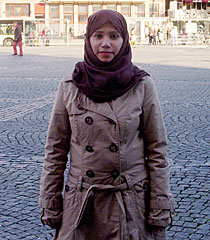
abeer21_Arab News offers this glimpse into the lives of some Saudi girls who are studying in the Netherlands. They talk about adapting to life in a liberal society; about how does it feel to be independent and free. They also talk about things like riding a bicycle or doing their own paperwork. Simple things, sure, but are they going to accept being denied of these things, let alone other much more important things, when they come back?

When I wrote about the scholarships girls back in November and suggested that they will play a pivotal role in reforming the country, some people disagreed and argued that this will not happen because the girls are simply as hypocrite as the guys. I think that’s a possibility, but I’d like to remain optimistic.

Read more: