Women, Diversity and Jails

A member of Shoura Council said that he would like to see a woman minister in the government. Khalil al-Khalil also said he would like to see women work “side by side” with men in the Shoura Council.

Al-Khalil was speaking during a discussion panel on diversity in the Saudi society which took place this Saturday at King Saud University, where he was supposed to be joined by his fellow Shoura member Abdullah Dahlan. The latter, however, was a no-show. The discussion panel was typical of events at KSU. It started 30 minutes late and the attendance was low. The speaker’s talk was too general and he admitted later that he shied away from tackling specifics to avoid controversy.

Al-Khalil said we should not be afraid of diversity because it is “not a Western invention,” and because even the most powerful governments cannot erase it. That’s why we should protect diversity by legislation, he added.

I agree with him when he says that the government needs to step up and take its responsibilities on this crucial matter, and I think that they have failed to do so in the past. He claims that the government has a clear policy when it comes to religious diversity that is based on justice but I really don’t know what clear policy he is talking about.

Al-Khalil, who heads the security committee at Shoura, ended his remarks by saying that if we want to promote diversity then we need to build more universities, not jails. Well, it is a very interesting thing to say considering that the government just announced last year they will spend SR1.7bn ($450mn) to build five new high-tech jails around the country. Not that he and his colleagues could have done anything about it but…
Matrook Al-Faleh Freed

Matrook al-Faleh has been released from jail earlier today. Al-Faleh was arrested last May in Riyadh after criticizing the poor situation of Buraida General Prison where his fellow activist Abdullah al-Hamed was jailed until last September after he completed a six-month sentence there. Al-Faleh, a political science professor at KSU, was put in solitary confinement for the whole period, he had no access to a lawyer, and no accusations were officially made against him.

It is good to see Matrook al-Faleh free again and back to his family and friends, and I certainly hope other jailed prisoners of conscience will be released soon.

Discussion Panel on Diversity at KSU

What: Diversity in the Saudi Society
Who: Khalil al-Khalil and Abdullah Dahlan
When: Saturday, January 10, 2009. 10:30 AM
Where: Building No.7, Auditorium 7A
RSVP: Attending

In a conservative, conformist society like ours, diversity is not a popular term. Its opponents have always tried to make diversity look like a threat to national unity. That’s total bull, of course. Because our diversity only makes us stronger.

Hopefully this and other interesting ideas will be tackled in this discussion panel hosted by the Literary Club at KSU next Saturday. The speakers are Khalil al-Khalil and Abdullah Dahlan, both members of the dead Shoura Council. It is an open event and everyone is encouraged to come. The discussion panel will also be broadcast live to Khadija Bin Khuwailed auditorium in Olayisha campus for girls.

Boring Drama, Happy Endings

Cinema is back to Saudi Arabia… sort of.

Rotana, the entertainment group owned by the country’s richest man Prince Alwaleed Bin Talal, premiered the comedy Menahi in Jeddah and Taif… but not in Riyadh. It was obvious that Rotana were trying to avoid a confrontation with the the Commission for Promotion of Virtue and Prevention of Vice aka the religious police. The Commission are much more powerful in Riyadh than they are in Jeddah and other places.

Still, it was obvious from the statements by Ayman Halwani, GM of Rotana, that they wanted to keep a low profile. They were wary of drawing too much attention to the screenings: “We’re worried that some of the conservatives might try to filibuster the opening,” he said. Have you ever heard of a movie producer who does not want his work to get much attention? Well, that’s Saudi Arabia for you, a country so full of contradictions it will make your head go dizzy.

Nevertheless, and despite the precautions taken by Rotana, the Commission unequivocally denounced the screenings. Sheikh Ibrahim al-Ghaith, head of the religious police told the press: “cinema is evil and we do not need it. We have enough evil already.” But one day later, al-Ghaith changed his tone on the subject. “We are not against having cinema if it shows the good and does not violate Islamic law,” he said. Now some people in the local media praised him for having the courage to take a U-turn, but many believe that he changed his line after a call from a senior royal.

In any case, his flip-floping did not seem to undermine the overwhelming enthusiasm of moviegoers who filled the theaters in Jeddah and Taif throughout the Eid holiday. The shows were all sold out and Rotana said they plan to produce 3 Saudi films this year.

So what does this mean to the country? Khalid al-Dakhil, former political sociology professor at KSU, thinks it is a giant step for the Saudi society. “(It shows) the erosion of the religious establishment’s influence, who realized they have to concede,” he told Reuters. I’m not sure that I agree with him on describing this step as “giant” but it certainly indicates the changes taking place in the country. Will 2009 see the official opening of the first proper movie theater in Saudi Arabia? I won’t bet on it, not just because betting is illegal here, but also because living in this place teaches you not to hold your breath when it comes to change.

Cinema, like women’s driving and other issues that we have been discussing for years now, has become a long, boring drama. Let’s just hope we will be graced by some happy endings.

Simple Things

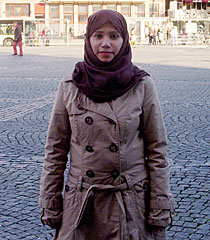
abeer21_Arab News offers this glimpse into the lives of some Saudi girls who are studying in the Netherlands. They talk about adapting to life in a liberal society; about how does it feel to be independent and free. They also talk about things like riding a bicycle or doing their own paperwork. Simple things, sure, but are they going to accept being denied of these things, let alone other much more important things, when they come back?

When I wrote about the scholarships girls back in November and suggested that they will play a pivotal role in reforming the country, some people disagreed and argued that this will not happen because the girls are simply as hypocrite as the guys. I think that’s a possibility, but I’d like to remain optimistic.

Read more:

Taking to Streets in Saudi Arabia

On the 19th of December, a few hundred people demonstrated in Qatif, a predominantly Shiite area east of Saudi Arabia, to protest the Israeli siege on Gaza. The protesters lifted posters of Hizbollah leader Sayyed Hassan Nasarallah and chanted anti-Israeli and anti-US slogans. According to the website Rasid, the demonstration ended peacefully under the eyes of security forces who watched closely. However, tens of young men who demonstrated were arrested in the following week.

After Israel started their barbarian attack on Gaza last Saturday, thousands of angry demonstrators took to the streets in Egypt, Jordan, Yemen and other countries. In Saudi Arabia, where the law does not give people the right to demonstrate publicly, more than 60 political and human rights activists signed a letter to the Ministry of Interior asking for permission to hold a peaceful demonstration in Riyadh.

While activists in Riyadh were waiting for a reply from MOI, protesters in Qatif demonstrated again on Monday, but this time they were faced by the security forces and riot police who fired rubber bullets to break up the protest. Mansour al-Turki, spokesman of MOI, denied that such protest took place. “Street protests are banned in the Kingdom and that the security forces will intervene to enforce the ban,” he added. His denial is not surprising, but everyone knows that people of Qatif have a long history in street protests with major demonstrations held in 1979, 2002 and 2006.

Four activists who signed the letter were summoned to meet a senior official at MOI today who also said the country’s regulations do not allow such activities. The activists said nothing in the local laws bans street protests but they signed a pledge that they will not hold the demonstration which was planned to take place tomorrow in Nahda Street. Another activist who did not sign the letter said he does not need a permission from anyone to protest. Khalid al-Umair said that he and other activists will be there tomorrow “because we are simply exercising our natural right in expressing our opinion peacefully.”

This was the first time for a group of activists to ask for such permission, and it was expected that MOI would not give a positive response. Although the request was denied, it seemed to encourage more people to take similar steps. More than 200 students at King Abdul-Aziz University in Jeddah sent a letter today to the rector asking for permission to hold a demonstration but he refused saying the university is not the right place to protest.

People should be allowed to protest, but it seems that the government is afraid that people will realize the power of public demonstration and later use it not just to protest against Israel but also to demand their rights. Giving permission to these demonstrations would set a precedent that the government clearly doesn’t want to deal with its results and consequences. 2009 will be interesting.

UPDATE: Khalid al-Umair and Mohammed Abdullah al-Otaibi have been arrested Thursday noon.

Also read: