Little Stories from Jeddah

“You are so lucky to present in front of the beautiful girls of Effat,” my friend Faiza told me with a little wink as we were waiting for our drinks at Teayana of Atallah Center last Thursday. Maan, from Saudi hip-hop band Dark2Men, quickly interjected, “I hate Effat girls!” He didn’t explain why he hates them, but his friend Tamer, the shy slow-talking other member of D2M, said that just because he hates them doesn’t make them any less beautiful.

Indeed, they are beautiful; not just their looks, but also their confidence, eloquence, intelligence, hard work and dedication. It was my first time to speak in Saudi Arabia, and the first time to give this kind of presentation, and I couldn’t ask for a better audience.

Still, I was very nervous and I stayed up late the night before the opening day, rehearsing and trying get over my fear. I slept for a few hours only to wake up on the message telling me that Fouad has been released. “This will be a good day,” I said to myself as I opened my laptop to write down some final notes that I thought I would need when I speak. I didn’t use the notes because I forgot the little notebook on the small table at the center of the stage, and when I came later I couldn’t find it!

I started my talk with a few words about my friend Hadeel, praying to God to grant her a speedy recovery. Then I went on to tell the background story of how I started my blog; a story I rarely shared with others, but I thought this was a good opportunity to do so. I talked about the growth of the local blogosphere and the diversity in the Saudi bloggers community. The last part of my talk focused on the lessons that I learned from my experience as a blogger for the past four years.

Speaking after the hilarious Baba Ali, I think I sounded inevitably boring. Obviously, and no matter how hard I may have tried to be funny, I knew I can’t compete with a real comedian, but since I’m already a fan of his that wasn’t a problem.

Elisabeth Bosely, our moderator, asked both of us a few questions and ended the discussion 30 minutes after we started, 15 minutes shorter than the official time announced in the schedule. Due to some organizational hiccups they were off to a late start and had to make sessions shorter in order to catch up with their crowded schedule.

Unfortunately, cutting the panel discussion short meant that students were not given any chance to ask questions despite the fact that many of them were eagerly raising their hands. Some students came after the session to talk outside the main hall, but as one speaker told me later, most students would be too shy to come and ask after you left the stage.

Most of those who talked to me after my presentation were really nice, and it certainly felt good to be at the receiving end of praise, but the truth is that I didn’t give the presentation just to impress. What I was trying to show is that I didn’t do anything extraordinary and that any of them could do it, and do much better actually.

Since most sessions at the symposium were concurrent, I did not attend many of them. But I did attend the opening presentation by Naif al-Muttawa, the creator of The 99, who has a good story although I think he could have told it better than he did. I also attended the iTunes U presentation by my friend Mohammed Milyani as well as a videoblogging workshop by Baba Ali and Yusuf Chowdhury.

Aside from the symposium, I have had a chance to hang out with my friends: Bandar, Yousef, Milyani, and Mohammed. I wanted to meet Fouad but by the time I talked to him he was already on his way to see his mom in Taif. I’ve also met Abdullah Thabit, author of al-Irhabi 20 (Terrorist 20), one of my favorite novels.

While standing in a line at Jeddah Airport, a lady approached me asking if I was “the blogger.” She said her daughters, who stood 200 meters away, have recognized me. She made me blush with her sweet compliments and later told me about her 16-year-old son who wants to be the first Saudi to play in the NBA. Seeing the hope and pride in her eyes filled me with joy and left me in high spirits, a feeling I never experience flying back home before.

Introducing Guest Blogger Lubna Hussain

Lubna HussainOld timers on this blog probably know that I’m a big fan of Lubna Hussain, and they probably remember how I used to link to her articles in Arab News frequently here. Unfortunately, Lubna stopped contributing regularly to Arab News sometime ago. Earlier this week, I had the pleasure to meet Lubna for the first time, and I told her that I miss her potent and strong articles. She asked me if she can write in my blog, and I, surprised by her kind gesture, immediately said: “yes, that would be great!”

Lubna Hussain currently runs NBC Universal Riyadh bureau, and she is the host of Bridges, a weekly political talk show that airs every Saturday on Channel 2 of Saudi TV. I’m extremely honored to have her as the first guest blogger on Saudi Jeans and looking forward to read her posts here.

Welcome, Lubna!

Seriously?!

This was the first thing I saw when I entered my college building this morning:

IMG_0200

Few hours later, someone decided to give them a piece of his mind:

IMG_0202

P.S. I’m not in the mood to translate but if you can read this and want to volunteer to translate, please do in the comments.

UPDATE: I guess someone didn’t like what the first someone did:

IMG_0206

Discussion Panel on Human Rights at KSU

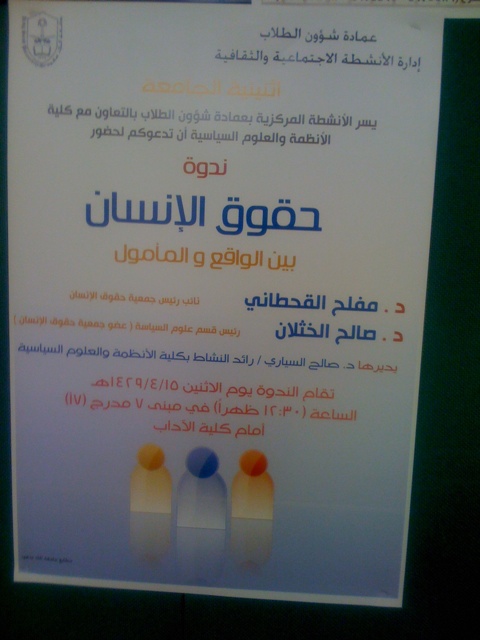
human rights at KSUMany people in the KSU community have been excited about appointing Abdullah al-Othman as a new rector. Although I despised all the ass-kissing published in the university newsletter after he took the helm at Saudi Arabia’s oldest university, I must give the man some credit for many good initiatives that he’s been pushing. One of the these initiatives is opening the campus for new voices rarely heard around here.

As part of their regular weekly events, the student affairs deanship at KSU will host tomorrow a discussion panel featuring Mufleh al-Qahtani and Saleh al-Khathlan from the National Society for Human Rights. It should be a good chance to raise awareness among ignorant students — if they show up, that is — and also talk about the current state of human rights conditions in the country.

Unfortunately, I have a practical exam at the same time so I won’t be able to attend, but I will try to finish early and catch what’s left by the time I’m done with my exam.

This is an open event, so if you are interested I highly encourage you to come. Girls are out of luck because AFAIK this event won’t be transmitted to the girls’ campus in Olaysha. Unless, of course, you have the ovaries to come to the boys’ campus and try to find a seat there. A few female journalists were allowed to attend Prince Turki al-Faisal lecture last month at Hamad al-Jassir auditorium.

What: Human Right — Between Reality and Ambition
Who: Mufleh al-Qahtani, VP of NSHR; Saleh al-Khathlan, member of NSHR
When: Monday, April 21, 2008. 12:30 PM
Where: Building No.7, Auditorium 7A, opposite to the College of Arts

Form for the Other Saudis

I don’t care if Mohammed al-Mussaed, aka Green Tea, and his likes call me a rafidi because the opinion of extremists is not of value to me. Now of course people like him would argue that “rafidi” is not meant as a sectarian slur but merely a description, but to me as well as many others this term has very negative connotations because it has been used for a very long time to degrade the group of Muslims to which I belong. But as I said, I could not care less.

What I care about, though, is how the government treat those so-called “rafida.” I expect our government to treat all citizens with justice and equality. This is what King Abdullah promised this nation, “a land of justice and moderation far removed from hatred and extremism.” And I still vividly remember his first speech as a King when he vowed justice for all.

When I was a young student, I was taught in school that all citizens of Saudi Arabia are Muslims, period. That’s why none of the official forms and papers used for Saudis here contain an item for religion. If you are a Saudi, you are automatically, er naturally, a Muslim. Or at least this is what I thought until I stumbled upon this form:

Form for Saudis

This form bears the logo of the Ministry of Health and it is used by the directorate of health affairs in Ahssa for those who apply for a job at government’s hospitals. The headline in this form clearly states: “Form for Saudis.” However, a few lines underneath that title there is a space where applicants are required to provide their religion and sect. So what’s going on here? Is this form only used in Ahssa or is it used throughout the Kingdom? I don’t know, but I can confirm that this form is not fake because I personally know someone who had to fill it when he applied for a job.

I have heard many people talk about sectarian discrimination at the healthcare sector in my hometown of Ahssa, but as a good citizen I always choose to ignore them and believe the government who insist that they don’t discriminate on sectarian basis. I would like to think that there no such thing as institutionalized discrimination here, but I think there are some individuals who use their power to pass discriminatory practices.

In this era of sectarian strife that is taking the region, it is high time for our nation to eliminate all practices conveying prejudices and for the government to take strong measures to stop discrimination on all levels. It is only with unity and solidarity that we are able to stand and overcome the challenges facing our country. Now let’s put the words into action.

Schism

Schism, fellow blogger Raed al-Saeed’s response to Geert Wilders’s Fitna has been making the rounds online with more than 130,000 views on YouTube and more than 1500 comments. I think I agree with Prometheus that the idea is good but the execution leaves much to be desired. Nevertheless, kudos to Raed for demonstrating how you can be positive and react rationally to opposing views instead of using violence and threats.

Read More:

UPDATE: Al-Watan daily came out yesterday with a ridiculous front page thing about the short film describing it as “provoking to Christians, rejected by Muslim.” They say any response to attacks on Islam should come from the so-called specialists: Sharia scholars blah blah blah. Obviously, terms like citizen journalism or user-generated content are so alien to the dead tree folks. They kept referring to Raed as “someone who claims to be Saudi” and none of those idiots bothered to check his blog or contact him despite the fact that his blog URL is clearly shown in the film, which means that they probably didn’t even watch the film in the first place. There are more stupidity in the article but I don’t have time for this crap.

Double-team for Women’s Employment

In my post last February on women’s employment I asked if whether we were moving towards more regulation or more segregation. According to a directive issued last week by Prince Khaled al-Faisal, Governor of Mecca, I guess regulation it is.

The directive, which was published in local media last Wednesday, is based on a letter sent by Labor Minister Ghazi al-Gosaibi who emphasized that the new labor law has deleted the clause banning women from working in mixed workplaces, and replaced it with a new clause that applies to both genders stating that “both the employer and employee must adhere to the law in conformity with Sharia.”

Now this last statement may sound vague and ill-defined, but it is still worthy of attention because the letter also affirmed that the Ministry of Labor is the government’s body responsible for regulating women’s working and that any involvement by other government’s bodies is unacceptable, in what seems to be a hint to the Commission and their sympathizers who keep nosing into these issues.

However, and as we have previously seen many times in the magic kingdom, writing laws is one thing and implementing them is quite another, especially when you don’t have an elected parliament to monitor the performance of government and question them when they fail to achieve their announced goals.

It was Ghazi al-Gosaibi who has tried three years ago to make working in women’s shops limited to Saudi women before he had to back down after fierce opposition by conservatives. What is different this time, though, is that he is not fighting alone. The support of Khaled al-Faisal, a figure many conservatives hate as much as they hate al-Gosaibi, could be the push the government need to put the laws in effect. It remains to be seen how crucial is this support will be.

UPDATE: In his column in Al Hayat today Abdul-Aziz al-Suwaid makes a good point about the vagueness of the law, asking MOL to define clear guidelines to protect women should they come under harassment. I totally agree.

Read More: