Bad, Bad Al-Watan (Updated)

UPDATE II 21/6/09: Jamal Khashoggi was not fired. He wrote an editorial today about the incident, saying “maybe what the Prince wanted to tell us is that there are many good things that you can do to serve this nation, and that is what we are going to do.”

UPDATE 21/6/09:There are conflicting reports regarding Khashoggi. Some sources confirm that he was fired, and some other sources deny it. I’m told he is unreachable because he is outside the country on vacation.

UPDATE 20/6/90: It has been confirmed that Jamal Khashoggi, the editor-in-chief of al-Watan, has been fired after the incident. This is the second time Khashoggi is fired of this job; the first one was in 2003.

For a long time I made no secret of my frustration with the policy of closing shops for prayer time, and also the fact that some government employees use prayer as an excuse to neglect their jobs. Actually, I posted about this more than four years ago. As the margin for freedom of expression is slowly increasing, the local press is finally getting the courage to discuss this matter, with a few articles appearing here and there. Here’s one of these articles that was published in al-Watan last week. Since the Commission for Promotion of Virtue and Prevention of Vice is the body responsible for enforcing this policy, I don’t think this will change anytime soon.

But speaking of the Commission and al-Watan, something interesting happened a few days ago. The Commission held an event in Riyadh last Tuesday to celebrate launching a strategic plan for the Hay’a. The ceremony was under the patronage of Prince Naif, the Second Deputy Premier and Minister of Interior, and after the ceremony there was a press conference where reporters had a chance to ask him about all kinds of issues.

The last questions in the press conference was by Mohammed Nasser al-Asmari, who writes a column for al-Watan. He asked the minister to explain why Riyadh has more Commission centers than police centers. Prince Naif said this is untrue, “and may God increase [the Commission centers],” he added, and then he went on to criticize the newspaper saying they have bad intentions, and that they attract writers against the faith and against the nation.

Al-Watan, which is considered one of the more liberal Arabic-langauge newspapers in the country, has strangely omitted the criticism from their coverage of the event that was leading their front page on Wednesday. Some observers have expressed their fear that the relative freedom al-Watan enjoyed since its inception might be coming to an end.

Adwan al-Ahmari, the reporter whose name appears in the byline of the story, told me the newspaper did not include that question in their coverage because al-Asmari is an opinion writer who does not represent the newspaper and that he was speaking for himself only. While I understand the choice the editors made here, I’m not sure if this was the best choice. Ignoring that comment raises questions about their transparency and credibility at a time when they really needed to emphasize such values.


Footnotes:
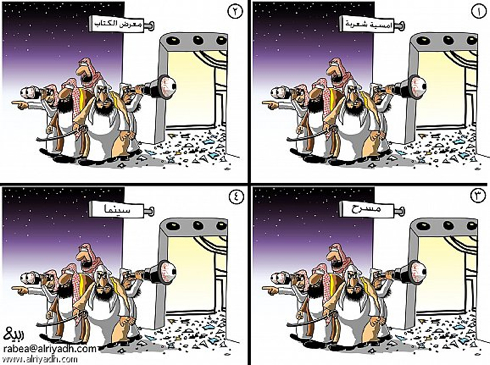
Let Them Protest

Riyadh witnessed a comeback for cinema after 30 years of absence. Menahi, a movie produced by Alwaleed’s Rotana, was opened to public in King Fahad Cultural Center (KFCC) last week. I was curious to see how this was going to play out, but not curious enough to actually go there myself. The main reason for missing on this “historical event,” as some called it, is because I dislike Faiz al-Malki (the rumors about his assassination are false btw, he is alive and well, shooting a TV series in Taif). I believe I’m free to dislike al-Malki, and also free to express that dislike in any way I deem appropriate. Look, I just did exactly that in this paragraph. Some people go to extreme measures to express their opinions, and that’s also fine, as long as they don’t cause physical harm to others or damage property. It’s called freedom of expression.

That being said, I was not surprised to read that several groups of young men attempted to disrupt the movie’s showings at KFCC, by trying to persuade moviegoers to leave in order to close down the show. We have seen this kind of behavior before in the book fair, Yamama College theater, and other places.

Dawood al-Sherian does not like how the local media covered what happened this time, or more specifically how columnists and opinion writers like him talked about it. He thinks that most writers have linked between the behavior of these young men with terrorism. “They almost made it look like a plot by al-Qaeda,” he wrote. He says that if the writers support the return of cinema as a form for freedom of expression, then they should welcome the reaction of those men in the same spirit.

I agree with him that linking this behavior to terrorism and al-Qaeda is unfair, but I don’t think it is far-fetched to link it to extremism. I don’t know about you, but I really think there is something extreme about trying to convince people to leave and close down the show. I admit it is hard sometimes to draw the line between what is accepted as freedom of expression and what is not, but in this case it seems easy enough. The young men should have been allowed to hold their protests outside KFCC, under the eyes of the police to make sure that things don’t get out of control. Now of course Dawood al-Sherian would never say such thing, probably because his limits are different than mine, or simply because he knows that public demonstrations are not allowed here.

Although I’m not sure if/how this would work, but I think that if they were allowed to express their disapproval this way they won’t feel it necessary to go extreme and try to stop the show, or start vandalizing and destroying like what happened in Jouf where they burned a tent prepared for literary events.

Decades of fundamentalist religious propaganda have made the concept of “freedom of expression” seems very alien to our culture, but that does not mean it truly is. This is a universal basic human right; it was not invented by the infidel West. Some Saudi pseudo-liberals claim that too much freedom of expression is bad — even dangerous — for this country, simply because it would give their opponents more rights that these opponents are trying to deny the rest of us now. That’s a fallacy. The real test of how sincere we are about freedom of expression is in how much we are willing to tolerate those we disagree with.

Norah and Adela

Norah al-Faiz says she has been misquoted. She does not say she was misquoted on what exactly: her Najdi niqab, introducing sports to girls schools, that she can’t appear on TV without permission, or the news that she started her talk with the reporters by saying “ya mama…” Alas, she said she will no longer speak to the press directly and will conduct all her interviews from now on via fax or email. I hope the new approach of the deputy minister would stop her from uttering nonsense like that she is more influential than Barack Obama. Al-Faiz has retracted her statements about introducing sports to girls schools, saying she is not against it and that “an integrated plan is being worked out to introduce PE in girls schools.” This actually could be true, not necessarily because al-Faiz said so but because someone who is far more influential than her is pushing for it.

Princess Adela bint Abdullah, the King’s daughter, told al-Riyadh daily yesterday that “it’s high time to look into the matter of introducing sports at girls schools seriously, following the teachings of Islam.” Princess Adela does not work in the government, but she is married to the minister of education. A friend of mine who met the princess says she is offering a new image for the women of the royal family. She is highly-motivated and very determined, and she is playing an increasingly assertive role in public life here. Since she is standing behind this, I think that female students might start enjoying their sports classes when the new school year begins this fall.

Commission is Hiring

Some people think they are doing good things. Some people think they are spreading horror around the city. What do they think? They think they are understaffed. According to Saudi Gazette, the Commission for Promotion of Virtue and Prevention of Vice aka Hai’a aka the religious police aka Mutaween (these guys have many names) in Riyadh has been given the go-ahead to increase the number of its staff. The plan to increase the staff include employing “temps” and “freelancers” after they receive what the Commission spokesman Abdul Mohsen Al-Ghafari described as intensive training. But wait, I thought they don’t hire freelancers anymore. Am I missing something here? Well, I don’t know. I shall ask you, however, to welcome the new recruits and wish them uneventful careers, free of harassing people and invading their privacy.

Roots

Something is bothering me about Norah al-Faiz, the deputy minister of education. Sure, as the first Saudi woman to be appointed in such a senior position, she has come under a lot of attention, and maybe a lot of scrutiny. But I’m not talking about her performance as an official; I believe it is still early to evaluate her work, probably in the same way she thinks it is too early to talk about introducing sports to girls schools (it’s not, btw).

What is bothering me is this: Why does she keep referring to her Najdi roots every time someone asks about her allegedly “leaked” picture and the niqab? I believe she has every right to be proud of her roots, but I don’t think this is the right context to highlight them and associate the niqab with them. She serves in the ministry of education, she should be a role model. What kind of message does her statements send to teachers and students? Why can’t she just say that it’s a personal choice and that she expects others to respect it?

Now I could easily find her picture and put it in this post, but I’m respecting her wish in that she does not want her picture to be published. Is it too much to ask her to respect the rest of us who put their nation’s interests above their regional affiliation?

Now Walk the Walk

President Obama’s speech was better than expected, but less than what I was hoping for. We know that he can give a good speech, and he certainly did that in Cairo. However, I think that in his attempt to be balanced, he came out sounding too balanced, especially on democracy and human rights.

Probably he was trying to be careful not to offend his hosts, but as I said in my New York Times op-ed, I was hoping that he would speak directly to the leaders in the same way that he did in his inaugural speech when he said: “To those who cling to power through corruption and deceit and the silencing of dissent, know that you are on the wrong side of history, but that we will extend a hand if you are willing to unclench your fist.”

However, I understand why he was cautious when he talked about democracy and human right, and I can’t blame him. He obviously wants to distance himself from the rhetoric and policies of the previous administration, and I guess that’s why he also did not use the word “terrorism” at all in his speech. Still, I think that in the few words he said on democracy he made several good and important points:

America does not presume to know what is best for everyone, just as we would not presume to pick the outcome of a peaceful election. But I do have an unyielding belief that all people yearn for certain things: the ability to speak your mind and have a say in how you are governed; confidence in the rule of law and the equal administration of justice; government that is transparent and doesn’t steal from the people; the freedom to live as you choose. Those are not just American ideas, they are human rights, and that is why we will support them everywhere.

There is no straight line to realize this promise. But this much is clear: governments that protect these rights are ultimately more stable, successful and secure. Suppressing ideas never succeeds in making them go away (…)

No matter where it takes hold, government of the people and by the people sets a single standard for all who hold power: you must maintain your power through consent, not coercion; you must respect the rights of minorities, and participate with a spirit of tolerance and compromise; you must place the interests of your people and the legitimate workings of the political process above your party. Without these ingredients, elections alone do not make true democracy.

In any case, he had too much ground to cover, and therefore it was only normal that he would choose to focus on some issues more than others. I think the way he talked about the Palestinian-Israeli conflict was different than what we usually hear from American presidents. Yes, he said the bond with Israel is unbreakable, but for the first time we hear a US president talk about “Palestine,” not just the Palestinian people, and use words like intolerable and humiliation to describe their suffering. It was also good that he dedicated parts of his speech to religious freedom and women’s rights, two issues where there is much to be done, especially here in Saudi Arabia.

Over all I think the speech was a good start for a frank dialogue between America and the Muslim world, but now those words must be matched with deeds so we can move forward. “And I want to particularly say this to young people of every faith, in every country – you, more than anyone, have the ability to remake this world,” Obama said at the end of his speech. Count me in. I, for one, want to remake this world, starting from here.

UPDATE 6/6/09: David Brooks described the part on democracy as “stilted and abstract — the sort of prose you get after an unresolved internal debate”:

But many of us hoped that Obama would put a gradual, bottom-up democracy-building initiative at the heart of his approach. This effort would begin with projects to create honest cops and independent judges so local citizens could get justice. It would make space for civic organizations and democratic activists. It would include clear statements so the world understands that the U.S. is not in bed with the tired old Arab autocrats.