They Know Better!

Abdullah Al-Obeid, the Minister of Education, is all over the front pages these days to brag about the new e-learning initiative his ministry has recently launched.

I think he can brag. After all, the man has single-handedly solved all the problems that have plagued our education system for decades. Female teachers no longer get killed on the road to their schools in God-forsaken remote places; all the textbooks have been fixed to be moderate and up-to-date; and extremist teachers have been kicked out for good.

That’s why it comes as no surprise to read about their latest genius decision: they will not issue any renewals for permission for Saudi students to attend international schools. Not that it was easy to enroll your kids in international schools in the past. I am told that it takes a hellova a wasta to do that, but now even your big ‘wow’ can’t save your kids from the Saudi education system.

Moreover, they say British schools will have to accept only British pupils, German schools German pupils, Indian schools Indian students, and so on. Nonsense. Because most international schools will not be able to operate without Saudi students who make up the bulk of enrollment.

Earlier this week, Tariq Al-Maeena published a letter from a distressed mother who says she would rather have her kids home schooled or move to Dubai or Bahrain. I don’t know what MOE has to say about the reasons behind their ruling, but in a country where the government think they can tell you what (or what not) to name your kids, it is only understandable that they know what’s best for the kids once it is time for them to go to school.

Little Stories from Jeddah

“You are so lucky to present in front of the beautiful girls of Effat,” my friend Faiza told me with a little wink as we were waiting for our drinks at Teayana of Atallah Center last Thursday. Maan, from Saudi hip-hop band Dark2Men, quickly interjected, “I hate Effat girls!” He didn’t explain why he hates them, but his friend Tamer, the shy slow-talking other member of D2M, said that just because he hates them doesn’t make them any less beautiful.

Indeed, they are beautiful; not just their looks, but also their confidence, eloquence, intelligence, hard work and dedication. It was my first time to speak in Saudi Arabia, and the first time to give this kind of presentation, and I couldn’t ask for a better audience.

Still, I was very nervous and I stayed up late the night before the opening day, rehearsing and trying get over my fear. I slept for a few hours only to wake up on the message telling me that Fouad has been released. “This will be a good day,” I said to myself as I opened my laptop to write down some final notes that I thought I would need when I speak. I didn’t use the notes because I forgot the little notebook on the small table at the center of the stage, and when I came later I couldn’t find it!

I started my talk with a few words about my friend Hadeel, praying to God to grant her a speedy recovery. Then I went on to tell the background story of how I started my blog; a story I rarely shared with others, but I thought this was a good opportunity to do so. I talked about the growth of the local blogosphere and the diversity in the Saudi bloggers community. The last part of my talk focused on the lessons that I learned from my experience as a blogger for the past four years.

Speaking after the hilarious Baba Ali, I think I sounded inevitably boring. Obviously, and no matter how hard I may have tried to be funny, I knew I can’t compete with a real comedian, but since I’m already a fan of his that wasn’t a problem.

Elisabeth Bosely, our moderator, asked both of us a few questions and ended the discussion 30 minutes after we started, 15 minutes shorter than the official time announced in the schedule. Due to some organizational hiccups they were off to a late start and had to make sessions shorter in order to catch up with their crowded schedule.

Unfortunately, cutting the panel discussion short meant that students were not given any chance to ask questions despite the fact that many of them were eagerly raising their hands. Some students came after the session to talk outside the main hall, but as one speaker told me later, most students would be too shy to come and ask after you left the stage.

Most of those who talked to me after my presentation were really nice, and it certainly felt good to be at the receiving end of praise, but the truth is that I didn’t give the presentation just to impress. What I was trying to show is that I didn’t do anything extraordinary and that any of them could do it, and do much better actually.

Since most sessions at the symposium were concurrent, I did not attend many of them. But I did attend the opening presentation by Naif al-Muttawa, the creator of The 99, who has a good story although I think he could have told it better than he did. I also attended the iTunes U presentation by my friend Mohammed Milyani as well as a videoblogging workshop by Baba Ali and Yusuf Chowdhury.

Aside from the symposium, I have had a chance to hang out with my friends: Bandar, Yousef, Milyani, and Mohammed. I wanted to meet Fouad but by the time I talked to him he was already on his way to see his mom in Taif. I’ve also met Abdullah Thabit, author of al-Irhabi 20 (Terrorist 20), one of my favorite novels.

While standing in a line at Jeddah Airport, a lady approached me asking if I was “the blogger.” She said her daughters, who stood 200 meters away, have recognized me. She made me blush with her sweet compliments and later told me about her 16-year-old son who wants to be the first Saudi to play in the NBA. Seeing the hope and pride in her eyes filled me with joy and left me in high spirits, a feeling I never experience flying back home before.
Jeddah Update

When the organizers of the L&T Symposium asked me few months ago who they should invite to speak about blogging in Saudi Arabia, Hadeel was on top of the list that I recommended. It would be hard for me to speak on the stage knowing that she is supposed to be there with me, but I will keep her in my thoughts and prayers.

I fly to Jeddah in a few hours. The symposium won’t kick off till Saturday, but I thought I would arrive a bit earlier to hang out with my friends and meet some people. I found out that fellow blogger Mohammed Milyani will also be speaking at the event but in a different session.

The symposium blog confirmed yesterday that Queen Rania of Jordan will be the opening night keynote speaker. If you want to follow the event keep an eye on their blog and this page. The sessions will be broadcasted live on ART (probably the open-to-air Ein channel), and it will also be webcast courtesy of MeduNet.

I’m not sure how often I will be able to update the blog while I’m in Jeddah but you can always check out my Twitter page to read some fresh bits and pieces.

Discussion Panel on Human Rights at KSU

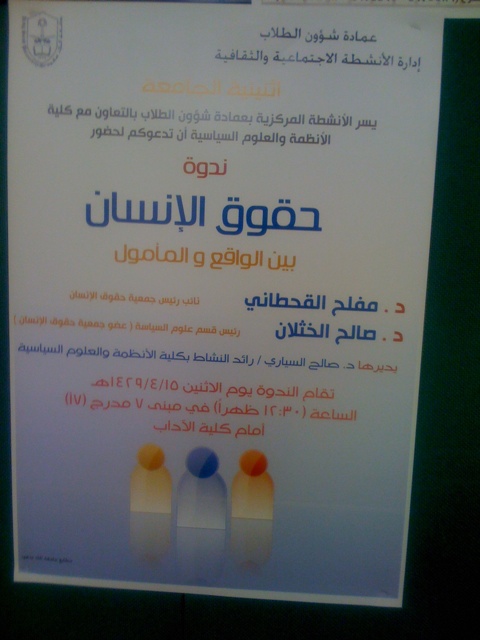
human rights at KSUMany people in the KSU community have been excited about appointing Abdullah al-Othman as a new rector. Although I despised all the ass-kissing published in the university newsletter after he took the helm at Saudi Arabia’s oldest university, I must give the man some credit for many good initiatives that he’s been pushing. One of the these initiatives is opening the campus for new voices rarely heard around here.

As part of their regular weekly events, the student affairs deanship at KSU will host tomorrow a discussion panel featuring Mufleh al-Qahtani and Saleh al-Khathlan from the National Society for Human Rights. It should be a good chance to raise awareness among ignorant students — if they show up, that is — and also talk about the current state of human rights conditions in the country.

Unfortunately, I have a practical exam at the same time so I won’t be able to attend, but I will try to finish early and catch what’s left by the time I’m done with my exam.

This is an open event, so if you are interested I highly encourage you to come. Girls are out of luck because AFAIK this event won’t be transmitted to the girls’ campus in Olaysha. Unless, of course, you have the ovaries to come to the boys’ campus and try to find a seat there. A few female journalists were allowed to attend Prince Turki al-Faisal lecture last month at Hamad al-Jassir auditorium.

What: Human Right — Between Reality and Ambition
Who: Mufleh al-Qahtani, VP of NSHR; Saleh al-Khathlan, member of NSHR
When: Monday, April 21, 2008. 12:30 PM
Where: Building No.7, Auditorium 7A, opposite to the College of Arts

Segregation or Regulation?

Although I have tried to register to participate at the 7th National Dialogue, I never received to a response from the organizers and therefore I have had to watch the dialogue on television.

This round of the National Dialogue, which took place earlier this week, focused on the dilemma of employment from different angles. The hottest topic, of course, was women’s employment. Now almost everyone agrees that we need to create more job opportunities for women; the disagreement, however, arises when it comes to how to approach and address this problem. More specifically, the disagreement is over how to define the proper work environment for women.

Two trends can be seen here. First, there are those who believe that in order to encourage more women to join the workforce we have to provide separate workplaces for them. They cite the example of the education sector, the field where 85% of working women in the country are in, and argue that the government should push in that direction.

However, I believe these guys are ignoring two important things: the fact that following education, the second field where most women are employed is the healthcare sector which is not segregated, and also the fact that many women chose to work at the education sector simply for the lack of other options, even if that choice means sometimes working in remote areas and being away from their families and putting themselves in danger of lethal car accidents.

The other trend regarding women’s employment in the dialogue argue that strict interpretations of religion and old social norms have only halted the development of the country and slowed down the growth of our economy. The insistence on providing separate work places for women, they say, is costly and impractical as it makes it difficult to keep a smooth workflow. Moreover, even if the government decided to go with that option, they won’t be able to force business to do the same.

Instead of separate workplaces, what they propose instead is writing new laws and regulation to create and maintain safe work environments that give equal opportunities and protect employees, especially women.

I expect this debate to continue, and I think we need to wait and see which argument of these two will attract more followers and prevail, or probably we will have to make some compromises and end up with a third way and a middle ground. The economic factor will be decisive here because, as one participant pointed out, the ever increasing living costs will mean that the one salary (currently the man’s) will no longer be enough to support a family.

I agree with Fatin Bundagji when she says that the idea of the national dialogue, even if it did not amount to obvious immediate results, is a good idea. And even though I was not invited to attend the dialogue at Makarem Ballroom in the Marriott, it was certainly refreshing for me to follow it and see my countrymen and women debate and take part in this conversation, which signifies, among many things, a change in mindset and a newfound respect for diversity, as well as a better understanding between the different faction in our society.

Walk the Walk

The patient education course I attended on Monday was OK. It suffered a lack of organization and they were lucky the number of participants was small. It could have been chaotic, and it didn’t help that the presentations were lame. Not much to say about the sessions, and I’m pretty sure you are not even remotely interested in knowing stuff such as the fact that 24% of the Saudi population have diabetes and 28% of those are not even aware they are diabetics!

But what I want to say is that I was really impressed by the female pharmacists. Despite being locked kept in the upper deck of the otherwise mostly empty auditorium, they were very vocal and gave the speakers a hard time with tough questions and critical remarks. Fellow male students tried to keep up with them (or was it to get the girls’ attention? ;-) but to no avail.

After the end of the course, and since the weather was nice and sunny, I went to take a walk inside the King Abdulaziz Historical Center area, one of my favorite places in Riyadh. I had a good time but I missed a friend of mine that I used to enjoy walking and taking pictures with. Speaking of pictures, I have taken some many of these during my walk; a couple of them are shown above and you can find the rest here.

We Would Like to Breathe

For some reason, Arab News chooses not to name KSU when they write about the stifling restrictions Saudi Arabia’s oldest university impose on their female students. Considering how this country is obsessed with segregation, there is no surprise here. And the ironic thing is, they say the university “is supposed to be a place where young women experience greater freedoms.” Says who? Wake up girls! This is freakin’ K of SA you are living in. The university, as you may expect, claim that the point of these restrictions is to protect the students. Again, no surprise. Welcome to Saudi Arabia, where everyone claims moral authority over the rest.

In the other hand, the newspaper chooses to name another university in Riyadh, Imam Mohammed bin Saud Islamic University, which supposedly is even more strict than KSU. It is said that IMSIU is to launch a new college of medicine, but according to Ali Al Mousa in Al Watan daily, the university president could not answer the question of whether female students would be accepted in the new college. Al Mousa tends to cut the president some slack because answering that question might put him in confrontation with the extremists who would, for sure, use the ‘segregation’ card. Let’s wait and see how this drama is going to play out.

And in case you didn’t know, the extremists are not only controlling the campuses in Saudi Arabia, but they also managed to extend their notorious control to the press in neighboring Kuwait, where this article by Dalaa’ Al Mufti was banned from Al Qabas daily, apparently because Al Mufti dared to comment on the ridiculous decision of the Committee for the Promotion of Virtue and Prevention of Vice to spend SR 700,000 on a study that examines the mingling of the sexes and its “harmful effects” on the society. I’ve told you that these people are obsessed, right?