Happy National Day, despite everything.
Happy Eid
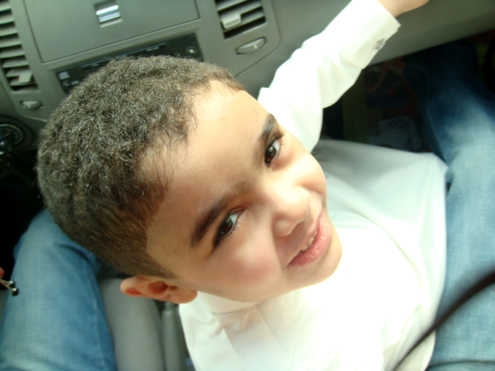
My little brother Mohammed and I would like to wish you all a Happy Eid.
Think
Shiekh Mohammed al-Nujaimi makes me laugh. No, not because he is funny, but because many of his statements are simply laughable.
Few weeks ago, when Human Rights Watch criticized Saudi Arabia for detaining thousands of terror suspects without charge or trial, he came out saying he has strong evidence that HRW is a zionist organization, because according to him they overlook Israel’s crimes against the Palestinians. Well, Israelis think that HRW is “maniacally anti-Israel” because the organization have recently done some fund rising efforts in Saudi Arabia. Go figure.
Something else: while debate on stopping all commercial activity during prayer times continues, one local news website has decided to advocate for this pause by closing the site for 20 minutes, five times a day. If visitors to Aen Hail visit the site during prayers, they are met with a message “Closed for Prayer” in Arabic along with a countdown to the end of the prayer break at the bottom of the page.

What does al-Nujaimi has to say about this? “Closing a Saudi website for half-an-hour during obligatory prayers is a noble Islamic act,” he said. “It’s free from any search for fame or unacceptable rigidness. It contributes to reviving the habit of individuals praying on time.” Let’s think about it. Prayer times differ depending on where you are. What if I’m in a city where it is not prayer time yet? “What if the person wishing to surf the page is a non-Muslim?” as Amal Zahid asked in al-Watan daily.
The two examples mentioned above can be forgiven or ignored, but to go and label everyone who disagrees with him as traitors who serve a foreign agenda is just unacceptable. Al-Nujaimi probably suffers from logorrhea, but that does not mean he is excused from at least trying to think before he opens his big mouth.
Jewels Become Eggs
Cast
Egg ……….. Girl
Mobile …… Guy
Pillows …… Religious Police
Women are no longer jewels?
Taste This!
The (in)famous slogan of our national air carrier is “Proud to serve you.” That’s a nice slogan, except for the fact that the kind of services provided by Saudi Airlines is nothing to be proud of, especially in their domestic flights. I have had my share of bad experiences with them, and I heard countless of negative stories from friends, family members and complete strangers. But forget about us, whiny customers, for a moment and check out this funny story featuring none other than Khalid al-Molhem, the Director General of the troubled airline, who found himself on board a Riyadh-to-Jeddah flight that was delayed for one hour. Why? Because the pilot was late. I guess Arab News got it right in their first line: “Talk about the worst possible day to be late for work” hehe.
How to Wear a Ghotra
Although the header of this blog shows my picture in a thobe and ghotra, those who know me know that I don’t wear them very often. And whenever I wear the ghotra, which is usually in a wedding or similar occasions, I face the dilemma of how to wear it. Unlike the necktie, where you are limited to a few choices when it comes to how to tie one and there are guidelines and tutorials on how to do it, there are so many different ways to wear the ghotra and there is no such thing as The Ultimate Ghotra Wearing Guide. However, last week I received an email that showed two dozens styles of ghotra wearing, and I thought I would share some of them here…
Modesty
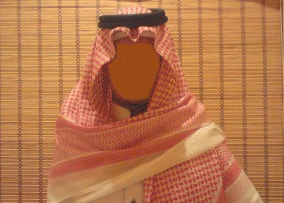
Very simple. Just throw one end of the ghotra on the opposite shoulder and you are good to go.
Eagle

Similar to Modesty, only this time you take the other end of the ghotra and left it on the aforementioned shoulder.
Mr. X
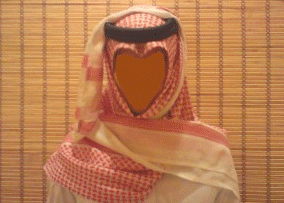
Throw both ends of the ghotra onto the opposite shoulder. Suitable for desert trips and cold weather.
VIP
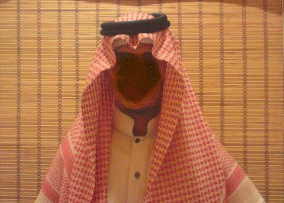
This one is usually sported by ministers and big officials, as well as in weddings and receptions. You just let your ghotra down, probably with some little folds on both sides of the mirzam, which is the area of the ghotra in the middle of the forehead.
Teachers

Again, you let the ghotra down only this time it goes behind your back. It is very simple and makes for easy quick movement, which is why it is perfect for teachers.
Schoolboys
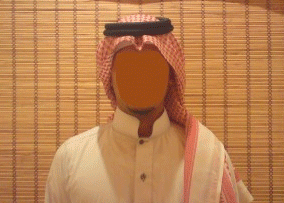
Modern with a traditional touch, this style is popular among students. You bring one end of the ghotra from behind and put it in front of the opposite shoulder, while the other end remains in the back.
Abu Rashed

Named after Khaled Abu Rashed, lawyer of the infamous drifter Abu Kab, who allegedly mastered this style. You through one end of the ghotra above your head while leaving the other end as it is.
Balance
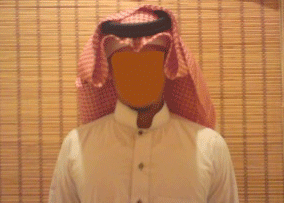
As you can see, this one looks like a scale from the front. You through both ends above the head with a slight angle while leaving space to form what resembles scalepans.
Cobra

This one got very popular in the 90’s, and it gets its name from the highly venomous snake. You need a large amount of starch to preserve that look, and you need to be careful when you move your head because quick moves might destroy it.
Butterfly

Unlike the Cobra which limits the motion range of the neck, probably causing a long lasting pain in the area, this one allows for freer movement. Easy and flexible, it makes for a full view of the face and it has a touch of elegance to it.
Bint al-Bakkar
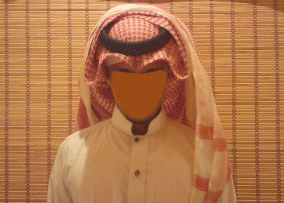
The name has a historical background that I don’t fully understand, but this style has become one of my favourites lately. Not easy to master, but when done right it is quite steady and looks very nice.
Bonus
Here’s a picture of me and my brother Hassan during a recent engagement party in Hofuf, both sporting Bint al-Bakkar:

Search Engine Terms (1)
Examples for search terms people used on their way to this blog, followed by commentary from yours truly:
– asphalt vs jeans
Jeans wins. Every time.
– how to have fun in riyadh
You don’t. You can’t.
– italian culture club jeddah
Is there such thing? UPDATE: Souma says there, actually, is.
– is it safe to visit to beirut in july 20
I was there in August, and it felt pretty safe.
– jeans not like my daughter dubai
Sorry what?
– saudis think emiratis are liberal
Do we think that?
– happy ending love boring
Oh come on! Love is not boring. Love is nice.
– nightlife in riyadh
Yeah, right!
 Saudi Jeans

You must be logged in to post a comment.