- Have you heard of the Air France flight attendant who was arrested for robbing passengers? Muhammed al-Ahidib provides four reasons why this woman would not have been able to steal if she were working for Saudi Arabian Airline.
- Here is another good review for Routes d’Arabie, this time from Bloomberg.
- Nasser Weddady offers another fine rebuttal to Rami Khouri’s op-ed in NYT. At the end of his blogpost, Weddady comments on a part of Khour’s article that I chose to ignore, which is about the “hypocrisy” of US government’s interest in social media while it supports the very same dictatorships that crush liberties. This is an old and overused argument, and something I have touched on in my op-ed in the same newspaper last year.
Category Saudi Arabia
Blocked in UAE?
There have been some conflicting reports yesterday over the blocking of Saudi Jeans in the UAE. The blog Emirates in Style reported the block and provided this screenshot:
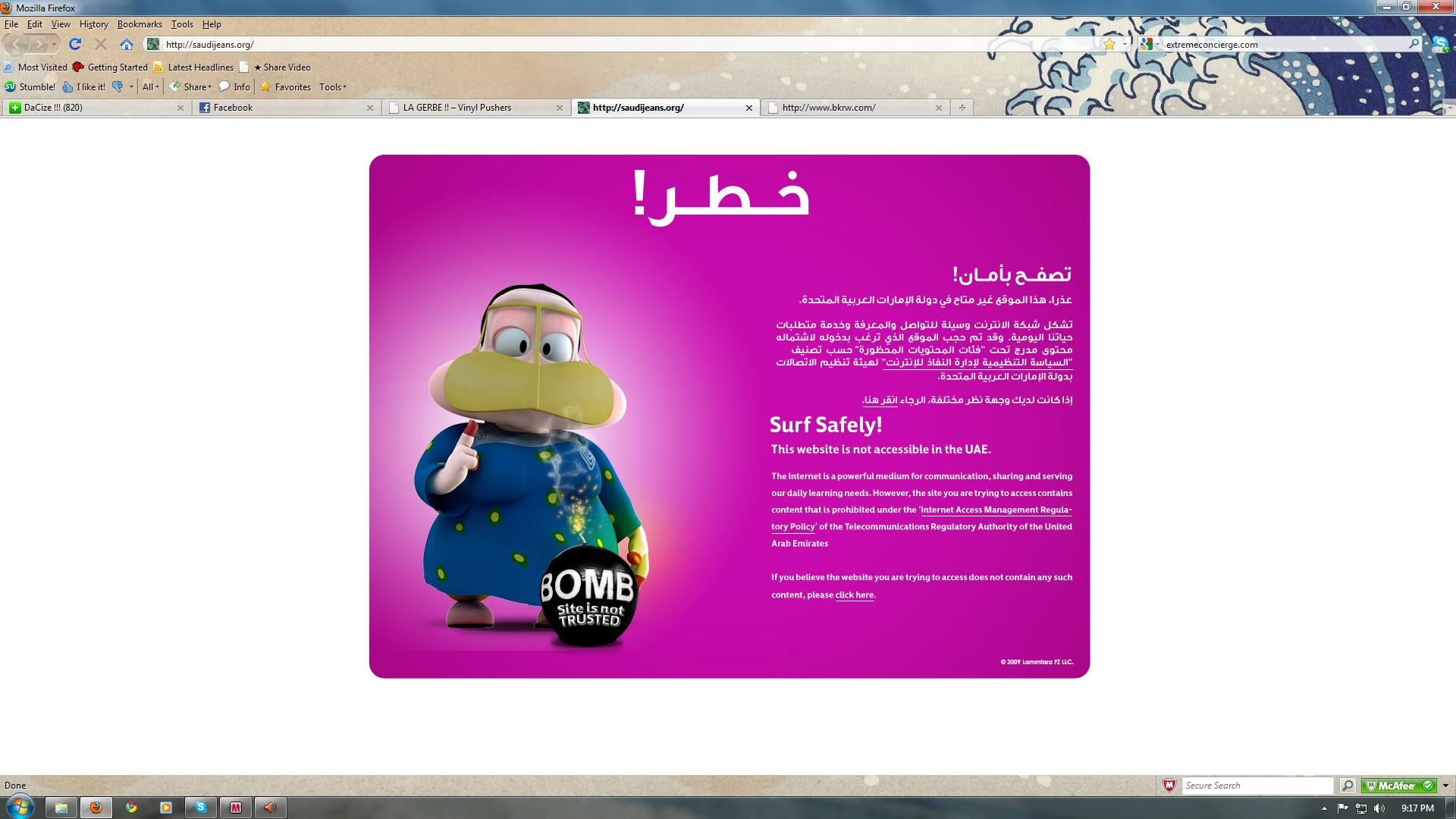
When I asked people on Twitter to confirm this, some of them said the blog was indeed blocked, while others said they can still access it. I’m still not sure what exactly is going here here, but I would like to know more. So readers in the UAE, can you please check if Saudi Jeans is blocked where you are or not?
Routes d’Arabie, Rami Khouri, Reverse culture shock
- The Saudi Routes of Arabia exhibition in Paris has been receiving some pretty good reviews. Hundreds of artifacts never before seen outside Saudi Arabia are currently on view at the Louvre. I have seen most of these pieces at the National Museum, and I’m glad the whole world is getting a chance to see this part of our history. I wish they would do more to promote the museums and exhibitions like this inside the country for the locals who only get to hear about such events when they take place abroad.
- Rami Khouri thinks the new media in the Middle East synonymous with the Al Jazeera effect of the 1990s, i.e. it is merely venting and therefor will not lead to any real change in the Arab political landscape. I’ve heard this rhetoric many times before. If he thinks that the current wave of activism is useless, then what exactly does he suggest? Should we just sit down, keep our mouths shut, and wait for his generation to bring about change? Based on their history, this seems pretty unlikely. But lamenting this whole phenomenon as merely venting is naïve. Khouri and other old media people obviously still struggle to understand new media and their influence. I never said blogging will change everything, but I think it is the start of something good, something that our predecessors were not able to do. The evidence is his comparison to Al Jazeera, which is a one-way medium just like the one he comes from, unlike new media where people are actively engaged and involved and not simply passive consumers.
- My friend Ben has been living in Saudi Arabia for a year, and now he is back to the US and is suffering from a “reverse culture shock.” Thankfully, he says, his condition is treatable. The doctor has prescribed him movies, lots of bacon, and a few happy hours.
Identity and social change, women’s rights movements, US diplomat in henna
- Qusay ponders the questions of identity and social change: “I am a product of that change, along with many others, just take a look at the Saudi’s writing in English. English is almost our first language, we grew up watching American shows and we dressed like the cool people we saw on TV. When we went out we ate fast food, and listened to American music, and watched Hollywood movies (not in theatres of course).” I wonder if I’m one the bloggers he is talking about. I don’t think that I’m one of them. I think my view of our society has more to do with our past, which I believe was better, than with what Western media sell as their lifestyle vs ours.
- The Philosophy Cube writes about the women’s rights movement in Saudi Arabia. Or rather the lack thereof. I think many of us agree that the economic factor is one of the strongest catalysts for change. “In light of all the social intricacies within the society, I am sure that it is poverty alone and the struggles of the lower classes that will bring Women’s Rights to the country.”
- Today’s picture:
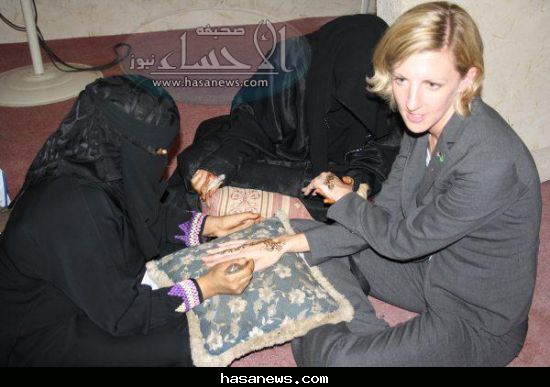
Cynthia Cook sits down to have her hands adorned with henna in a local summer festival here in Hofuf, east of Saudi Arabia. Cook is the Public Affairs Officer at the US Consulate in Dhahran, and she was part of an American delegation that visited the festival earlier this week. You know, public diplomacy and stuff :P
Pop culture, funny lawyer, summer festivals
- Saudi Dawn aka the Eternal Philosopher thinks Saudis are brainwashed with a certain pop culture that “is filled with half-truths and out of context religious information that is promoted to control the masses.” I agree.
- Lawyer Ahmad Al-Rashid said he will sue Riyadh’s summary court after it refused to consider his lawsuit against MBC for what he called “encouraging deviant behavior in Saudi society.” The court told him to contact the Ministry of Culture and Information’s media violations committee, but he said he won’t. Funny. As a lawyer he should be well aware of this. Citing the example of Mazen Abdul Jawad case doesn’t make much sense here. That case was against Abdul Jawad not LBC, although the channel later got punished for operating without a permission (which is also funny because none of the other non-Saudi channels working in the Kingdom have such permission).
- Lou K has another good post. This time about so-called Saudi tourism and its so-called summer festivals. “Basically, our summer festivals are nothing but shopping festivals.. There’s nothing more to it..” he says. There is a lot of truth in what he says, but there are also exceptions. The local summer festival here in Al-Ahsa, known as Hasana Falla, tries to mix culture (folklore, arts, traditional crafts, etc.) with entertainment and some shopping. I made a short visit last night to the event, ironically to meet some American visitors, and I thought it was okay. In the words of a Hassawi girl on Twitter, it’s “not half-bad, but nothing much to do.”
Welcome to Earth
So today I had to dig into my family’s archive to look for the immunization documents from my early years (long story). While flipping through the papers I found this thing:
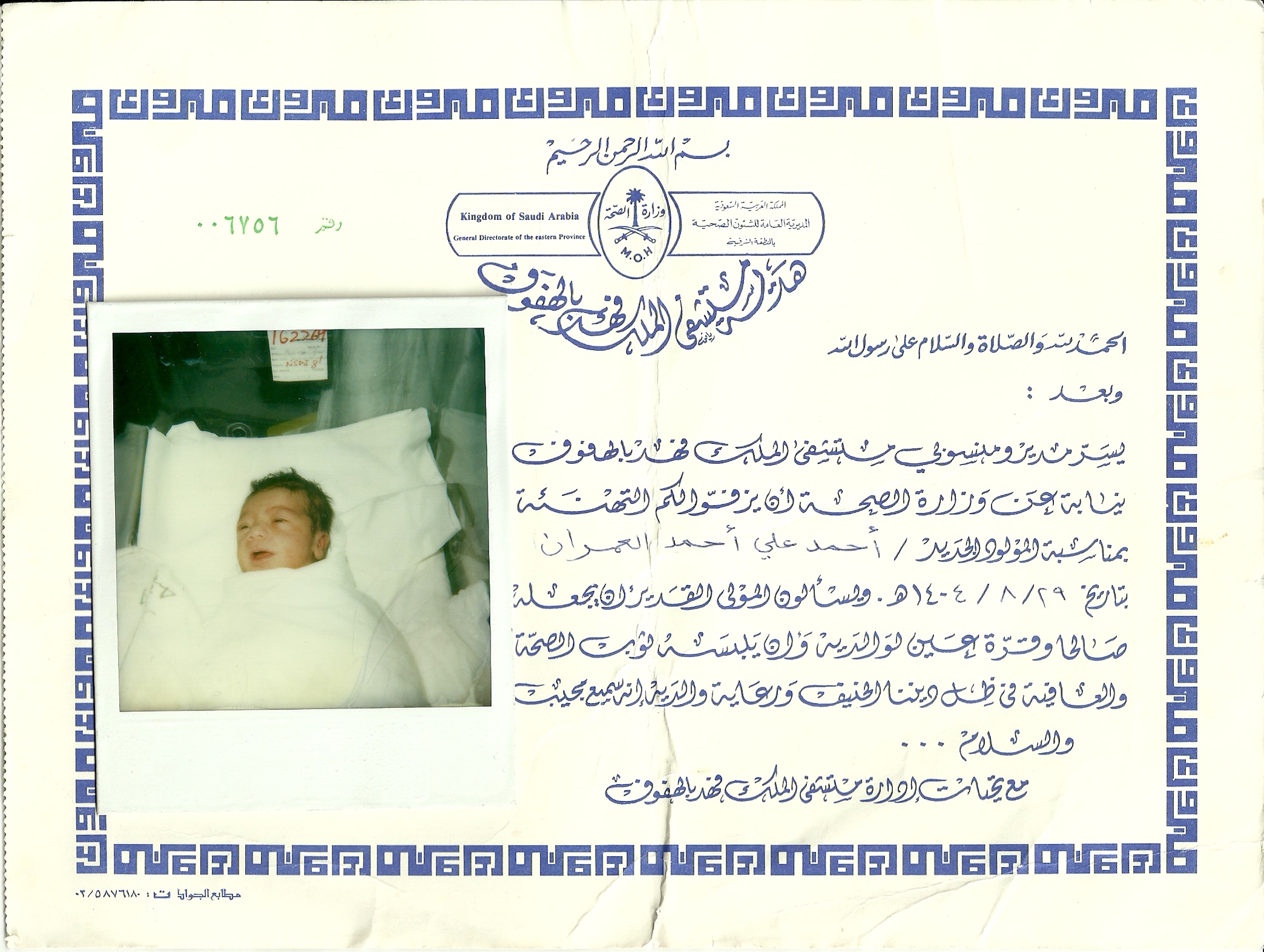
It is not a birth certificate. It is a gift from the hospital where I was born. It has my picture, date of birth, and wishes of a long prosperous life. I’m the only one of my brothers who has one of these. According to my mother, the hospital stopped giving these away shortly after. My favourite part of it is the polaroid, which is still in a good shape after all these years. The picture was taken during my first few minutes into this world, apparently still inside the incubator. I can only guess what the expression on my face means, but it’s probably a combination of bemusement and boredom. Yeah, I’ve been in this place for like 5 minutes and I was bored already :P
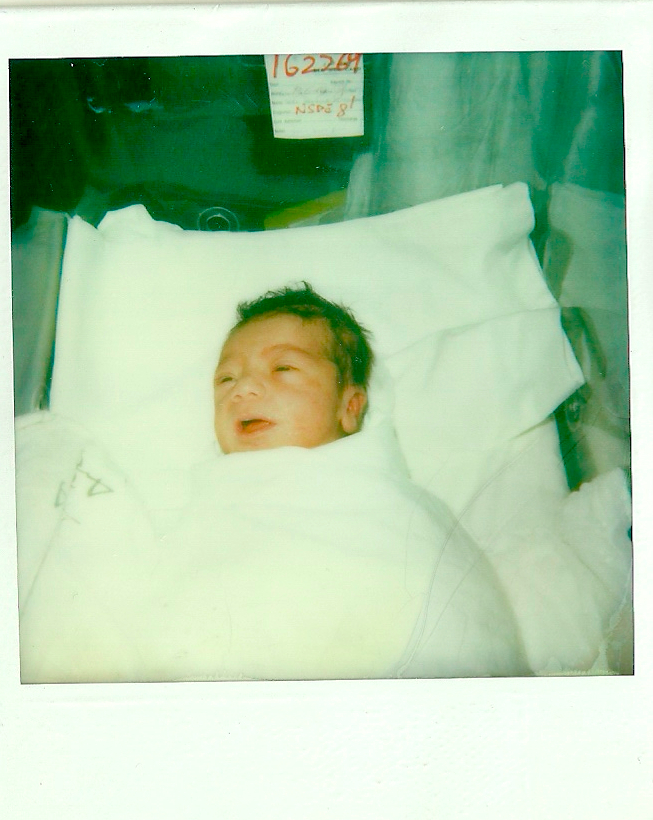
If you liked this one (and seriously, what’s not to like? JK ;-) you might also want to check these two blogposts where I posted old pics from the days when I was fat and happy. A new header for the blog is also in the works, so stay tuned.
Abdullah al-Eyaf, Ahmed Bin Baz
- If you enjoyed reading about Abdulmohsen al Mutairi and young Saudi filmmakers, you probably want to read this interview with director Abdullah Al-Eyaf. His latest film, “Ayesh,” has been well received and won the first award of the Gulf Film Festival that was recently held in Dubai.
- In the second part of a series on Saudi Arabia, GlobalPost runs this piece by Caryle Murphy who profiles the upstart scholar Ahmed Bin Baz. I have been reading for the young Bin Baz for a while now, so I’m not surprised by the opinions he offers in this interview. However, I’m a bit surprised to see Dr. Mohammed al-Hodaif, father of the late Hadeel al-Hodaif, likens Bin Baz to Paris Helton in the sense that he is using his father’s name to become famous. Totally uncalled for.
 Saudi Jeans
You must be logged in to post a comment.