 It is extremely saddening how some of us were so brainwashed that they reached a stage where even the most basic human rights have become alien to them. Al-Riyadh daily asked their readers earlier this week about blogging and if blogs are a medium for spreading ideas and sharing opinions or simply a place for bragging and showing off. So freedom of expression is bragging now? *sigh*
Category Politics
Rants from Beirut
Sorry about the hiatus. I’m back in town after a few days in Beirut, and No, I wasn’t there to enjoy the Eid break. I was invited by the World Association of Newspapers (WAN) to participate at the 3rd Arab Free Press Forum. I was a speaker at last year’s event and I had a good time there. This year, my friend Fouad al-Farhan was invited to speak on a discussion panel on the changing face of Arab blogging. Unfortunately, Fouad was stopped at Jeddah airport and was told that he is banned from leaving the country.
I was in Riyadh airport preparing to take my plane to Beirut when I received the disturbing news which made me upset. What happened to Fouad reminded me with other good people in this country also banned from traveling despite what they have contributed to this nation. People who sacrificed their freedom to promote free speech, human rights and justice. It is truly sad that such people are treated this way, especially in these times that carried the signs of reform and hope for a better future.
However, Saudi Arabia was not alone in this shameful act. Syria and Tunisia followed suit by banning two journalists and a human rights activist from traveling to attend the event. In his opening remarks, Timothy Balding, CEO of WAN, thanked the authorities of Tunisia, Saudi Arabia and Syria for this eloquent and timely demonstration of their contempt for, and fear of, free expression. Of course this is not surprising. According to the latest Annual Worldwide Press Freedom Index released by RSF, the three countries ranked 143, 161 and 159 out of 173.
Now coming to the forum’s sessions, the first one dealt with new tactics used by governments and the judiciary to impede and sanction the independent press. In his introduction, the moderator described these new tactics as oblique or subtle. But Ibrahim Essa, editor-in-chief of Al Dastour daily in Egypt refused such description, saying the Arab governments are not cleaver enough to employ such tactics. “I think Arab governments are stupid and repressive and they don’t need to resort to oblique tactics. Our governments don’t need to resort to oblique tactics because they are blunt,” he added.
The second session, on which Fouad was supposed to speak, focused on the Arab blogging scene. Interestingly, and maybe not surprisingly, the three presenters are all living and writing from outside their countries. Syrian blogger Mohammed al-Abdullah talked about restrictions on the internet in his country and the evolution of the Syrian blogosphere. He said the bloggers have become a source of information for Syrian citizens, despite all the constraints and obstacles for even just being on the internet. Mohammed left Syria after being arrested twice and facing a third arrest (his father and brother are both in jail).
Sami Ben Gharbia, as usual, was awesome. He talked about Tunisia’s sophisticated internet blocking apparatus, and how bloggers and activists have used Web 2.0 technologies to find and use innovative ways around the system.
But I have to say that it was Kizzie Shawkat, the blogger from Sudan, that I felt I could relate to her story the most. Kizzie started blogging because she had no venue to express her opinion, but quickly found herself in a role where she was providing a view of her country from a different perspective from official sources. I agree with her that blogging has become an important forum for social activism, and I think this could lead the way for other kinds of activism in the future. “You have to allow people to express themselves and we’re not used to doing that,” she concluded.
While the third discussion panel of the day that addressed editorial policies, trends and innovations in Arab newsrooms was not particularly interesting to me, the first day of the conference ended with much drama as four Tunisian government officials interrupted the presentation of a new report by the Tunisia Monitoring Group about the lack of freedom in Tunisia. The Tunisian officials broke into a shouting match with the speakers and other attendees who found themselves quite amused by those officials who shamelessly embarrassed themselves.
The second day of the conference had only one panel which discussed the business of newspaper publishing in the Arab World. Later on the day, we witnessed the ceremony of the Gebran Tueni Award. This year’s prize was handed out to Ibrahim Essa, who was recently pardoned by his country’s president, but still facing 32 lawsuits.
Away from the conference, and although Fouad’s travel ban left a dark shadow on the trip, it was as always good to be back to Beirut and meet friends and fellow bloggers. The city was filled with tourists and visitors, many of them Saudis, but I avoided hanging out in their favourite spots. I want to thank my friend Buthaina for taking me to the Comedy Night show, where Mario Bassil and his colleagues entertained us for more than 2 hours and made fun of almost every single Lebanese politician. I want also to thank my friend Alex for the good times, especially at Club Sociale in Gemayzie where we enjoyed a lovely performances by Hiba Mansouri and Zeid Hamdan aka shift Z.
Finally, I want to leave you with this interesting column (Arabic) by Yahia al-Ameer. He argues that what makes Beirut attractive to Saudis is not its touristic spots like Raouche, Solider or Aley but rather the freedom, diversity and individuality they can touch here, which represents a stark contrast to the conformity of their society. You think this is the case? Discuss.
The Old Turtle
 Mazen Baleelah, member of the Shoura Council, has been working to pass a new law criminalizing sexual harassment in the workplace. Some people supported him in his effort saying it is long overdue; some other people thought he is exaggerating and that sexual harassment is not yet a pressing issue that we need to deal with by legislation. However, the most surprising reaction so far has come from some female academics who spoke to al-Madinah daily last week. They objected to the proposal because they think such law would encourage mixing of the sexes in workplaces. Baleelah was quick to respond that although none of the six articles in the new law encourages mixing of sexes, such mixing is a reality of our everyday life in this age that we need to address properly if we want move forward.
What do I think about all of this? Well, the Shoura Council is dead to me so I’m not expecting anything good to come out of that place. Also, it seems ironic that some women are standing against a law that should protect women, but hey, what do I know? Finally, are we moving forward? Yes we are! We are moving forward, but really really slowly, like an old quadriplegic turtle.
Shame On You
I feel ashamed that there are 270,000 unemployed Saudi young men and a similar number of unemployed Saudi young women in a country that employs more than seven million foreigners
— Ghazi al-Gosaibi, the minister of labor.
I hope that many other officials feel the same way. In a shame culture like ours, this can be a good thing.
10 Must Read Saudi Blogs
More than a year ago, I posted my list of top ten Saudi blogs. Things have changed since then. Hadeel passed away, Rasheed moved from Jeddah to Abu Dhabi to Brazil, and few more others are no longer actively blogging. So I thought I will need to update the list. Similar to the old one, blogs from 1-5 are in Arabic, while those from 6-10 are in English, however, the list is absolutely in no particular order.
- Yassir al-Ghaslan: He is an old media guy, coming from Saudi Arabia’s largest media empire SRPC, but earlier this year he embraced new media big time: blogging, podcasting and vlogging. His blog also features some interesting guest bloggers.
- Ljo2 Qalam: In order to protect himself from a passing storm, Thmuar al-Marzougi decided to take his blog down for some time, but there is no question that this blog has been one of the most active and controversial destinations in the Saudi blogosphere in 2008.
- Marwan’s Blog: If Thumar bent to avoid a storm, then this guy has taken the blogosphere by storm. Marwan’s hot start has given the impression of a snarky edgy blogger who has nothing to lose, but he has obviously slowed down since he moved to Manchester to pursuit his education.
- Yazeed.net: Now this is different. Instead of offering his personal views and commentary like everybody else, Yazeed regularly features some nostalgia-inducing goodies from the ‘80s and ‘90s. Those should bring some really sweet memories for my generation of bloggers in our 20’s.
- Najla: She is articulate. She is sweet. She is controversial. She can be many things, but certainly not lame. This how I usually like to describe her: she has one of the most interesting female voices in the Saudi blogosphere.
- Crossroads Arabia: John Burgess keeps his spot on the list as he continues his daily effort to put Saudi Arabia in context. Essential reading for anyone interested in a country that is full of contradictions and paradoxes.
- In the Making: My friend Aysha has studies screenwriting in the US and recently came back home to tackle the absurdity of living in the capital. She seems to be coping well, but she is currently seeking a new direction for her blog. My suggestion: short stories from Riyadh.
- American Bedu: Carol Fleming’s blog got an honorable mention last time. Since then she moved the blog to a new domain and keeps adding valuable content. This daily updated blog is certainly one of my favourites.
- Hala_in_USA: I started reading for Hala al-Dossary in Arabic in al-Hayat daily where she writes regularly. She later moved to the US to study and started this English blog where we get a chance to read her observations about this experience among other things.
- Saudiwoman’s Blog: I’ve never met Eman al-Nafjan, but a friend of mine that I introduced to Eman blog met her and described her as one impressive Saudi woman. Some of my favourite posts on her blog include those about notable Saudi personalities.
I was going to list some blogs at the end that I think worth checking out, but I realized there are quite a few of those and I will probably forget many of them. That’s why I will advice you to keep an eye on the Lifestream section at the right sidebar of this blog where I frequently link to interesting posts from all around the blogosphere. Finally, I would like to repeat that this is strictly my opinion; if you think there are other blogs that should have been included in the list please do leave a comment or, even better, you can make up your own list and post it on your blog.
Related:
- Yazeed posts a graphical version of this blog post. Thanks!
Welcome to Riyadh
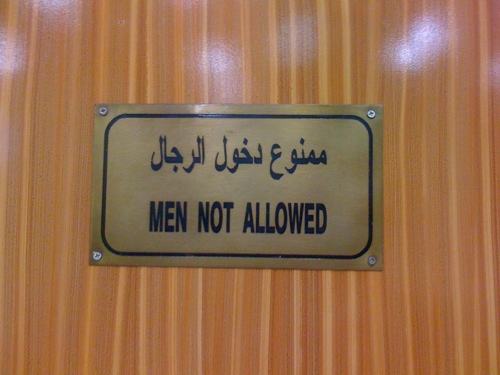
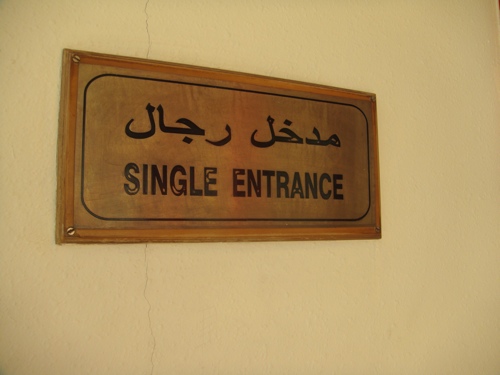
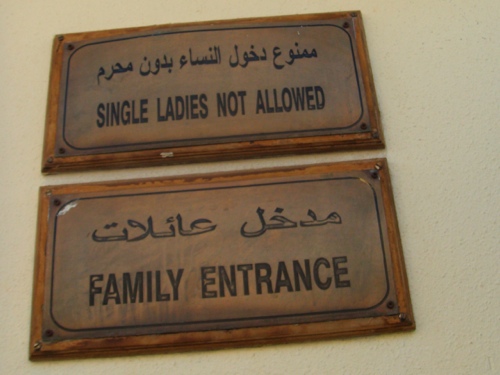
Taken at al-Tazaj, Takhassosi Street, Riyadh.
Want to Marry a Foreigner? Over Their Dead Body
The Shoura Council is an advisory body comprised of 150 members appointed by the King and serves as a quasi-parliament. Those members are academics, technocrats and businessmen. They are, in other words, the intelligentsia of the Saudi society, the crème de la crème, the elite, the… well, you get the idea.
 However, I find myself rather gobsmacked by some of the conclusions they make and the recommendations they reach on some issues. Here’s a recent example: after being equally split over a need to simplify the regulations of Saudi marriages to foreigners, the newly appointed vice president Bandar al-Hajjar rejected the proposal. What a disappointing start for Mr. al-Hajjar who was just a few days ago the president of the National Society for Human Rights.
I do not understand the harsh restrictions enforced on citizens who want to marry foreigners. Why should the government bother with who one chooses to marry? I really do not understand the government’s obsession with interfering in the minutiae of people’s personal lives.
The argument offered by the proposal opponents is embarrassingly weak and wrongheaded they should be ashamed of themselves. “Such recommendations would greatly increase the number of Saudis marrying foreigners while we are fully aware of the complications that such marriages create,” they said. They also said changes would only exacerbate the problem of spinsterhood in the Kingdom. Are they trying to convince us that by taking these unfair measures they are actually protecting Saudi women?
As for the “complications” bit, the best response comes from Sabria Jawhar who says, “Well, those complications are created by the Saudi government in the first place. Perhaps minimizing the complications that exist in the law would help those marriages.”
Now how can a large group of supposedly intelligent people all agree on taking such an unintelligent position is just beyond me. Sadly, it is not the first time and this is not an isolated, single case. Remember the weekend thing?
Around one year ago, my good friend Khaled said that we should not get all worked up over the nonperformance of the Shoura Council because it is nothing more than a dead body that we should respectfully leave to rest in peace. I guess he was right all along.
 Saudi Jeans
You must be logged in to post a comment.