The Onaiza Girl, Again

The Onaiza girl case is back to make headlines after the court there upheld its earlier verdict. Judge Habib Al-Habib’s original stipulated that the girl must reach the age of puberty before determining whether she would continue her marriage solemnized in June 2007. A relative of the girl told CNN that the judge “insisted that the girl could petition the court for a divorce once she reached puberty.” The Court of Cassation had rejected the previous verdict and demanded that the case be reconsidered. But in Saturday’s hearing the judge stuck to his earlier verdict, after he failed to convince the husband to nullify the marriage contract in lieu of returning the dowry he paid.

I don’t understand the position of the judge. So he wanted the husband to nullify the marriage, but when the husband refused, he decided to stick to his earlier bizarre verdict? Anyways, I’m not surprised, especially when we remember that the Grand Mufti himself sees nothing wrong in marrying off girls who are 15 and younger. Sources told Saudi Gazette that if the elderly husband continues to refuse and the judge sticks to his verdict, the Court of Cassation will hand over the case to another judge. Let’s wait and see…

Read more:

Confusing Signals

More than two years after publishing their first report, the National Society of Human Rights (NSHR) published their second report, and I have to say that I am impressed. The report is written in a simple, clean, and professional language that should promote human rights principles among Saudi citizens.

The report criticized many government departments for their abuses of human rights, and also criticized the slow pace of reforms in judiciary as well as the performance of the Shoura Council. The full text of the report is available here (Arabic PDF). Arab News provides some highlights from the report.

I don’t think I need to talk in detail about the report. I already said that I was impressed and I really think the report speaks for itself. But I would like to point out to one interesting tidbit here.

As part of the remarks on the Shoura Council performance, the report called for electing the members instead of the current method of selection. The report also said there is a need to take effective steps to protect and promote women’s rights. But soon after the report was released, Interior Minister Prince Naif came out to say that Saudi Arabia has no need for women members of parliament or elections. Yesterday, Prince Naif was appointed as second deputy premier.

Now this is exactly the kind of mixed signals that makes the world question the commitment of our country to its much publicized reform plans, not to mention how it leaves the people confused about where their nation is heading. So what’s going on here? Frankly, I don’t get it. I. Just. Don’t. Get. It.

Injustice

After the recent blunders of our very dysfunctional justice system, you would think judges will become more careful when they handle some cases. Not so much, unfortunately.

The latest episode of this depressing, long nightmare comes from a little town in the north, where a 75-year-old Syrian woman was sentenced to 40 lashes, four months imprisonment and deportation from the kingdom for having two unrelated men in her house. The two men, who were reportedly bringing her bread, including one who was her late husband’s nephew, were also found guilty and sentenced to prison and lashes.

So Saudi Arabia takes another slap in the face. It is also a slap in the face for the new minister of justice, who obviously needs to fight really hard in order to end the embarrassments caused by our courts and implement the much publicized changes in the justice system.

It is good to know that the brilliant human rights lawyer Abdul-Rahman al-Lahem has traveled to Hail to take the case. He said he plans to appeal the verdict, and I totally trust him to win this battle, not just for the sake of the old woman and the two young men, but also for the cause of justice and human rights in this country.

Related:

Riyadh Book Fair ’09

While I sincerely hope that the Ministry of Culture and Information would drop the word ‘International’ from the name of what has become the most important cultural event in the Saudi calendar, I’m glad that the Riyadh Book Fair is back again. Seeing the crowds celebrate books and reading is heartwarming, regardless of whatever gripes I might have about the organizers and their approach. The book fair is taking place for the first time at the new Riyadh International Exhibition Center on King Abdullah Road, which is much nicer and much bigger than the old exhibition center in Morouj.

If you plan to come, you may want to stop by at our table in booth SA-60 where my friends and I are volunteering to sell the books of fellow blogger Hadeel al-Hodaif who passed away last year. The proceeds will go to charity. We are also taking the chance to promote the Hadeel Prize, which will be launched later this year.

I think the book fair this year is better than the previous ones, except, of course, for the usual kerfuffles by the religious police. After making a scene with Abdou Khal, Abdullah Thabit and Halima Mozaffar on Thursday, they made another scene last night when they decided that saleswomen are not allowed to be there on men’s days. All saleswomen were kicked out. I really don’t see the point of having the religious police in the book fair, but it is obviously part of the compromise deal the Ministry of Culture and Information had to make with the conservatives in order for the book fair to go on.

The Riyadh Book Fair is open until Friday, March 13, from 10 AM to 10 PM. Some days or part of them are open to men only, so make sure to check this page before you drive there. Oh, I forgot that women are not allowed to drive. Never mind. Just go, have fun and enjoy the books. And if you have any recommendations, please do share them in the comments. See you there.

King Renders Me Speechless

On the second week of February every year, the international media is usually full of stories about the assault on Valentine’s Day in Saudi Arabia by the infamous Commission for Promotion of Virtue and Prevention of Vice aka the religious police. However, the biggest news on V-Day this year wasn’t the Commission and their war against all things red. On the morning of last Saturday, February 14th, the air in Riyadh was filled not with love but rather with rumors about some upcoming changes in the Saudi government. Around midday, news finally began to materialize and royal decrees started hitting the wire one after another.

Considering that King Abdullah has not made any big changes in his government since he ascended the throne in 2005, it was expected that we were going to see some changes this year, although many speculated it wouldn’t happen until the summer. I think the cabinet shuffle was not surprising in itself, but rather in its scale and some of the details.

In areas like education and health care, changes seemed inevitable because despite the massive government spending, both sectors were at the center of negative attention as the public grew increasingly dissatisfied with their services.

The new minister of health Dr. Abdullah al-Rabia is a bright surgeon who has an international reputation, and was the head of the health services department at the National Guard. He has led his medical team successfully in complex operations to separate conjoined twins, but some people have questioned his managerial skills. There is no doubt that he is facing an enormous challenge, especially at a time when the government is trying to implement a new national health insurance scheme.

The picture is more interesting at the ministry of education with three new appointments. The government has been trying to implement a huge plan to reform the educational system through a new vision, and Prince Faisal bin Abdullah, the new minister, is not just a member of the royal family. He is the King’s son-in-law and is said to be very close to him.

It is worth noting, however, that he has no background in education.
He used to work for the National Guard and most recently he worked as Assistant Director of General Intelligence. But he is also the chairman of Al-Aghar Group think tank, which is credited with many of the reform plans in the country, including the aforementioned Tatweer program.

The second change in MOE was the appointment of Faisal bin Mummar, the former SG of King Abdul-Aziz Center for National Dialogue as a new deputy minister.

The third change, and the one that by far grabbed the most attention, was the appointment of Nora al-Faiz as the new deputy minister for girls’ education. It is the first time that a Saudi woman was chosen for a senior position in the government, and many saw this as a sign of reform as well as recognition of the effort of Saudi women who have worked very hard over the years and contributed to the development of the country.

Interestingly, Mrs. Al-Faiz gave a long interview to Al-Watan daily last week where she said she was immensely upset because her photo was published in the media. “It is well known that I am a Saudi woman from Najd and thus I wear a niqab,” she said. She added that she has no intention of visiting men’s office buildings in the ministry. I found her statements strange to say the least, but it could be that she does not want to anger the conservatives on her first few days on the job.

Many observers, including Khalid al-Dakhil believe that the most important aspect of this reshuffle relates to changes in the justice system. We are finally witnessing the end of Sheikh Saleh al-Lhuaidan’s reign (good riddance!), which will pave the way for more fundamental reforms in the judiciary. Establishing the new supreme court is a great step in that direction, and hopefully many other steps will soon follow.

Now coming to the ministry of information, I did not expect to see Iyad Madani shown the door. It is true that the conservatives were very unhappy with what they considered an extreme liberalization of official media, but the word on the street was that Madani is one of the King’s men. Another explanation for the change at MOI surfaced last week, and argues that the decision to give the position to Abdul-Aziz Khoja was made to reward him for his outstanding work as Ambassador to Lebanon during the recent crises, and not due to dissatisfaction with Madani’s performance.

I guess I was not the only to see the irony in kicking out Sheikh Saleh al-Ghaith, head of the Commission, on Valentine’s Day. Al-Ghaith was often criticized for being weak and therefore not able to control his men, which led to many horrible incidents involving the Commission over the past few years. Unfortunately, they were never held accountable for any of their actions, even when the results were very disastrous and included the loss of life. Can the new man, Sheikh Abdul-Aziz al-Humayen, exercise more control and constraint over the so-called lions? Let’s wait and see.

There were also some changes in the Council of Senior Ulama, which will include for the first time scholars from other schools beside the Hanbali school. I even read some speculations that the council might include Shia scholars in the near future, which is expected to be part of larger reforms and will have greater effect on shaping the policies and culture of the country. I have to say that this sounds like a very long shot to me, but who knows?

The cabinet reshuffle was well received by the people here, but I could not help but sense that some people are being overly optimistic about what kind of change these new appointments can bring. It is usually not enough to change faces, because there is only so much one person can do when you have a system that is dysfunctional and has been like that for years. Newspapers have enjoyed their hoopla for a week now, so I think it is time now for all of us to sit back and watch what these new guys (and woman) are going to do over the course of the next few months. As I always say, I’m not holding my breath.

Letter to Amna

TO: Amna Fatani
CC: Saudi Arabia

Although I have said that censorship does not work anymore, censorship is still a reality of our lives in this part of the world. Unfortunately, censorship by the government is not the only kind of censorship we have to endure and resist here. There is another, more difficult kind to deal with: social censorship.

In our deeply conservative and conformist society, any attempt to differentiate oneself is frowned upon if not outright rejected. You are expected required to think, talk and even look like everyone else. If you dare to to say or do anything that does not conform with the conventional wisdom, then you are simply asking for trouble. Not only your ideas will be ridiculed but you will also be personally attacked, and your parents will be blamed for not raising you well.

Now you think that’s bad? It gets ten times worse if you are a woman. Actually, you don’t even need to express a deviant opinion. Being a woman in itself can be enough for some people to denounce you, because to them women are secondary beings that should be kept in dark closets, away from the light of public life. I’m sure you’ve heard all that ‘jewel’ crap many times before.

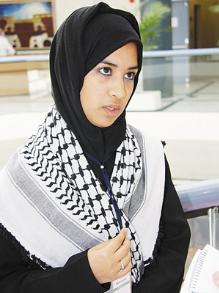
amna_fatanyThat’s why when Amna Fatani started a campaign to preserve heritage sites earlier this year, her father received hateful text messages telling him that he has no shame. Fatani appeared again in a local newspaper last week wearing a Palestinian keffiyeh during her participation at the Saudi-British Youth Forum in Jeddah. Again, she was faced with similar reactions. The first comment by a reader was: “let her cover herself up, and worry about her religion first.”

I’m sorry you had to go through this Amna, but if it’s any consolation, know that you are not alone. When AlArabiya.net published my interview with Reuters two years ago, people left many unpleasant comments, calling me a “Westernized spoiled brat” and “retard” among other things. Sure, it didn’t feel good but I have grown a thicker skin. Sometimes it is not just total strangers who try to put you down. More than one of my relatives have told me to “quit this nonsense” I’m doing. You, however, are lucky to have a supportive family who are very proud of you.

So dear Amna, whenever something like that happens to you, remember you are not alone and that we are all in this together. We are young and we are not amused. We are eager and determined. We will not be silenced and we will not be intimidated. We shall speak up and we shall overcome. Open your minds and hearts. Listen to our fresh voices.

Sincerely,
Ahmed