Zait o’ Za’tar

Growing up in Al-Ahssa (aka Hassa, Hofuf), one of my favourite meals was pastries served in these little diners run by Turkish workers that spread at different corners of the city. These pastries are similar in many ways to the famous Lebanese mana’eesh. When I moved to Riyadh few years ago I started to miss the pastries because I could not find any place in Riyadh that serves good pastries in reasonable prices. I mean: why oh why would a little man’oshat za’tar cost 5 or 7 riyals? No, thanks. I can get the best za’tar in Al-Ahssa for just 1 riyal.

But last week, thanks to a good friend of mine, I stumbled upon a new restaurant in the trendy Tahlia St., or what many people here like to call “The Champs Elysées.” The restaurant is called Zait o’ Za’tar, and I should say I was very surprised and pleased with the quality of their food. They simply serve the best pastries I had since I came to the city in 2002. You can always go for traditional choices such as labneh or cheese, but you probably should try some of their special offerings such as Mexican chicken or Za’tar with tomatoes and onions. And for those of you on a low-carb diet, they also offer ‘Lite’ variations of some items on their menu.

This time of the year is absolutely the best to visit Riyadh because the weather is really, really nice. It is still warm, and there is this refreshing cool breeze in the air. Considering the mild weather and that many restaurants in Tahlia St., including Zait o’ Za’tar, have tables on the sidewalk, it would be a good idea to enjoy a meal out there if you have some time. Know of another place in Riyadh which offer good pastries? Please let me know in the comments.

Living Colors


Living Colors Originally uploaded by saudi jeans.

I had lunch on Saturday at Living Colors of Faisaliah Mall. Like Fahad, I had the Chicken Panini with Balsamic and it was good; not great, but good. Better than the food was the design and the colors of the place and packaging. Living Colors have another branch on Tahlia St. (aka Prince Mohammed bin Abdul-Aziz St.).

The National Museum

Few months ago, I asked what SBG described as a mind-provoking question. Well, my point of that post was not just to provoke minds. The idea of the post came after a visit to the Saudi National Museum. I have been living in Riyadh for 3 years, and I never heard and/or seen any ads to promote the museum and its content. However, I always wanted to visit it. None of my friends wanted to come with me, because they think “museums are boring.” I could have went by myself, but I just hate to do stuff like that alone.

So finally, Mohammed, my good friend and roommate, agreed to go with me. Before going, I had to check their website to see the visiting hours and days. I did not want to go all the way downtown just to come back because “it’s families only” day. Tuesday is the only day when “bachelor men” are allowed in the evening, and it was the only choice I had because most of my daytime was already occupied with lectures.

According to the timetable on their website, the museum is open from 1600-2100, but I decided to go at 1900 because I did not want to be forced to leave when Esha prayer time comes, and also because I thought two hours would be more than enough time to finish our tour. But, boy I was so wrong. We entered around 1900 and did not leave until it was past midnight. Yes, we spent about five good hours, and we could even spend more time in there.

The museum was nearly empty, and we hardly have seen any people. Probably that’s why we saw two Saudi families inside on a “bachelors’ day.” I have no problem with this, except for one thing: if I were to come on families’ day, would they let me in? Back to our tour. The objects, documents, sound recordings, films, and other media, cover a long history: starting from the creation of the universe to the unification of the third Saudi state by King Abdul-Aziz Al-Saud.

I really liked the Ancient Arab Kingdoms section, which shades the light on the people, tribes, and states that lived in the Arab Peninsula before Islam. There is also this touchscreen where you can choose one of the great seven poems (المعلقات) of the pre-Islamic era, and then hear the voice of the narrator citing that poem. I also liked the bridge on the second floor, which resembles the prophet’s migration from Mecca to Medina. While you walk on this bridge, you would hear the voices of children chanting “6ala3 al-badru 3laina.”

The wing of the Islamic centuries is not the most interesting part of the museum. This is due to the fact that the capital of the Islamic state was located in the Arab Peninsula for only the few first years of Islam, before moving to Damascus and then to Baghdad, when Islam witnessed its golden years, and later to Cairo and Istanbul. Moreover, most of the original pieces from Mecca and Medina were taken to Europe (Turkey and France), and what’s left was recently destroyed by Wahhabis.

Next is the wing of the Al-Sauds history, which is not a very large one. In this area, you can watch the “Unifying the Kingdom” show. After this, you go down again to the ground floor, where you can find the last part of the museum, documenting the Hajj journey and the two Holy Mosques.

I was surprised that it took us about 5 hours in the museum, but I went there again last week with my brothers, and enjoyed it very much. The National Museum is a must visit for everyone. Another good reason to go to the museum now is the special display of Islamic artifacts from the Louvre’s collection.

Thirteen Unread Books, and Counting…

This post is inspired by Roba, who’s been on fire lately with some really fine blogging in the past few days


I love reading, but pharmacy is a bitch. No matter how hard I try, I always find myself with a long reading list that I want to go through, and it is just getting longer without any trace of hope to finish anytime soon. Reading endless pages of pharmacology, pathophysiology, pharmacognosy, microbiology, and pharmaceutical chemistry leaves no time or mode for reading.

Riyadh could be a city for lovers, as a friend of mine wrote last summer, but it is certainly not a city for readers. The lack of good bookstores in the city makes it even more difficult for books lovers. Please don’t be fooled by name of Jarir Bookstore; Jarir is actually a megastore which sells stationary, computers, electronics, mobile phones, and other things. Books are just a small part of these other things. Al-Obeikan Bookstore’s collection of books is larger than Jarir’s, but it is less diverse. They mainly promote the books they publish (they are the publishers of Don’t Be Sad by Sheikh Ayedh Al-Garni, a Saudi bestseller with more than one million copies sold, and translated to several languages), and the books they sell have a somewhat conservative theme; don’t expect to find books by the likes of Turki Al-Hamad and Abduh Khal there. The bad news: most of their books are in Arabic, and their English books section is embarrassingly small and outdated.

Now if you were looking for some new and fine Arabic books, even the banned books, then there is only one place in Riyadh that I can think of: Al-Makatba Al-Turthia. Again, don’t be fooled by the name (it is translated: The Heritage Bookstore). This bookstore, located near Exit 11 on the Northern Ring Road, has always the latest products from the major Arab publishing houses in Lebanon and Egypt, with a great interest in books written by Saudi writers. I order some books from Amazon every once in a while, and even though books are usually cheaper on Amazon, but with the crazy shipping rates they cost much more than they should.

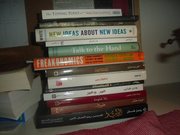
Currently, I’m (still) reading The Secret Life of Bees by Sue Monk Kid, and in the photo above you can see the books on my table waiting to be read, with a few more unread books back home in Hassa. Let’s take a look on my reading list for the coming few months/years/decades/whatever:

· Al-Waleed by Riz Khan: I met him (Khan not Al-Waleed ;-) during the Al Jazeera Forum in Doha last January, but what’s interesting about this book is Prince Al-Waleed Bin Talal’s initial decision not to publish the book in Saudi Arabia because he did not want it to go under the governmental censorship. However, the book is now available here and sold many copies during the Riyadh International Book Fair, but without the accompanying DVD.

· The Tipping Point by Malcolm Gladwell, and Freakonomics by Steven Levitt and Stephen Dubner: Probably everybody has already read these two books by now. I got them a long time ago, and still can’t find time to read them.

· Fusooq by Abduh Khal: A story of a runaway girl who gets the reputation of a prostitute. Like almost every recent Saudi novel, this book was harshly attacked by the extremists conservatives because it contains some criticism to the religious police.

· Bla Hshouma by Soumaya Naamane-Guessous: This book, originally published in French about 20 years ago under the title Au-delà de toute pudeur, but only recently translated to Arabic, tackles the subject of female sexuality in Morocco.

· Shanghi Baby by Wei Hui: A controversial novel that was banned in China, where the government burnt about 40,000 copies of the book publicly in April 2000.

· Gheir.. o’Gheir by Hajar Al-Makki: I’ve never heard of this writer before, but I purchased her novel out of curiosity during the Book Fair after a quick look that revealed a lot of SMS’s, emails, and IM’ing in its pages. The fact that the theater of this novel is Jeddah was another reason to buy it, because most of Saudi novels talk about Riyadh or the villages, and ignore the remaining parts of this huge desert kingdom.

· The Television Culture by Abdullah Al-Ghadhmi: Here is a small excerpt: “The proclaimed cultural invasion is a delusion that aims to exaggerate the fear of ourselves, because the youth who wear jeans and eat fast-foods are the same who stand against the imperialist policies; this occurs in our country the same way it occurs in Europe.”

· Hind wa al-Askar by Badriah Al-Bisher: After two collections of short stories, this columnist writes her first novel. The heroine suffers a sexual assault during childhood, and her brother becomes one of the suicidal bombers in the terrorist attack that destroyed the General Security Building in Washem St. in Riyadh two years ago.

· Love Poetry of Famous Muslim Jurists (الإلمام بغزل الفقهاء الأعلام) by Ghazi Al-Gosaibi: This collection of pieces of poetry chose by the well-known Saudi minister would probably makes you go wow, as you would never think that Muslim scholars could be so in love and write some of the most romantic things. Fast forward to check out the scholars of our days, and how they view love poetry… *sigh*

· Malameh by Zainab Hafni: Another novel by another Saudi female writer. This new one is occasionally compared to Banat Al-Riyadh, and some people have even called it Banat Jeddah. The heroines of this novel, like those of Rajaa’s, would drink, have premarital sex, and even get involved in some lesbian relationships. Hafni should get ready for some serious personal attacks by the conservatives.

· New Ideas About New Ideas by Shira White: This is a “fresh, lively, and inspiring perspective on innovation.”

· Talk to the Hand by Lynne Truss: I liked her book Eats, Shoots & Leaves, which was on punctuation, and this new one about manners and etiquette, about the rudeness of the modern world, is supposed to be a fun light read.

You got your own list of unread books? Share it with us.

Best Shawerma in Riyadh

Living in Riyadh for the past three years, I can say that I have become an expert on shawerma. Actually, shawerma was not my favorite choice of fast food when I used to live in Hassa, but coming to Riyadh and going through the crap of many restaurants with high prices and bad food, I had come to the conclusion that shawerma seems to be a safe and cheap choice. However, with like a zillion restaurant in Riyadh offering shawerma, I started to be so picky about it.

So, after testing some of the well-known restaurants such as Mama Noura, Al-Karawan, and Shawermer, I found that Ya Mal Al-Sham restaurant was serving the best shawerma in Riyadh. And even though they were selling the sandwich for 4 riyals, one more riyal that you would usually pay for such thing, I was willing to pay the extra riyal for its goodness and deliciousness. However, good and delicious things do not live forever. Later on, Ya Mal’s shawerma had worsen very much. They started to make it greasy, and with so little chicken that a friend of mine has called it “the pencil sandwich.” Now, they are selling it for only 3 riyals, but it is still not as good as it used to be.

I had to go experimenting with shawerma again. After a few weeks of experimentation, I can say that the best shawrma in Riyadh currently is served by Shawermer. During my first stage of experimentation, Shawermer’s shawerma was bad; so bad that I thought it tastes like fish not chicken. But I think that they have improved much since then. Actually, when it was opened few years ago, Shawermaer introduced a new concept in the business of making this kind of food. They offer only shawerma (recently they added basbousa to their menu), and they have a unique style. They are the only restaurant to offer it with several flavors, such as cheese, hummus, and lemon and garlic, and they also offer the sandwiches as meals with Pepsi and French fries, a step that several restaurants followed later.

How about you Riyadh people? Who do you think offer the best shawerma sandwiches in the city? I’m not a native, and maybe I’ve been missing on something good, so have your say!

Panino’s Restaurant

For years, I used to pass by this restaurant called Panino’s in streets and shopping malls, and never been even curious just to take a quick look at what they make. Recently, they opened a new branch on Thalatheen St. (aka Prince Sultan bin Abdul-Aziz St.) in Olaya.

During one of our hangouts, my roommate suggested, out of curiosity, that we stop by to take their menu. According to the menu, Panino’s: Italian Sandwiches and Gourmet Pizza, is “the bridge between fast food and full service restaurants.” They claim to use only fresh ingredients to make their “signature sandwiches, salads, and pizza.” The content of the menu, which included some pictures that looked delicious to us, has encouraged us to go and try it.

Last night, my roommates and I went to have dinner there. I had a Pollo Romano sandwich with a slice of Margherita pizza. The Caesar dressing used in the sandwich makes it stand out from other grilled chicken sandwiches, and it is far better than Subway’s. They use oregano for pizza; something not usual in other pizza places. In short, the food tastes good, and the place is nice, clean, and big. The service was not what I can call impressive, but it was ok. For a similar experience, you can also try 2 in 1 Restaurants, which have the same model of making full service restaurant food in a fast food style.

In addition to this branch, Panino’s has three more branches in Riyadh: in Faisaliah Mall, Mamlaka Mall, and Sahara Plaza, and three branches in Jeddah: in Jeddah Mall, Tahlia Mall, and on King Abduallah St. in Khalediah.