Saudi Writer Hamza Kashgari Flees Country After Controversy on Twitter

UPDATE 2/12/12 03:09ET: Hamza Kashgari has been deported to Saudi Arabia by Malaysian authorities, several news agencies reported. Malaysian human rights lawyers say they had a judge order to stop the deportation, but by the time they reached the airport the plane already took off.

Hamza Kashgari, a young Saudi writer, caused a firestorm when he posted a series of tweets on the birthday of Prophet Mohammad last week. In his tweets, Kashgari imagined a conversation with the Prophet in which he said they are equal, and that although he admires many of the Prophet’s characteristics there are also others that he disliked.

Saudi users on Twitter erupted with outrage, posting nearly 30,000 tweets on the topic in less than 24 hours. Many people believed that he insulted the Prophet by addressing him and speaking about him like that. They accused Kashgari of blasphemy, atheism and apostasy. Many said he must be punished and some said he should be killed. Others even went as far as threatening to kill him or offer money for his head.

The outcry resulted in a full U-turn by Kashgary, who deleted the controversial tweets and published an apology saying he has sinned and that he has now repented. He explained that what he wrote earlier was “feelings I erred in describing and writing, and that I ask God for forgiveness, but they don’t really represent my belief in the Prophet.”

The apology was not enough for many people, especially the religious conservatives who demanded that Kashgari be tried in a Sharia court. One of these people is a cleric named Nasser al-Omar, who appeared in a YouTube video weeping because he said he could not bear to see the Prophet insulted.

“These people [like Kashgari] should be put to trial in Sharia courts,” al-Omar said. “It is known that cursing God and his Prophet is apostasy. And the fact that he has repented with cold words will not probably save him in the court.”

Al-Omar and others insist that even if Kashgari has repented he should still be sentenced for apostasy, effectively calling for his death by sword. Al-Omar called on his followers to send telegraphs to the King, Crown Prince and the Grand Mufti to punish Kashgari.

Yesterday, several websites said that the King has ordered the arrest of Kashgari and today news came that he has fled the country. According to Al Arabiya’s sources, Kashgari had flown to Jordan then the UAE before reaching a country in southeast Asia.

The 23-year-old writer used to write a column for the Jeddah-based al-Bilad daily, but yesterday the information minister Abdul Aziz Khoja ordered all newspapers not to carry any article by Kashgari. “I have instructed all newspapers and magazines in the Kingdom not to allow him to write any thing and we will take legal measures against him,” Khoja said.

How a couple of tweets by an obscure writer reached the King and resulted in an arrest order and a possible death sentence in the matter of three days is nothing short of astonishing. Saudi Arabia being a conservative Muslim country, the outrage over Kashgari’s tweets was expected. Remember the Danish cartoons? Nevertheless, this case escalated rapidly.

While I understand how many Muslims would take offense at anything that touches the prophet, I don’t think it explains the whole story. Yes, many feel strongly about such matters and therefor they reacted accordingly. However, it is clear that many on the right decided to take advantage of the incident to score points and make political gains. It was a low hanging fruit.

While some may perceive religious conservatives defending the Prophet’s honor simply as piety, others say there is more behind it, that this is actually part of a long-term plan.

“This is not spontaneous,” a friend of Kashgari’s told me. “Hamza has had people marking him since the Marriott affair and before.”

There is a disturbing “bloodthirstiness” about the conservatives’ reaction, the friend said, adding that Hamza is “just the first in a list they’re targeting.”

Ironically, Kashgari had a conservative upbringing. He was part of the many “circles for memorization of Quran” in Jeddah, and according to one source familiar with the matter, his old preachers helped convince him to delete his controversial tweets and apologize. However, these very same preachers refused to come to his defense publicly in the face of the rabid attacks by the conservatives.

Contrary to reports circulating in Twitter and some sites, Kashgari was not detained upon his arrival to the airport in southeast Asia. He is free, his friend told me, but remains worried about being extradited.

This controversy emerges as an equally contentious case is finally coming to an end.

Local media reported this week that the King has pardoned Hadi Al Mutif, a man who was sentenced to death in 1996 after being convicted of allegedly insulting the Prophet. King Abdullah did not confirm the death sentence as required under Saudi law and Al Mutif remained in jail for 18 years. He is expected to walk free later this week.

UPDATE 2/9/2012 15:25ET: According to Malaysia state news agency BERNAMA, Hamza Kashgari has been detained.

https://twitter.com/ahmed/status/167704227991388161

Riding the Wave

For some reason, the government here finds itself compelled to get involved in organizing cultural events even when they suck at it. Why? Maybe because they don’t allow non-governmental organizations that usually play such roles in other countries. Or maybe because they want to keep the matters of arts and culture under control. Anyway, they keep organizing these events and it is very rare that anything good comes out of them.

Recently, the Ministry of Culture and Information (MOCI) organized in Riyadh what they called the second intellectual forum. The word ‘intellectual’ here is a vague term used to describe a diverse group of people who work in the fields of arts and culture: writers, novelists, columnists, artists, journalists, etc.

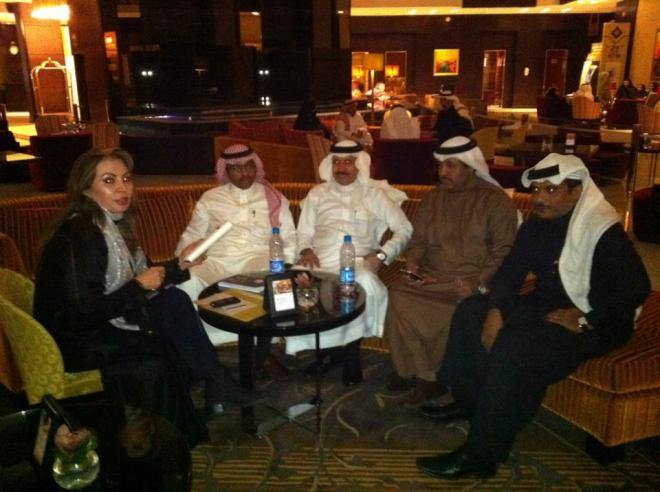
This forum that took place in the Marriott hotel included discussion panels and meetings with senior government officials. It was also a chance for these so-called intellectuals, many of them have known each other for years, to meet and talk. Like most of these events, the forum almost passed unnoticed. That is, until al-Watan daily columnist Saleh al-Shehi tweeted this:

Translation: What happened in the Marriott lobby on the margins of the intellectuals forum is a shame and a disgrace.. I believe that the so-called cultural enlightenment program in Saudi Arabia is centered on women

That tweet generated some angry responses by other people who attended the forum. Author Abdo Khal, winner of the International Prize for Arabic Fiction aka the Arabic Man Booker, tweeted: “Your allegation has crossed the line. Either you prove it or face trial for libel. You should apologize before things get there.”

Abdul Aziz Khoja, the minister of information and culture, and whose this event is happening under his auspices, also took to Twitter to make his feelings clear:

Translation: For criticism to cross its goals and ethics and reaches the stage of libel and slandering, that is what’s shame. And I will say no more.

Al-Shehi was unapologetic. He insisted that as a good Muslim there was no way he could remain silent about what happened at the Marriott lobby. He also said that he plans to sue Khoja. This kind of talk struck a chord with the conservatives, who took his tweet and ran with it because it reaffirms their view of the so-called liberal intellectuals as a group of immoral men and women.

During a talk show on Rotana TV, Khal pressed al-Shehi to say what did he see exactly that he deemed too scandalous. The latter kept refusing to answer, but at the end of the show he agreed to provide one example: some women there did not cover their hair.

The horror. Seriously? All this fuss over a few strands of hair? People thought al-Shehi saw some orgy going on or something. I mean look at these photos: some really hardcore stuff, no?

Some people think the government must be thrilled to see the elite of society bickering over trivialities like this instead of demanding political reform. For a government that paid billions in money handouts and made some merely symbolic concessions to prevent the Arab Spring from reaching their shores, a controversy like this one is certainly a welcome distraction.

The past few months have seen a wave of conservatism that al-Shehi and his supporters seem more than happy to ride. Hardliners are on the rise, and that shows in the heavy-handed manner in which authorities are dealing with recent calls for reform.

Earlier this week, the interior ministry ordered the arrest of 23 citizens wanted in connection to last October’s unrest in the city of Awwamiya in Qatif in the eastern part of the country. The ministry held a press conference to make the announcement and released a list of names and photos in a way that eerily similar to how the government dealt with Al Qaeda cells few years ago.

Few days later, the organizers of an event for arts and culture in Riyadh were ordered to cancel all the musical segments in their program, and two days ago long-time activist Mohammed Saeed Tayeb was stopped at the airport when he tried to board a plane to Cairo to attend his daughter’s wedding there.

In July 2010, Saleh al-Shehi wrote about meeting Abdo Khal in a Parisian cafe, where “girls of all nationalities and ages were flying around us like butterflies in the Spring season.” Why is he now all worked up about some Saudi women not covering their hair? Halal in Paris, haram in Riyadh?

Saleh al-Shehi kept repeating the word “shame” to describe what he saw at the now-infamous lobby, but failed to provide any specific examples except for the uncovered hair of some women. If some free strands of hair offend his sensibilities that much, then he probably should not be there in the first place. However, there are many other things in the country that he, and all of us, really, should be ashamed of like injustice, corruption and discrimination.

For shame, Saleh. For shame.

On the Statement and Shameless Apologists

Two stories were the focus of much debate and discussion in Saudi Arabia recently: a) the trial of what the local media likes to call the “Jeddah cell,” a group of reform activists accused of terrorism and plotting to overthrow the monarchy; and b) the tragic events in Qatif that resulted in the death of four young men and injury of two members of the security forces.

On December 5th, a group of activists released a statement condemning what they called the “extremely harsh sentences” against the Jeddah reformers, and also condemning how the government handled the events in Qatif. The list of signatories on the statement included some prominent Sunni and Shia activists such as Mohammed Said Tayeb, Abdullah Farraj al-Sharif, Tawfiq al-Saif, Mohammad al-Ali and others.

This, as far as I’m concerned, is business as usual in Saudi Arabia. Something happens; a statement or a petition is released by a group of people. After all, it is not like there is much more they can do. Street protests are strictly prohibited, and there is no elected parliament where these people can question the government and hold it accountable for its actions.

However, something else happened this time around. Shortly after the statement was released, it was received with an aggressive backlash in the local media, where columnists held no punches in their scathing attack on the statement and those who signed it. Some observers even suggested that the attack looks coordinated and is probably orchestrated by the interior ministry to win public opinion.

But I don’t think the media backlash was coordinated. As Ahmad Abdulaziz said, it is not as if columnists in the local newspapers wait for government orders to open their verbal fire on government critics. “After a long practice, they have come to know very well what they have to do without even getting instructions,” he wrote. Also, let’s be honest here, does the government care all that much about public opinion?

I have read about 50 columns over the past 3 weeks attacking the statement and those who signed it. Some of these columns were penned by editors of the papers. This is fine, I’m all for free speech. If you feel this strongly about the statement and truly feel compelled to defend the official line on these issues, by all means go knock yourselves out.

One little problem though: none of these papers actually dared to publish the statement or report on it. If readers wanted to know what statement the columnists are talking about then they had to go Google it themselves. When the new editor of al-Eqtisadiah Salman al-Dosary was confronted with this fact in a recent TV interview, he said “we don’t publish anything” because they practice responsible freedom and protect national security.

Al-Dosary seems to think that protecting national security is part of his job description. Yay for the independent Saudi press! But I digress. Let me focus here on “we don’t publish anything.” In his column, al-Dosary accused those who signed the statement of “incitement to overthrow the regime and the government.” Nothing in the statement language even remotely suggests this.

It is one thing to choose to take the government side on some issues. It is quite another to lie and distort the facts just to show how patriotic you are and, while at it, imply that those on the the side of these issues are unpatriotic. The problem with many government apologists is that they severely lack any kind of class; they are shameless.

People like Samar al-Mogren, Adhwan al-Ahmari and Saud al-Rayes for example went as far as calling the signatories terrorism supporters. Seriously? But hey, this is a free country as I said earlier, I’m all for free speech. I just think that it is rather a sad day for this country (and boy did we have many of those lately!) when some people, including the grand mufti, try to score points with the government by using false accusations to discredit some national figures like Mohammad Said Tayeb.

Taybe, a long time activist who was repeatedly jailed over the past four decades, used Twitter to defend himself, calling those columnists a “choir” from a bygone era.

After a series of tweets directed at the columnists, he chose to send a message to Crown Prince Naif: “We understand the interior minister’s duties and responsibilities, but we believe that the most important duty of the crown prince is to guarantee the protection of public freedoms and human rights.”

I’ve been putting off writing this post because I thought the period of verbal diarrhea by government apologists would end soon, but the articles kept on coming nonstop like the floods of Jeddah.

Right, whatever happened to holding the corrupt officials accountable in that disaster? Oh, we are not supposed to talk about this? Sorry, my bad.

On Being Hashtagged

Adhwan al-Ahmari seems to think that there is some kind of war raging between Saudi journalists and activists. He said the revolution in Egypt has produced a divide between the two groups. This war is taking place in Twitter and in newspaper columns.

First, let’s get some facts straight. There is a lot of broad-brush statements and sweeping generalizations being thrown around here.

For example, Adhwan says activists are demanding the immediate release of all detainees and apply the criminal procedures law to them even for terrorism suspects. This statement is not entirely true. I never heard any activist say they want all detainees released. What most activists want is simply to have the criminal procedures law applied to all detainees, because indefinite detention is illegal and violates their basic human right to a speedy and fair trial.

The activists I have been talking with tell me that keeping detainees in prison for prolonged periods will backfire because these individuals who feel they have been locked up unfairly will leave prison — if and when they do — with a good reason to hate the government, and to act on it. The government needs to respect the law and present the detainees to a court of law, activists said, where they would get charged or acquitted.

Adhwan disagrees. He thinks that activists are exaggerating the numbers of detainees and their grievances, and even lying to promote their cause. Moreover, Adhwan thinks terror suspects should not enjoy the legal protections provided by the criminal procedures law because terrorists have killed innocent people, bombed buildings, and attempted to overthrow the government. That’s why the government, he argues, is not bound by the law when dealing with them.

Of course Adhwan is not the only one of this opinion. Other people, in the media and outside it, agree with him. Recently, some journalists who share this opinion have grown fed up with the activists rising calls on the government to respect the law. Since such topics are still sensitive for mainstream media in the country, activists have turned to social media and the international press to make their voices heard. This did not set well with some local journalists like Adhwan, who seems to have a lot of pride in his profession.

Adhwan’s colleagues, as I have written earlier this week, decided to take on what they called the “New Activism.” Activists, and their supporters, don’t have newspaper columns. They have Twitter. There, they denote their tweets about a specific topic using a hashtag. When someone says something controversial and what they said becomes a topic of discussion on Twitter, we commonly say that he has been hashtagged.

However, because we as a society are not used to critical thinking and open debate, this practice makes some people uncomfortable. I’m not saying Twitter is perfect for every kind of discussion. Sometimes people will use the hashtag to attack the person instead of discussing his ideas. Is that good? No, but I think it comes with the territory and I can live with it. Plus, in a country where frank debate of our most pressing issues is still laden with political, religious and social mines, Twitter is providing a great window into the psyche of the nation where people can freely talk about these issues

Again, I’m not saying that unchecked personal attacks are okay. All I’m saying is that if you decided to publish an opinion then get ready to be not just criticized but to take whatever you get. If you are too sensitive and can’t take criticism then you probably should not put your opinions out to the public.

If getting hashtagged hurts your feelings.. well, tough shit. Grow up. Welcome to the Internet.

Some people downplayed the role of social media in the Arab Spring. Now some local columnists like Salman al-Dossary are trying to do the same. But even if the number of Saudi users on these sites is still not very big, I think tools like Twitter and Facebook have become mainstream enough to offer a good representation of society.

Al-Dossary says it is “laughable” that anyone would take Twitter seriously when there is only 115,000 Saudi users of the service. However, when you consider that many of these users have more followers than the daily circulation of his paper, you wonder who should be laughing.

The New Activism

It is rather sad that at a time when peoples are toppling dictators and changing regimes, we are still stuck talking about women driving, underage marriage and the right of prisoners to get a speedy, fair trial. I’m not saying these issues are unimportant, but let’s face it: their importance pales quickly when compared to other countries’ struggles to change their reality.

So, what’s up in Saudi Arabia?

The latest Saudi story to make international headlines was about a proposed anti-terror law that the interior ministry has been aggressively pushing through the Shoura Council. Amnesty International somehow obtained a copy of the draft and published it on their website.

Amnesty said the proposed law would strangle peaceful protest, and asked the King to “reconsider this law and ensure that his people’s legitimate right to freedom of expression is not curtailed in the name of fighting terrorism.”

The draft, probably leaked by a member of the Shoura Council, contained comments made by the Council’s security committee. Based on the copy, they seem to have made very few and minimal changes on the text prepared by the ministry. These changes, however, do not touch on the articles that caused concern to Amnesty and activists in the country like Article 29, which says: “Anyone who doubts the king or crown prince’s integrity will face punishment of at least 10 years in jail.”

The Saudi embassy in London responded to Amnesty’s leak by saying the concerns of the human rights organization were “baseless and mere assumptions.”

Local media did not report much on the news, but newspaper columnists made a point of attacking Amnesty and activists who raised their concerns about the proposed law on social media sites. “Amnesty have committed a crime by interfering [in a domestic matter] and publishing confidential documents,” wrote Ahmed al-Towayan in Okaz daily. “They proved that they are an organization that includes a group of ignorants, rebels and people who have interests; an organization morally and financially bankrupt seeking money any way they can.”

But the most severe and sinister attacks were saved for local rights activists, who have gotten increasingly vocal in their criticism of some government practices lately. In the same week, the Saudi edition of Al-Hayat daily carried two columns calling activists “erotic dancers” and outlaws.

“There is no doubt that the new activism has become a dangerous phenomenon,” Saud al-Rayes wrote, “because it aims to challenge the state and its organizations.” Al-Rayes linked local activism to the Iranian influence in the region, a bold statement for which he did not bother to provide any evidence, then called activists to support the National Society of Human Rights instead of questioning government policies.

The article understandably angered activists who turned to Twitter (where else?) to release their fury. Al-Rayes, as we now say in Saudi Arabia, has been hashtagged.

His fellow columnist in the same paper Hani al-Dhaheri could not just stand their while his colleague gets ripped up by the kids in social media. Few days later, he penned this column in which he called rights activists khawarij who use social media to incite people against the government.

After getting a slap on the wrist for signing one of the reform petitions earlier this year, al-Dhaheri has learned his lesson and conformed.

“How could a whiner in Twitter, Facebook or YouTube assert that someone is innocent or oppressed unless they have an ulterior motive beyond this cause which they use to cover their agenda,” al-Dhaheri wrote today. He kept repeating a line about targeting the “legitimate leaders” of the country, despite the fact that none of the local activists actually question the legitimacy of the royal family.

After writing 457 words, al-Dhaheri concludes in the last paragraph that this “suspicious project run by activists ‘from their homes’ is not new,” and that those activists will either end up distracted by fame and money or leave the country to join the opposition in London. Again, al-Dhaheri does not bother to tell us how he reached that definitive conclusion. Maybe he has a magic ball?

Mohammed Fahad al-Qahtani, co-founder and president of the Saudi Civil and Political Rights Association, noted what he called an “attack campaign” on human rights activists.

“My message to all #saudi columnists who ridicule and humiliate people that one day you will be held accountable in people’s court,” he tweeted.

One day.

Here and there

  • The Guardian sent their south Asia correspondent Jason Burke to Saudi Arabia for a special series on the country. While I think the overall reporting of the series leaves something to be desired, it was the third part of the series that made the headlines locally. Sheikh Saad al-Shethri (remember him?) said he intends to sue the paper because he claims that they misquoted him.
  • The families of detainees protested earlier today outside the ministry of interior. A number of men, women and children have been arrested. ACPRA condemend the arrests and repeated their call on the minister and senior officials to be fired and tried.
  • Rasheed Al-Khiraif notes the decrease in fertility rate in the country and asks if Saudis need to use contraceptives. I think the answer to that question is pretty obvious.
  • It’s funny/sad how local media are finally able to discuss things like closing shops during prayer. I wrote about this here on the blog six years ago.
  • Eman al-Nafjan takes a moment to reflect on what happened regarding the issue of women driving over the past few weeks. Good read.

On June 17

  • Saudi women did drive on June 17. More than 50 of them drove, and the day went by peacefully for the most part. Check out my post for NPR’s Two-way blog to read more and hear from some of the women who got behind the wheel and defied the ban.
  • I somehow made Foreign Policy’s Twitterati 100 list for the most influencial people on Twitter, and what’s great about it is that I’m in good company.
  • Speaking of Foreign Policy, they published a good piece by Ebtihal Mubarak looking into the historical background of the demands for women driving in the country.
  • Remember when I asked if there was hope for Saudi Arabia? ColdRevolt thinks there is none. She says, “Our society is not only backward for debating a basic human right, but looking at its reaction to the revolutionary movements across the Arab world, and the uprisings in Bahrain specifically… it’s absolutely hopeless.”