The Broken Frame

Here’s yet another piece about joy riding, aka drifting, aka tafheet, aka total nonsense. Yes, we are bored. Yes, we are young and we are not amused. And yes, we live in a place that severely lacks proper entertainment outlets for the youth. But is this a good reason for you to go drive your car recklessly in public roads? I hate to repeat myself, but here it goes:

Bored? Go read a book, rent a movie, go swimming, or even go wank yourself for all I care, but please oh please don’t get behind the wheel to jeopardize our lives. Driving in these roads is dangerous enough, and we already have seen much blood spilt on the asphalt, we don’t need idiots killing themselves and others just because they were trying to have some fun.

Oh, and a word to Robert Worth and other foreign journalists who fall for the usual traps and fail to see the big picture: instead of trying to fit everything you see here in your ready-made frames, please go and try to find some new frames for your Saudi stories. Or, even better, how about no frame at all? We are really, really sick of being pictured like aliens. It is probably much easier to write about car drifters than write about people like Waleed Abul-Khair, Najla Barasain, Hashim al-Refaie, and Amna Fatani, but that’s a lame excuse.

Maybe we are not what you would call a normal country, but I think there is more about us than this.

On Madinah

I did not want to write about the tension in Madinah over the past few days and the reason is simply because there was no reliable, trusted news sources that I can use to draw any conclusions or make an informed opinion. Mainstream media were sticking to the official story which, as usual, played dumb and pretended that it was no big deal. Websites on both sides, Shia and Sunni, were extremely biased and that was expected considering the sectarian nature of the incidents.

So what is the truth about the tension in Madinah? I’m not sure if anybody knows.

But here is what I know: what happened is serious and unacceptable under any circumstances. All parties involved were supposed to respect where they are and exercise some form of self-restraint. The Prophet’s Mosque is Islam’s second most holy site, and the least they could do is to emulate the prophet manners and ideals. Sadly, they all failed to show any respect to this great religion that they claim to represent.

Now I could delve into some of the disturbing details, or cast blame on either party, or analyse the long lasting effects of these sorry incidents. But I don’t want to do that because it will not make any difference.

Let me just finish by saying this: I’m truly and deeply ashamed to see what happened in Madinah. It should not have happened, and we must make sure it will not happen again.

P.S. I’m turning off comments because I will be traveling with my family for a couple of days. I will turn them on after I come back. Comments are back. Please be rational and respectful. Offensive comments will not be tolerated.

King Renders Me Speechless

On the second week of February every year, the international media is usually full of stories about the assault on Valentine’s Day in Saudi Arabia by the infamous Commission for Promotion of Virtue and Prevention of Vice aka the religious police. However, the biggest news on V-Day this year wasn’t the Commission and their war against all things red. On the morning of last Saturday, February 14th, the air in Riyadh was filled not with love but rather with rumors about some upcoming changes in the Saudi government. Around midday, news finally began to materialize and royal decrees started hitting the wire one after another.

Considering that King Abdullah has not made any big changes in his government since he ascended the throne in 2005, it was expected that we were going to see some changes this year, although many speculated it wouldn’t happen until the summer. I think the cabinet shuffle was not surprising in itself, but rather in its scale and some of the details.

In areas like education and health care, changes seemed inevitable because despite the massive government spending, both sectors were at the center of negative attention as the public grew increasingly dissatisfied with their services.

The new minister of health Dr. Abdullah al-Rabia is a bright surgeon who has an international reputation, and was the head of the health services department at the National Guard. He has led his medical team successfully in complex operations to separate conjoined twins, but some people have questioned his managerial skills. There is no doubt that he is facing an enormous challenge, especially at a time when the government is trying to implement a new national health insurance scheme.

The picture is more interesting at the ministry of education with three new appointments. The government has been trying to implement a huge plan to reform the educational system through a new vision, and Prince Faisal bin Abdullah, the new minister, is not just a member of the royal family. He is the King’s son-in-law and is said to be very close to him.

It is worth noting, however, that he has no background in education.
He used to work for the National Guard and most recently he worked as Assistant Director of General Intelligence. But he is also the chairman of Al-Aghar Group think tank, which is credited with many of the reform plans in the country, including the aforementioned Tatweer program.

The second change in MOE was the appointment of Faisal bin Mummar, the former SG of King Abdul-Aziz Center for National Dialogue as a new deputy minister.

The third change, and the one that by far grabbed the most attention, was the appointment of Nora al-Faiz as the new deputy minister for girls’ education. It is the first time that a Saudi woman was chosen for a senior position in the government, and many saw this as a sign of reform as well as recognition of the effort of Saudi women who have worked very hard over the years and contributed to the development of the country.

Interestingly, Mrs. Al-Faiz gave a long interview to Al-Watan daily last week where she said she was immensely upset because her photo was published in the media. “It is well known that I am a Saudi woman from Najd and thus I wear a niqab,” she said. She added that she has no intention of visiting men’s office buildings in the ministry. I found her statements strange to say the least, but it could be that she does not want to anger the conservatives on her first few days on the job.

Many observers, including Khalid al-Dakhil believe that the most important aspect of this reshuffle relates to changes in the justice system. We are finally witnessing the end of Sheikh Saleh al-Lhuaidan’s reign (good riddance!), which will pave the way for more fundamental reforms in the judiciary. Establishing the new supreme court is a great step in that direction, and hopefully many other steps will soon follow.

Now coming to the ministry of information, I did not expect to see Iyad Madani shown the door. It is true that the conservatives were very unhappy with what they considered an extreme liberalization of official media, but the word on the street was that Madani is one of the King’s men. Another explanation for the change at MOI surfaced last week, and argues that the decision to give the position to Abdul-Aziz Khoja was made to reward him for his outstanding work as Ambassador to Lebanon during the recent crises, and not due to dissatisfaction with Madani’s performance.

I guess I was not the only to see the irony in kicking out Sheikh Saleh al-Ghaith, head of the Commission, on Valentine’s Day. Al-Ghaith was often criticized for being weak and therefore not able to control his men, which led to many horrible incidents involving the Commission over the past few years. Unfortunately, they were never held accountable for any of their actions, even when the results were very disastrous and included the loss of life. Can the new man, Sheikh Abdul-Aziz al-Humayen, exercise more control and constraint over the so-called lions? Let’s wait and see.

There were also some changes in the Council of Senior Ulama, which will include for the first time scholars from other schools beside the Hanbali school. I even read some speculations that the council might include Shia scholars in the near future, which is expected to be part of larger reforms and will have greater effect on shaping the policies and culture of the country. I have to say that this sounds like a very long shot to me, but who knows?

The cabinet reshuffle was well received by the people here, but I could not help but sense that some people are being overly optimistic about what kind of change these new appointments can bring. It is usually not enough to change faces, because there is only so much one person can do when you have a system that is dysfunctional and has been like that for years. Newspapers have enjoyed their hoopla for a week now, so I think it is time now for all of us to sit back and watch what these new guys (and woman) are going to do over the course of the next few months. As I always say, I’m not holding my breath.
Letter to Amna

TO: Amna Fatani
CC: Saudi Arabia

Although I have said that censorship does not work anymore, censorship is still a reality of our lives in this part of the world. Unfortunately, censorship by the government is not the only kind of censorship we have to endure and resist here. There is another, more difficult kind to deal with: social censorship.

In our deeply conservative and conformist society, any attempt to differentiate oneself is frowned upon if not outright rejected. You are expected required to think, talk and even look like everyone else. If you dare to to say or do anything that does not conform with the conventional wisdom, then you are simply asking for trouble. Not only your ideas will be ridiculed but you will also be personally attacked, and your parents will be blamed for not raising you well.

Now you think that’s bad? It gets ten times worse if you are a woman. Actually, you don’t even need to express a deviant opinion. Being a woman in itself can be enough for some people to denounce you, because to them women are secondary beings that should be kept in dark closets, away from the light of public life. I’m sure you’ve heard all that ‘jewel’ crap many times before.

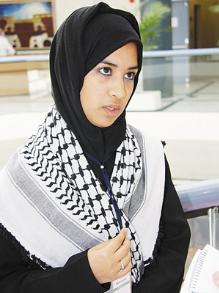
amna_fatanyThat’s why when Amna Fatani started a campaign to preserve heritage sites earlier this year, her father received hateful text messages telling him that he has no shame. Fatani appeared again in a local newspaper last week wearing a Palestinian keffiyeh during her participation at the Saudi-British Youth Forum in Jeddah. Again, she was faced with similar reactions. The first comment by a reader was: “let her cover herself up, and worry about her religion first.”

I’m sorry you had to go through this Amna, but if it’s any consolation, know that you are not alone. When AlArabiya.net published my interview with Reuters two years ago, people left many unpleasant comments, calling me a “Westernized spoiled brat” and “retard” among other things. Sure, it didn’t feel good but I have grown a thicker skin. Sometimes it is not just total strangers who try to put you down. More than one of my relatives have told me to “quit this nonsense” I’m doing. You, however, are lucky to have a supportive family who are very proud of you.

So dear Amna, whenever something like that happens to you, remember you are not alone and that we are all in this together. We are young and we are not amused. We are eager and determined. We will not be silenced and we will not be intimidated. We shall speak up and we shall overcome. Open your minds and hearts. Listen to our fresh voices.

Sincerely,
Ahmed

Taking to Streets in Saudi Arabia

On the 19th of December, a few hundred people demonstrated in Qatif, a predominantly Shiite area east of Saudi Arabia, to protest the Israeli siege on Gaza. The protesters lifted posters of Hizbollah leader Sayyed Hassan Nasarallah and chanted anti-Israeli and anti-US slogans. According to the website Rasid, the demonstration ended peacefully under the eyes of security forces who watched closely. However, tens of young men who demonstrated were arrested in the following week.

After Israel started their barbarian attack on Gaza last Saturday, thousands of angry demonstrators took to the streets in Egypt, Jordan, Yemen and other countries. In Saudi Arabia, where the law does not give people the right to demonstrate publicly, more than 60 political and human rights activists signed a letter to the Ministry of Interior asking for permission to hold a peaceful demonstration in Riyadh.

While activists in Riyadh were waiting for a reply from MOI, protesters in Qatif demonstrated again on Monday, but this time they were faced by the security forces and riot police who fired rubber bullets to break up the protest. Mansour al-Turki, spokesman of MOI, denied that such protest took place. “Street protests are banned in the Kingdom and that the security forces will intervene to enforce the ban,” he added. His denial is not surprising, but everyone knows that people of Qatif have a long history in street protests with major demonstrations held in 1979, 2002 and 2006.

Four activists who signed the letter were summoned to meet a senior official at MOI today who also said the country’s regulations do not allow such activities. The activists said nothing in the local laws bans street protests but they signed a pledge that they will not hold the demonstration which was planned to take place tomorrow in Nahda Street. Another activist who did not sign the letter said he does not need a permission from anyone to protest. Khalid al-Umair said that he and other activists will be there tomorrow “because we are simply exercising our natural right in expressing our opinion peacefully.”

This was the first time for a group of activists to ask for such permission, and it was expected that MOI would not give a positive response. Although the request was denied, it seemed to encourage more people to take similar steps. More than 200 students at King Abdul-Aziz University in Jeddah sent a letter today to the rector asking for permission to hold a demonstration but he refused saying the university is not the right place to protest.

People should be allowed to protest, but it seems that the government is afraid that people will realize the power of public demonstration and later use it not just to protest against Israel but also to demand their rights. Giving permission to these demonstrations would set a precedent that the government clearly doesn’t want to deal with its results and consequences. 2009 will be interesting.

UPDATE: Khalid al-Umair and Mohammed Abdullah al-Otaibi have been arrested Thursday noon.

Also read:

Blogging or Bragging?

070709_tech_karaoketnIt is extremely saddening how some of us were so brainwashed that they reached a stage where even the most basic human rights have become alien to them. Al-Riyadh daily asked their readers earlier this week about blogging and if blogs are a medium for spreading ideas and sharing opinions or simply a place for bragging and showing off. So freedom of expression is bragging now? *sigh*