- The good news is: Samar is free. Social media and new activism FTW! Now that she has been released, we should keep up the momentum and direct our energy to another person who has been imprisoned for the past four months: Mukhlif bin Daham Al-Shammary, a human rights activist in the EP.
- Also good news: a tip by Saudi intelligence officials helped Americans discover a terrorist plot to send explosives from Yemen to the United States by courier.
- The bad news is: Sand Gets in My Eyes, one of my favourite blogs by expats living in Saudi Arabia, has been blocked last week. I’m not sure exactly how the censors think, but I don’t see why would they do such thing. Not that they are particularly smart and/or selective about what they choose to block. You can help by filling the unblock form here.
- Since no knot is being tied, I will consider this bad news, too: Asmaa has a nice post on the dilemma of young Saudis who want to get married. Well, she specifically talks about her cousin, but I think many of us can relate to what is happening with him. Probably most of you already know how I feel about the way people get married back home.
- Finally, here is the ugly news: the Saudi religious establishment issued a fatwa today saying it is not permissible for women to work as cashiers in supermarkets. Apparently, female cashiers are haram.
Category Human Rights
Press freedom ranking, arms, doctors, genies, he’s back!
- At least 20 Saudi medical doctors wanted to show the world what kind of ignorant idiots they are, so they went and joined an ongoing campaign calling for special government hospitals for women in order to prevent mixing of genders. Carol Fleming, who worked for hospitals in Riyadh, comments.
- The recent US-Saudi arms deal, with an estimated $60bn price tag, was marked by the unusual absence of any opposition by Israel and its lobby in Washington DC. Dov Zakheim, blogging at Foreign Policy’s Shadow Government blog, says this is “In part because the Israelis do not expect such an attack [from the Saudis]; in part because they will be receiving the more advanced F-35 the same year that the Saudis begin to take ownership of the F-15s…” At the end of his post he mentions one more reason: “Riyadh is the biggest prize and the Israelis are ready to go to great lengths to win it over — and if that means silence in the face of a massive purchase of American arms, so be it.”
- Speaking of Foreign Policy, they have this aptly titled article by Simon Henderson about the return of Prince Bandar bin Sultan, head of the National Security Council, after two years of being AWOL. Elaph had the scoop on this one a couple of weeks ago.
- RSF released their 2010 Press Freedom Index. Saudi Arabia, unsurprisingly, is at the bottom ranking 157 out of 178. Last year we were 163. Can we call this progress? As a journalism student, I’m not quite sure how to feel about this.
- Everybody back home is laughing about this. I don’t want to talk about it.
Samar
Samar Badawi has always struggled with her father. He abused her verbally and physically, and even after she got married and had a son of her own, he kept interfering with her life. She got divorced, and decided to live with her brother. The father tried to sue his son and daughter, who was taken to a women’s shelter thanks to an order from Prince Mishal bin Majed, the mayor of Jeddah.
The father did not stop there. He tried to sue Samar again, but the case was dismissed. After staying in the shelter for sixteen months, she sent a letter to the mayor asking for permission to live with her son. The mayor accepted her request, and asked the police to protect her from the father.
Samar filed a lawsuit to lift her father’s guardianship, and the court ruled in her favor. The father filed a “filial ingratitude” complaint against her. When she went to challenge the complaint, “the judge pledged to teach her obedience and flog her himself.” Despite the previous court rulings and her father’s documented abuse, and even a royal order from Prince Khalid al-Faisal, governor of Makkah, to send her back to the shelter, the judge sent her to prison.
Samar told the Financial Times that the judge thinks a woman must submit to her father, regardless of how abusive he is. “Conservative judges hate the government’s women’s shelters because they empower women. They call them brothels,” she said.
This was six months ago. It was only last week that Samar and her lawyer decided to go public with the case. Since the local newspapers won’t pick up a sensitive story like this one, they went online. With help of fellow blogger Fouad al-Farhan, they set up a blog where they told Samar’s story and uploaded all the documents of her case. The case was also heavily discussed on Twitter, where users in Saudi Arabia used the hashtag #samar to denote their tweets about it.
While Samar enjoyed a lot of support from most users on Twitter, there have been some people who defended the judge, saying the case is being used to attack the Saudi judicial system. Moreover, a blog was to “basically show how the people responsible for the news breakout are not credible, liberal westernizers,” according Lou K.
Earlier today, Samar’s lawyer Waleed Abu Alkhair tweeted that the Supreme Judicial Council has opened an investigation into the case, anticipating a resolution in the next few days.
Samar’s story is undoubtedly a disturbing, heartbreaking one. It’s surely nor over yet, but now that the case is — I hope — moving forward, let me take a moment to say two of things about this:
- The case shows that despite all the promises and the billions of riyals allocated to reform the judiciary system, we are still so far away from anywhere near a true reform for this institution. It’s been three years, and we are yet to see any tangible progress.
- While many people still like to question the power of web and social media to make a difference to our society, this case offers a good evidence that the influence of online tools can be effective. Remember, the story was not picked up by any newspaper in Saudi Arabia so far.
I salute Fouad, Waleed and the others who supported this case. It fills my heart with hope to see many of my countrymen and women speak up and refuse to ignore injustice. Our nation deserves better than this, and we should never settle for less.
Dancing, Reform, HRW Report, Arab iPhone developers
- YouTube video mashups of Saudi folk dancing with Western music have been a popular item on this blog. Here is the latest in this series, courtesy of Mctoom.
- Ahmed Ba-Aboud: “When would reforms in Saudi Arabia be real reforms and not the gift of the King? It is when those reforms focus on finding solutions to the real issues of the country rather than creating more fictional wars.”
- Speaking of reforms, Human Rights Watch recently released their report on Saudi Arabia in which they try to review and evaluate the past five years. The report is well written and reaches a conclusion many of us already know: there have been some changes here and there, but there is still much more to do, and these changes need to be institutionalized to ensure their sustainability.
- Jordanian blogger Ahmad Humeid writes about the new opportunities that the iPhone and the iPad offer to software developers in the Arab World, with a shout out to my good friend Bandar Raffah.
Protests near Ground Zero
Today marks the ninth anniversary of 9/11. The day witnessed heated demonstrations — against and for the proposed Islamic community center — two blocks away from ground zero. I was there this afternoon with a friend of mine, and took some pictures.
Free Ali Abdulemam
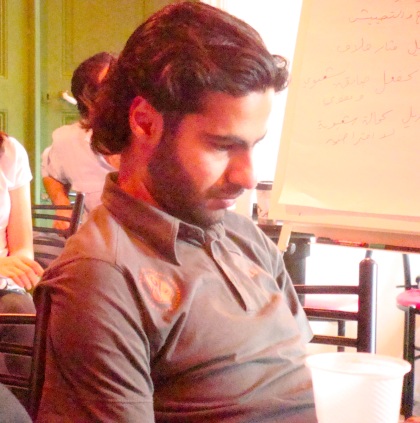
I was shocked to learn that my friend Ali Abdulemam, a leading Bahraini blogger, was arrested yesterday by the Bahraini authorities for allegedly spreading “false news” on BahrainOnline.org portal, one of the most popular pro-democracy outlets in Bahrain. It is not the first time that Ali has been arrested for content published on his portal. I met Ali a couple of times in Beirut, where both of us attended Arab bloggers meetings. He is, in the words of Sami Ben Gharbia, “a pioneer among Arab activists, using the internet to militate for peaceful reform. He inspired many young Bahrainis and Arabs to use the internet to express themselves and engage in spirited debate.”
Please support Ali in any and every way you can: blog, tweet, and follow the updates here.
Saudi video plea to Obama
A group of Saudis have launched this video plea asking US president Barack Obama to pardon their countryman Humaidan al-Turki, who was convicted in a Colorado court four years ago for several crimes and was sentenced to 28 years in prison. The short video is well produced, and has racked up more than half a million views on YouTube so far. It features several Saudi celebrities, bringing together, probably for the first time, a Sunni cleric and a Shia cleric as well as some other notable Saudis including a columnist, a tv talk show host, and a former footballer. The idea for this video plea grew out of a column by Najeeb al-Zamil, a member of the Shoura Council, who also appears in the video. However, the highlight of the video is the emotional appearance of Ruba, the 12-year-old daughter of Humaidan.
The effort by Al-Muhannad Al-Kadam, Asem Al-Ghamdi, and the young Saudi team behind this work is no doubt commendable. But like Abdulrahman al-Lahem and John Burgess, I wonder about the real impact of the video. The case has been raised by Saudi officials in several exchanges with US counterparts, but to no avail. In December 2006, Colorado Attorney General John Suthers travelled to Riyadh to explain the original convictions to Saudi officials.
The timing to release this video was apparently chosen to coincide with the fourth anniversary of his sentence, but from the American perspective it seems like a bad timing. The controversy over building an Islamic community center near ground zero has resulted in a rise of anti-Muslim sentiments here. As John points out, “At this time, sad to say, Islam and Muslims do not enjoy favorable views by a majority of Americans. There is simply no up-side to the President’s issuing a pardon.”
In any case, and regardless of the outcome of this work, I’m certainly glad to see such grassroots effort gains traction. It is a good example of what regular citizens can do to make a difference, and it is a also a good example for the use of social media to promote a cause. The idea that started with a newspaper column now has a Facebook group with more than 26,000 members. The goal of the video, according to the website, is to deliver the Saudi point of view on this issue. I think this goal has been reached. Can this goal be a catalyst for a presidential pardon in favor of Homaidan Al-Turki, like the campaign hopes? That’s a totally different matter.
 Saudi Jeans
You must be logged in to post a comment.