- YouTube video mashups of Saudi folk dancing with Western music have been a popular item on this blog. Here is the latest in this series, courtesy of Mctoom.
- Ahmed Ba-Aboud: “When would reforms in Saudi Arabia be real reforms and not the gift of the King? It is when those reforms focus on finding solutions to the real issues of the country rather than creating more fictional wars.”
- Speaking of reforms, Human Rights Watch recently released their report on Saudi Arabia in which they try to review and evaluate the past five years. The report is well written and reaches a conclusion many of us already know: there have been some changes here and there, but there is still much more to do, and these changes need to be institutionalized to ensure their sustainability.
- Jordanian blogger Ahmad Humeid writes about the new opportunities that the iPhone and the iPad offer to software developers in the Arab World, with a shout out to my good friend Bandar Raffah.
Category Asides
Free Entertainment
Students at Columbia J-School don’t have much free time. And when they have some free time they probably don’t have much money to spend on entertainment. Can they have some fun without spending a fortune?
PS. The artists featured in the piece are: Swear and Shake, Liz Tormes, and Lara Ewen.
PPS. This is another piece from my audio reporting class. Not great, but probably better than the first one.
Illusive reform, Swedish TV interview
- Neil Patrick says, “All in all, substantive Saudi reform is largely illusive.” That’s debatable. What is not debatable is that many of the changes made since 2005 lack an institutional basis and have not captured our imagination, mine at least.
- I was interviewed by Swedish television a while I ago. I said things. Jameel al-Theyabi, editor of the Saudi edition of al-Hayat daily, said things, too. I don’t think that Moroccan journalist Mohammed al-Jama’ai wears a suit to work everyday. That’s not my laptop, I’m a Mac. I hate the adjective ‘absolutely.’ What else? Oh, I’m not religious.
CPA and their PR puff, MFA and their tracking system
- The Saudi Consumer Protection Association (CPA) would like to inform you that they have joined Consumer International (CI), a global federation of consumer groups. The head of CPA said this membership will help them do a better job. I would really like to believe it, but this sounds to me more like a PR puff than anything else. CPA has almost nothing for local consumers in the past. I know they don’t care about a tiny consumer like myself, but here is my little piece of advice to Dr. Mohammed Al-Hamad and his agency: stop talking to the press and do some real work. Kthxbai.
- Saudiwoman: “I am currently on a family vacation in Italy but I had to post what the Ministry of Foreign Affairs sent my husband. Apparently they have a new service where they send the male guardian a text every time a “dependent” leaves the country. They don’t state which country the dependent left for but simply state that they did leave.”
Robbery in skies, Routes of Arabia, Weddady’s response to Khouri
- Have you heard of the Air France flight attendant who was arrested for robbing passengers? Muhammed al-Ahidib provides four reasons why this woman would not have been able to steal if she were working for Saudi Arabian Airline.
- Here is another good review for Routes d’Arabie, this time from Bloomberg.
- Nasser Weddady offers another fine rebuttal to Rami Khouri’s op-ed in NYT. At the end of his blogpost, Weddady comments on a part of Khour’s article that I chose to ignore, which is about the “hypocrisy” of US government’s interest in social media while it supports the very same dictatorships that crush liberties. This is an old and overused argument, and something I have touched on in my op-ed in the same newspaper last year.
Routes d’Arabie, Rami Khouri, Reverse culture shock
- The Saudi Routes of Arabia exhibition in Paris has been receiving some pretty good reviews. Hundreds of artifacts never before seen outside Saudi Arabia are currently on view at the Louvre. I have seen most of these pieces at the National Museum, and I’m glad the whole world is getting a chance to see this part of our history. I wish they would do more to promote the museums and exhibitions like this inside the country for the locals who only get to hear about such events when they take place abroad.
- Rami Khouri thinks the new media in the Middle East synonymous with the Al Jazeera effect of the 1990s, i.e. it is merely venting and therefor will not lead to any real change in the Arab political landscape. I’ve heard this rhetoric many times before. If he thinks that the current wave of activism is useless, then what exactly does he suggest? Should we just sit down, keep our mouths shut, and wait for his generation to bring about change? Based on their history, this seems pretty unlikely. But lamenting this whole phenomenon as merely venting is naïve. Khouri and other old media people obviously still struggle to understand new media and their influence. I never said blogging will change everything, but I think it is the start of something good, something that our predecessors were not able to do. The evidence is his comparison to Al Jazeera, which is a one-way medium just like the one he comes from, unlike new media where people are actively engaged and involved and not simply passive consumers.
- My friend Ben has been living in Saudi Arabia for a year, and now he is back to the US and is suffering from a “reverse culture shock.” Thankfully, he says, his condition is treatable. The doctor has prescribed him movies, lots of bacon, and a few happy hours.
Identity and social change, women’s rights movements, US diplomat in henna
- Qusay ponders the questions of identity and social change: “I am a product of that change, along with many others, just take a look at the Saudi’s writing in English. English is almost our first language, we grew up watching American shows and we dressed like the cool people we saw on TV. When we went out we ate fast food, and listened to American music, and watched Hollywood movies (not in theatres of course).” I wonder if I’m one the bloggers he is talking about. I don’t think that I’m one of them. I think my view of our society has more to do with our past, which I believe was better, than with what Western media sell as their lifestyle vs ours.
- The Philosophy Cube writes about the women’s rights movement in Saudi Arabia. Or rather the lack thereof. I think many of us agree that the economic factor is one of the strongest catalysts for change. “In light of all the social intricacies within the society, I am sure that it is poverty alone and the struggles of the lower classes that will bring Women’s Rights to the country.”
- Today’s picture:
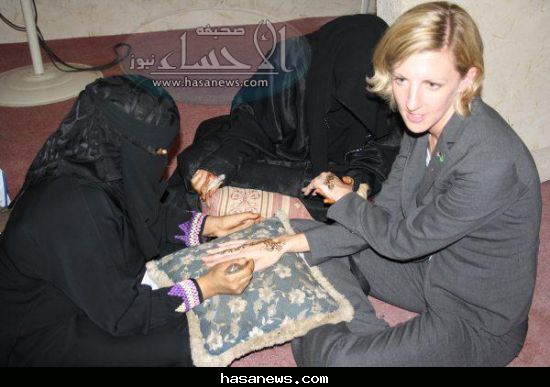
Cynthia Cook sits down to have her hands adorned with henna in a local summer festival here in Hofuf, east of Saudi Arabia. Cook is the Public Affairs Officer at the US Consulate in Dhahran, and she was part of an American delegation that visited the festival earlier this week. You know, public diplomacy and stuff :P
 Saudi Jeans
You must be logged in to post a comment.