Norah and Adela

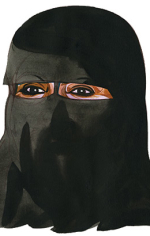
Norah al-Faiz says she has been misquoted. She does not say she was misquoted on what exactly: her Najdi niqab, introducing sports to girls schools, that she can’t appear on TV without permission, or the news that she started her talk with the reporters by saying “ya mama…” Alas, she said she will no longer speak to the press directly and will conduct all her interviews from now on via fax or email. I hope the new approach of the deputy minister would stop her from uttering nonsense like that she is more influential than Barack Obama. Al-Faiz has retracted her statements about introducing sports to girls schools, saying she is not against it and that “an integrated plan is being worked out to introduce PE in girls schools.” This actually could be true, not necessarily because al-Faiz said so but because someone who is far more influential than her is pushing for it.

Princess Adela bint Abdullah, the King’s daughter, told al-Riyadh daily yesterday that “it’s high time to look into the matter of introducing sports at girls schools seriously, following the teachings of Islam.” Princess Adela does not work in the government, but she is married to the minister of education. A friend of mine who met the princess says she is offering a new image for the women of the royal family. She is highly-motivated and very determined, and she is playing an increasingly assertive role in public life here. Since she is standing behind this, I think that female students might start enjoying their sports classes when the new school year begins this fall.

Roots

Something is bothering me about Norah al-Faiz, the deputy minister of education. Sure, as the first Saudi woman to be appointed in such a senior position, she has come under a lot of attention, and maybe a lot of scrutiny. But I’m not talking about her performance as an official; I believe it is still early to evaluate her work, probably in the same way she thinks it is too early to talk about introducing sports to girls schools (it’s not, btw).

What is bothering me is this: Why does she keep referring to her Najdi roots every time someone asks about her allegedly “leaked” picture and the niqab? I believe she has every right to be proud of her roots, but I don’t think this is the right context to highlight them and associate the niqab with them. She serves in the ministry of education, she should be a role model. What kind of message does her statements send to teachers and students? Why can’t she just say that it’s a personal choice and that she expects others to respect it?

Now I could easily find her picture and put it in this post, but I’m respecting her wish in that she does not want her picture to be published. Is it too much to ask her to respect the rest of us who put their nation’s interests above their regional affiliation?

Now Walk the Walk

President Obama’s speech was better than expected, but less than what I was hoping for. We know that he can give a good speech, and he certainly did that in Cairo. However, I think that in his attempt to be balanced, he came out sounding too balanced, especially on democracy and human rights.

Probably he was trying to be careful not to offend his hosts, but as I said in my New York Times op-ed, I was hoping that he would speak directly to the leaders in the same way that he did in his inaugural speech when he said: “To those who cling to power through corruption and deceit and the silencing of dissent, know that you are on the wrong side of history, but that we will extend a hand if you are willing to unclench your fist.”

However, I understand why he was cautious when he talked about democracy and human right, and I can’t blame him. He obviously wants to distance himself from the rhetoric and policies of the previous administration, and I guess that’s why he also did not use the word “terrorism” at all in his speech. Still, I think that in the few words he said on democracy he made several good and important points:

America does not presume to know what is best for everyone, just as we would not presume to pick the outcome of a peaceful election. But I do have an unyielding belief that all people yearn for certain things: the ability to speak your mind and have a say in how you are governed; confidence in the rule of law and the equal administration of justice; government that is transparent and doesn’t steal from the people; the freedom to live as you choose. Those are not just American ideas, they are human rights, and that is why we will support them everywhere.

There is no straight line to realize this promise. But this much is clear: governments that protect these rights are ultimately more stable, successful and secure. Suppressing ideas never succeeds in making them go away (…)

No matter where it takes hold, government of the people and by the people sets a single standard for all who hold power: you must maintain your power through consent, not coercion; you must respect the rights of minorities, and participate with a spirit of tolerance and compromise; you must place the interests of your people and the legitimate workings of the political process above your party. Without these ingredients, elections alone do not make true democracy.

In any case, he had too much ground to cover, and therefore it was only normal that he would choose to focus on some issues more than others. I think the way he talked about the Palestinian-Israeli conflict was different than what we usually hear from American presidents. Yes, he said the bond with Israel is unbreakable, but for the first time we hear a US president talk about “Palestine,” not just the Palestinian people, and use words like intolerable and humiliation to describe their suffering. It was also good that he dedicated parts of his speech to religious freedom and women’s rights, two issues where there is much to be done, especially here in Saudi Arabia.

Over all I think the speech was a good start for a frank dialogue between America and the Muslim world, but now those words must be matched with deeds so we can move forward. “And I want to particularly say this to young people of every faith, in every country – you, more than anyone, have the ability to remake this world,” Obama said at the end of his speech. Count me in. I, for one, want to remake this world, starting from here.

UPDATE 6/6/09: David Brooks described the part on democracy as “stilted and abstract — the sort of prose you get after an unresolved internal debate”:

But many of us hoped that Obama would put a gradual, bottom-up democracy-building initiative at the heart of his approach. This effort would begin with projects to create honest cops and independent judges so local citizens could get justice. It would make space for civic organizations and democratic activists. It would include clear statements so the world understands that the U.S. is not in bed with the tired old Arab autocrats.
Lame

It’s official now. The municipal elections will be put off for two years, but instead of saying we are delaying the elections the government came out today saying they will extend the mandate of municipal councils by two years. Classic. They said they want to give time to “expand the participation of citizens in the management of local affairs” and to draft new regulations for the councils toward this goal.

Let me repeat what I said back in October of last year, that’s a lame excuse. The unannounced reason could be simply that the government does not want to deal with the issue of women’s participation in the election as voters and candidates. Considering how negligible these councils have been since they have been elected four years ago, I don’t think most people here would be alarmed by the delay.

So much for our infant democratic experience…

Girls Beware!

In a lecture he gave earlier this week at KSU, Sheikh Abdul Aziz Bin Abdullah Aal Al-Sheikh, the Grand Mufti and Chairman of the Board of Senior Ulema, warned Saudi girls of those who want to deviate women from the right Islamic path:

They want her to go unveiled, moving about and traveling on her own, getting involved in relationships with whoever she wants, and calling whoever she wants to start up friendships with whoever she wants.

Who are they? They are the liberal forces. Damn them.

Al-Faiz in the TIME 100

norah_alfaiz_2In their annual TIME 100 issue, Time magazine named Norah al-Faiz, the new Saudi deputy minister of education, as one of the 100 most influential people in the world. I have nothing against al-Faiz, but I think that the magazine is overestimating her influence. The woman has been in office for less than 3 months. Her most talked about decision was a directive she sent to schools warning the students of the perils of reality TV shows. I’m not trying to pick on her, but I think it is way too early to try to assess her performance or influence.

Now the selection of al-Faiz by Time might be questionable, but how the Saudi media handled the news is just laughable. They reacted orgasmically, saying she came ahead of Obama and his wife! Does it really take a genius to realize that the list published on the website is not ordered according to influence? Probably not, but it is exactly this kind of idiocy that makes me despise Saudi media.

Again, I want to repeat that I have nothing against al-Faiz, but I believe that a critical analysis for the performance of her department could be much more useful than celebrating a fake victory.

والله ما مثلك بهالدنيا بلد

Saudi Arabia is one of the worst places on earth to be a blogger. Or a woman. Or a lawyer. Or a human rights activist. Or just someone looking for a job.

Sometimes, it is not even a good place to be a Saudi.

Related:

The title comes from a well known national song here. It can be translated as: this country is like no other.