Women’s Driving: Standstill

Abdulrahman al-Rashed confirms what I have been saying for the past few months: Saudi women will not start driving their cars in the Kingdom anytime soon. Al-Rashed heads al-Arabiya news channel and is usually described as pretty close to decision makers in the country.

In his column in Asharq al-Awsat last Wednesday, al-Rashed dismissed the idea of petitioning the government to allow women to drive, arguing that women’s driving simply does not enjoy enough public support. Without such public support, the government would never push for a change to the status quo. The government will not take it upon itself to do this because “governments all over the world tend to avoid adventures,” he says.

But today another columnist in the same newspaper expressed his disagreement with al-Rashed’s viewpoint. Mishari al-Thaidy argues that without any practical way to measure public opinion in the country, it is difficult to tell where the majority stands. “Where is this public opinion? How is it made? Where can you see it? Who represent it?” al-Thaidy asked.

Women’s driving, he says, is just like girls education, radio, television, satellite dishes, and combining the administrations of boys and girls together into one governing body. All of these changes were faced with fierce opposition by some elements in society. However, the government did not bow to this opposition. They stood their ground, and these changes were eventually accepted.

Where does that leave us when it comes to women’s driving?

Pretty much in the same place where we were five years ago.

Now some people like to say that women’s driving is not an important issue, and that there are far more important issues for women, and the country at large, to tackle at the moment. It is not a priority, they say. But I call BS on the “priorities” talk.

If you a are a woman who can’t go to work because you can’t drive and you can’t afford a driver then it is an important issue for you. It becomes your priority. I agree with those who think issues like male guardianship and fixing the judicial system to become more women-friendly are probably more important in the long term.

But here is why I think women’s driving matters: I believe that this issue has become a symbol for all other reform issues in the country, especially the ones related to women status. It has become like a psychological barrier. If we can overcome this, then we can cruise into our other challenges with more confidence and determination. I still believe that we need a brave, courageous political decision to make it happen. Without such courage, our society will keep running slowly in the same devoid vicious circle.

Bogus Trends

Trend stories are some of my least favourite kind of stories in the media. Even worse, many of these trend stories tend to be bogus. “The bogus trend story thrives thanks to the journalists who never let the facts get in the way when they think they’ve discovered some new social tendency,” says Slate’s Jack Shafer.

It is said that one is an exception, two is a coincidence, but three is a trend. However, when it comes to Saudi Arabia and its infamous religious police two is more than enough to make a trend, apparently. During the last week, international media went crazy over two little stories about attacks on the members of Commission for Promotion of Virtue and Prevention of Vice (CPVPV) aka Haia.

haya_logo_inverseMany reporters who worked on these stories from abroad called their sources in the Kingdom asking them the same question: Does this incident (and later these two incidents) indicate a shift in attitude by the public towards the religious police? Regardless of the answers they got, they somehow came out with pieces along the line that Saudi people have had it and are finally rising up against Haia.
Sorry to disappoint you guys, but I really do not think this is the case. The talk about a revolt against Haia is a gross exaggeration. What these stories suggest is not an anti-Commission revolution but rather a change in the press. Few years ago these kind of stories won’t make headlines; now they do. Local media cannot be blamed for hyping up Haia stories because, well, they sell. It is outside observers and self-appointed experts that should be blamed for falling for bogus trends.

World Cup broadcast rights, GPYW grilled in Shoura

  • Broadcast rights of major sports events such as the World Cup used to be a hot topic for debate in the Arab World. Not anymore as most people here have grown accustomed to the realities of premium TV in the region. But something in this article from the New York Times caught my attention: “In many smaller European countries, public broadcasters still have a firm grip on the World Cup, under a collective agreement between FIFA, the governing body for the tournament, and the European Broadcasting Union, a group representing public broadcasters. A similar deal was signed between FIFA and the African Union of Broadcasters, providing viewers with free access to all the World Cup matches across much of sub-Saharan Africa.” Why this is not the case here? In the Middle East there is such a union. It’s called ASBU. Unfortunately for the people in this region, ASBU is too weak and has been subdued by private TV networks owned by individuals with close ties to Arab government. Go figure.
  • Speaking for the World Cup, Saudi Arabia did not make it to this year’s tournament for the first time since 1994. This failure to qualify and other local sports issues have been recently discussed in the Shoura Council. The General Presidency of Youth Welfare (GPYW) has come under strong criticism from Shoura members who questioned the performance of GPWY and how they spend their budget. I highly doubt this will change anything in that aging body, but I’m glad to see them getting kicked, even if it was merely symbolic.

Jeddah, Jeddah, Jeddah

  • The King has received the board of directors of Jeddah Chamber of Commerce and Industry. The JCCI delegation included 3 women. National newspapers made sure to show that in the pictures. During the reception, Saleh Kamel, chairman of JCCI, promised the King to create jobs for new university graduates. Last week, an official from the minister of labor said there are 200,000 unemployed Saudi women; 78% of those women hold a college degree. The official described this as a “sad matter.”
  • File this under good news for transparency and fighting corruption. Saudi Gazette says, “As the Control and Investigation Board (CIB) begins Saturday its investigations into the case files of over 70 persons facing charges related to the Jeddah flood disaster of November 2009, sources told Okaz that the accused would be put on trial publicly. Construction contractors found guilty may also be liable to pay blood money.”

Let’s Ban Everything

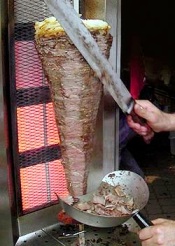
If I sound irritable lately, it is because I’m going through withdrawal symptoms. It’s been ten full days since I had shawerma for the last time. “Then go get yourself some shawerma,” you might say. Well, I guess you haven’t heard: shawerma is banned in al-Ahsa!

In a boneheaded move, Al-Ahsa municipality decided to ban shawerma during the summer. The whole thing started last year, when some people suffered food poisoning after they had shawerma at different restaurants in town. Following the incidents, the municipality issued an order to all restaurants telling them they are not allowed to serve the delicacy for the four months of summer (yes, summer here can last four, five, and even six months).

ShawermaI’m actually pissed off, not just because I can no longer have one of my favourite meals, but also because of the way the municipality is dealing with the whole matter. Instead of monitoring the restaurants to make sure they are following safety and health regulation, and then punish those who violate them, they go and ban everyone. They are punishing everyone. There are places that sell nothing but shawerma, and this decision would simply kill their business.

This type of collective punishment is easy for the municipality to inflect because the affected parties don’t have the means to protest. What could they do? Go to the municipal council? Please! Plus, even if they wanted, they can’t because they are not Saudis. You see, although these restaurants are owned by Saudi citizens, they are run by foreign workers. They pay an annual fee to the Saudi owner who does not care what the hell happens to the restaurant as long as he gets his money at the end of the year.

I’m really disappointed in al-Ahsa municipality. They have done some good work in building new infrastructure and improving streets and services. But this decision banning shawerma is just ridiculous. In addition to being irresponsible, it shows laziness on their part. They don’t want to do their job of making sure that the regulations are followed, so they go and issue a general ban.

If we are to use the (il)logic of our municipality, then we should close down restaurants altogether since you could get food poisoning from eating anything. While we are at it, we should also ban cars because they kill so many people. We might as well ask men and women not to marry or have children because, you know, they will die at some point. Let’s ban everything. That would make life much easier for many of us, wouldn’t it?

Read more:

Origin of Arab News, Saudi coed study

  • Arab News is celebrating its 35th anniversary this year. To commemorate the occasion, the newspaper has published a supplement that carried articles by many people, including one by Prince Turki al-Faisal, the former Saudi ambassador to the US and the UK. In his article, Prince Turki reveals that both Arab News and Asharq al-Awsat, the flagship publications of SRMG, were actually the brainchildren of himself, Kamal Adham, and Hisham Ali Hafiz. In other words, both newspapers were born at the offices of the Saudi intelligence agency.
  • A study on co-education at university level has been recently conducted. The study sample was comprised of 440 med students from KSU and KAU. 71% of them said they support co-education, compared to 29% who were against it. Makes you wonder about all those ‘majority’ arguments that some people like to bring up when discussing controversial issues in the country.

Street Terror

According to WHO, Saudi Arabia has the highest road accident death toll in the world. It is very rare that you will meet anyone here who has never lost a friend or a relative in a car accident. Inspired by the death of his cousin, Ala’a al-Maktoum aka McToom made this impressive video illustrating the magnitude of the problem. Check it out: