I was shocked to learn that my friend Ali Abdulemam, a leading Bahraini blogger, was arrested yesterday by the Bahraini authorities for allegedly spreading “false news” on BahrainOnline.org portal, one of the most popular pro-democracy outlets in Bahrain. It is not the first time that Ali has been arrested for content published on his portal. I met Ali a couple of times in Beirut, where both of us attended Arab bloggers meetings. He is, in the words of Sami Ben Gharbia, “a pioneer among Arab activists, using the internet to militate for peaceful reform. He inspired many young Bahrainis and Arabs to use the internet to express themselves and engage in spirited debate.”
Please support Ali in any and every way you can: blog, tweet, and follow the updates here.
A group of Saudis have launched this video plea asking US president Barack Obama to pardon their countryman Humaidan al-Turki, who was convicted in a Colorado court four years ago for several crimes and was sentenced to 28 years in prison. The short video is well produced, and has racked up more than half a million views on YouTube so far. It features several Saudi celebrities, bringing together, probably for the first time, a Sunni cleric and a Shia cleric as well as some other notable Saudis including a columnist, a tv talk show host, and a former footballer. The idea for this video plea grew out of a column by Najeeb al-Zamil, a member of the Shoura Council, who also appears in the video. However, the highlight of the video is the emotional appearance of Ruba, the 12-year-old daughter of Humaidan.
The effort by Al-Muhannad Al-Kadam, Asem Al-Ghamdi, and the young Saudi team behind this work is no doubt commendable. But like Abdulrahman al-Lahem and John Burgess, I wonder about the real impact of the video. The case has been raised by Saudi officials in several exchanges with US counterparts, but to no avail. In December 2006, Colorado Attorney General John Suthers travelled to Riyadh to explain the original convictions to Saudi officials.
The timing to release this video was apparently chosen to coincide with the fourth anniversary of his sentence, but from the American perspective it seems like a bad timing. The controversy over building an Islamic community center near ground zero has resulted in a rise of anti-Muslim sentiments here. As John points out, “At this time, sad to say, Islam and Muslims do not enjoy favorable views by a majority of Americans. There is simply no up-side to the President’s issuing a pardon.”
In any case, and regardless of the outcome of this work, I’m certainly glad to see such grassroots effort gains traction. It is a good example of what regular citizens can do to make a difference, and it is a also a good example for the use of social media to promote a cause. The idea that started with a newspaper column now has a Facebook group with more than 26,000 members. The goal of the video, according to the website, is to deliver the Saudi point of view on this issue. I think this goal has been reached. Can this goal be a catalyst for a presidential pardon in favor of Homaidan Al-Turki, like the campaign hopes? That’s a totally different matter.
Neil Patrick says, “All in all, substantive Saudi reform is largely illusive.” That’s debatable. What is not debatable is that many of the changes made since 2005 lack an institutional basis and have not captured our imagination, mine at least.
I was interviewed by Swedish television a while I ago. I said things. Jameel al-Theyabi, editor of the Saudi edition of al-Hayat daily, said things, too. I don’t think that Moroccan journalist Mohammed al-Jama’ai wears a suit to work everyday. That’s not my laptop, I’m a Mac. I hate the adjective ‘absolutely.’ What else? Oh, I’m not religious.
The Saudi Consumer Protection Association (CPA) would like to inform you that they have joined Consumer International (CI), a global federation of consumer groups. The head of CPA said this membership will help them do a better job. I would really like to believe it, but this sounds to me more like a PR puff than anything else. CPA has almost nothing for local consumers in the past. I know they don’t care about a tiny consumer like myself, but here is my little piece of advice to Dr. Mohammed Al-Hamad and his agency: stop talking to the press and do some real work. Kthxbai.
Saudiwoman: “I am currently on a family vacation in Italy but I had to post what the Ministry of Foreign Affairs sent my husband. Apparently they have a new service where they send the male guardian a text every time a “dependent” leaves the country. They don’t state which country the dependent left for but simply state that they did leave.”
Have you heard of the Air France flight attendant who was arrested for robbing passengers? Muhammed al-Ahidib provides four reasons why this woman would not have been able to steal if she were working for Saudi Arabian Airline.
Here is another good review for Routes d’Arabie, this time from Bloomberg.
Nasser Weddady offers another fine rebuttal to Rami Khouri’s op-ed in NYT. At the end of his blogpost, Weddady comments on a part of Khour’s article that I chose to ignore, which is about the “hypocrisy” of US government’s interest in social media while it supports the very same dictatorships that crush liberties. This is an old and overused argument, and something I have touched on in my op-ed in the same newspaper last year.
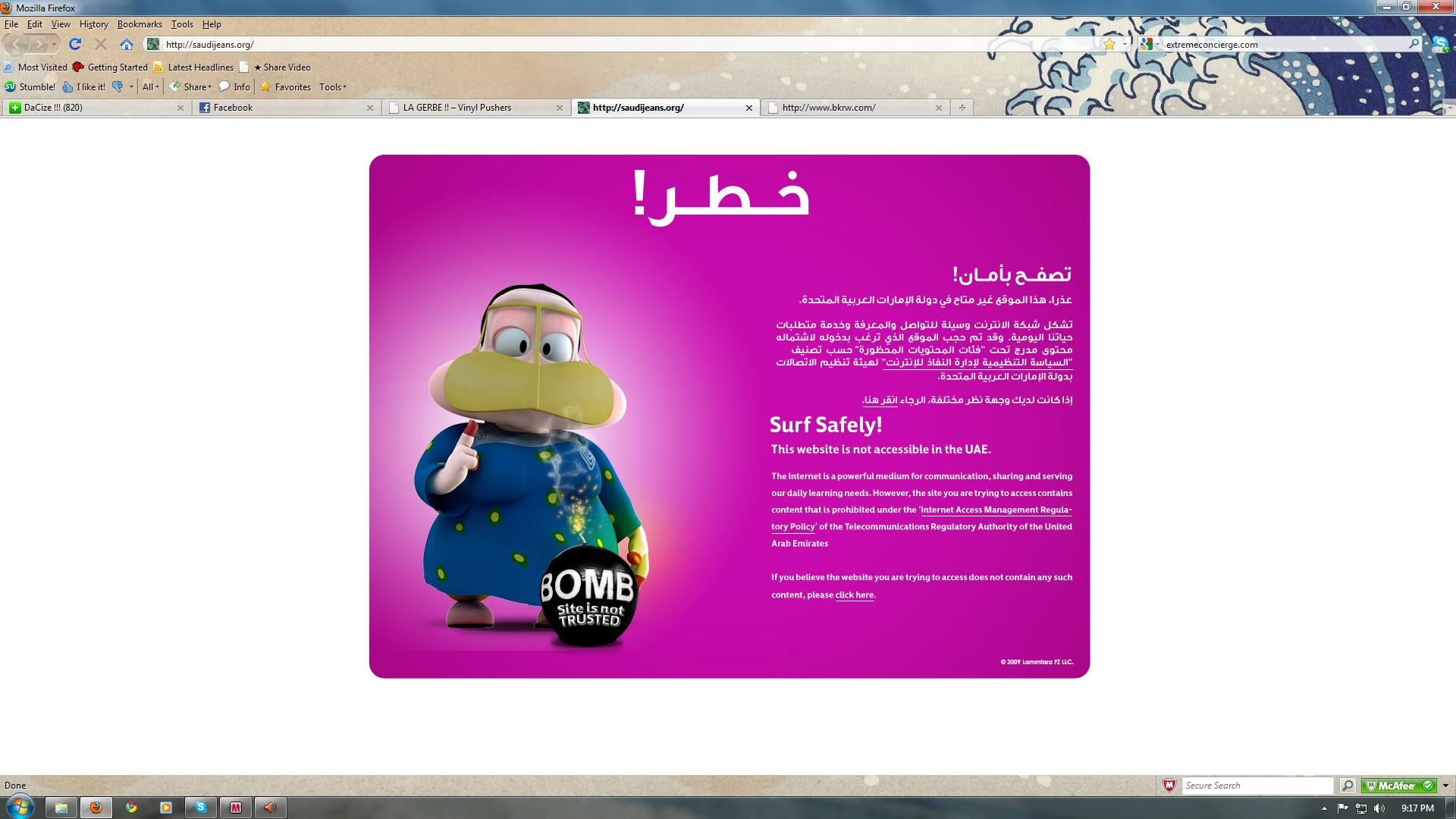
There have been some conflicting reports yesterday over the blocking of Saudi Jeans in the UAE. The blog Emirates in Stylereported the block and provided this screenshot:
When I asked people on Twitter to confirm this, some of them said the blog was indeed blocked, while others said they can still access it. I’m still not sure what exactly is going here here, but I would like to know more. So readers in the UAE, can you please check if Saudi Jeans is blocked where you are or not?
The Saudi Routes of Arabia exhibition in Paris has been receiving some pretty good reviews. Hundreds of artifacts never before seen outside Saudi Arabia are currently on view at the Louvre. I have seen most of these pieces at the National Museum, and I’m glad the whole world is getting a chance to see this part of our history. I wish they would do more to promote the museums and exhibitions like this inside the country for the locals who only get to hear about such events when they take place abroad.
Rami Khouri thinks the new media in the Middle East synonymous with the Al Jazeera effect of the 1990s, i.e. it is merely venting and therefor will not lead to any real change in the Arab political landscape. I’ve heard this rhetoric many times before. If he thinks that the current wave of activism is useless, then what exactly does he suggest? Should we just sit down, keep our mouths shut, and wait for his generation to bring about change? Based on their history, this seems pretty unlikely. But lamenting this whole phenomenon as merely venting is naïve. Khouri and other old media people obviously still struggle to understand new media and their influence. I never said blogging will change everything, but I think it is the start of something good, something that our predecessors were not able to do. The evidence is his comparison to Al Jazeera, which is a one-way medium just like the one he comes from, unlike new media where people are actively engaged and involved and not simply passive consumers.
My friend Ben has been living in Saudi Arabia for a year, and now he is back to the US and is suffering from a “reverse culture shock.” Thankfully, he says, his condition is treatable. The doctor has prescribed him movies, lots of bacon, and a few happy hours.
 Saudi Jeans
You must be logged in to post a comment.