Saudi Unflagger and Blocking Twitter

Public demonstrations are banned in Saudi Arabia. We don’t have codified laws, so you will not find any official text that explicitly says it, but everybody knows it. What do we do when we want to protest publicly? We go to the internet and start a campaign online. Back in 2006 I wrote, ”Online campaigning is appealing to many people because most of the time it doesn’t take much resources.” Most of the time it takes little more than starting a freely hosted blog, design a few banners, maybe add a mailing list, and viola! you have a campaign.

This year alone, we have seen a plethora of campaigns that goes from the useful to the useless, and everything in between. We had the Khalooha… series, which covered topics like greed of car dealerships, women’s rights, and marriage expenses among other things. Most recently we had two confusing, similar but apparently opposing campaigns on the issue of male guardianship. But what I want to talk about today is a campaign called SaudiFlager (sic).

SaudiFlager’s goal is to clean up YouTube of videos offending to Saudi Arabia by flagging them. In addition to the unfortunate misspelled name, I believe this campaign has two main problems. First, what is an offending video? What are the criteria for such thing? I mean, what is offending to you can be quite harmless to me, right? So who gets to decide which videos are offending? Second, YouTube is already heavily censored by CITC. Do we need another layer of censorship?
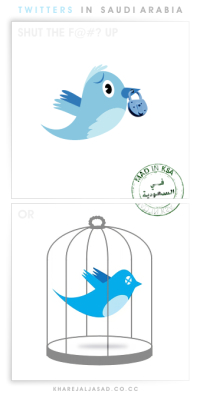
twitter_cageI’m all for free speech, so don’t get me wrong. If you feel strongly offended by a video on the website, go ahead and flag it. Knock yourself out, I’m not going to stop you. Actually, I can’t stop you. But I think that organizing a campaign for such purpose is a just a waste of time and effort. What is worse, it is enforcing yet another form of censorship and that is the last thing we need. CITC is already doing a great job at it that I find myself occasionally amazed by how dedicated they are to this job.

This dedication is shown clearly in their latest blocking spree, which included Twitter profiles like those of @Mashi97 and @abualkhair. Blocking @Mashi97 was particularly strange because it came after he tweeted about having fried eggs for breakfast, which made him think that maybe someone at CITC does not like eggs. Also, what CITC don’t seem to realize is that blocking profile pages on Twitter does not prevent the users from updating. Go figure.

Which brings me back to online campaigns: should we start one to unblock these guys? I think we should, but currently I’m busy with another campaign of mine: Saudi Unflagger. Who is in?

Killjoy

Add this to their list of achievements: interrupting a nasheed concert for kids in Dahran Mall. Just look at how the policeman stole the mike from the performer’s hand. Impressive.

UPDATE: For those who asked about context, here is a story from yesterday’s al-Watan. The Commission spokesman said they interrupted the concert because the families area was very crowded. The concert was later continued. Does that change how you feel about the incident?

Petty Victories

Sabq talks about an email that has been circulating over the past few days. I have been trying to get a copy of this email with no luck so far. The email allegedly contains a list of what some conservatives consider achievements they have gained in the last six months. According to Sabq, the list includes:

  • Canceling movie screenings in Jazan, Taif, EP, and Abha.
  • Canceling the summer music concerts in Abha.
  • Canceling scholarships for talented female highs school students.
  • Canceling Onaiza cultural festival.
  • Canceling events for liberal thinkers Turki al-Hamad and Abdullah al-Ghathami.

There is no question that the conservatives have been enjoying a powerful push lately, and they are trying to take full advantage of this period by flexing their muscles as much as they can and in every direction. But seriously guys, this is pathetic. What’s next? Celebrating that you managed to cut the afro of three young men in Tahlia?

Don’t Be Stupid

Those of you following me on Twitter have probably noticed that I was in Lebanon for a few days last week. I was participating in a media workshop on climate change organized by the League of Independent Activist aka IndyACT. The venue of the workshop was the MFDCL hostel and training center, located in a pristine, small forest in the quaint village of Ramlieh in the Aley District, Mount Lebanon, at an altitude of 800 m. It was a bit of a hassle to get there, but I was glad they chose this place, 40 Km away from Beirut and its tourists and humidity.

The goal of the workshop was to instill a sense of urgency over climate change, which has become a serious threat to humanity. That’s why the climate change summit that will take place in Copenhagen later this year possess a great significance. Officials from 192 countries will try to agree a new climate treaty as a successor to the Kyoto protocol. If no agreement is reached, life on earth will not be as we once knew it. Small, beautiful islands like the Maldives would simply disappear:

Environmental issues have never attracted enough attention in Saudi Arabia. Such issues do not seem like a priority for the government (what are their priorities, btw?) and the lack of a civil society mean that taking care of the environment is left to non-institutionalized, individual efforts. It is true that we as citizens should contribute as much as we can, but the challenge we face today calls for action on larger scale.

As the world’s biggest oil producer, Saudi Arabia must act responsibly and play a a constructive role in protecting the environment, but the fact that our economy is dependent on oil has made the government take a negative stance on the necessity of reducing greenhouse gases emissions. And it’s not only economics, it’s also about political influence that comes with oil. This stance is also shared by other oil producing countries like Kuwait. When asked how much of financial aid would it take for them to change their environmental policies, a Kuwaiti official explicitly said it’s not about the money.

Some environmental activists suggest that Qatar can work to exert pressure on Saudi Arabia here, but I really doubt that Qatar would sacrifice their recently improved relations with the big neighbour over an issue like climate change (shocking, I know). So counting on Qatar seems like wishful thinking to me.

The Saudi stance does not strike me as the result of ignorance or denial, but rather stems from underestimating how urgent the issue of climate change is. The government is also well aware that oil will not last forever, and they know it is not wise to be overdependent on its revenues in a volatile energy market. They are already moving in the direction of diversifying their economy by investing in different sectors and industries.

Saving the world is a very noble goal, but sadly it is not enough of a reason to convince countries to change their greedy policies. To win this battle you need to convince them what’s good for them in it. The Saudi attitude here reminds me of the US attitude. It took the US a change of administration to change their position. I don’t know what would it take to change the Saudi position.

No Country for Young Men

Ibrahim Ismail Kutbi complains in this article from Arab News that most restaurants and cafes in Jeddah are catering to families only, excluding single men or those unaccompanied by their female relatives. If this complaint is coming from Jeddah, the most liberal city in Saudi Arabia, you can imagine how is the situation in Riyadh and the rest of the country. Abdu Khal wrote something closely related in Okaz last week: “If you count the number of youths who have nowhere to go to because malls, parks and beaches are dedicated to families, then you would be appalled. What will the youth do when they find themselves trapped and discarded?”

Well, they will do other things that you probably will not like.

Untouchable

This YouTube video has been making the rounds online lately. The video allegedly shows a group of SABB employees dancing to a song in what looks like a party held by the bank. The short clip has caused an uproar on some blogs and forums, between those decrying the deterioration of morals and those who deemed it insensitive to thousands of people who lost their money in the stock market crash.

Reasonable people may ask: so the bank was having a party, what’s the big deal? Frankly, it is not a big deal, except for one problem that my friend Abdul-Majeed eloquently put here: a party like this shows that we have two different sets of rules in this country, one for the poor and commoners, and one for the rich and powerful. “It is only the poor and commoners who get watched, monitored and prosecuted by the Hay’a, while the others have their own places that the Hay’a don’t dare to even get near them,” he said.

Let me be clear, I have nothing against such parties. I am not social by any stretch of the imagination, but I enjoy a good party, and as we can see in the video apparently the guys were having loads of fun. Good for them, but the question is: why they can shake their bums freely in a fancy hotel like it’s 1999, but those who want to enjoy a concert of acoustic rock get raided by the Hay’a?

It is this kind of hypocrisy and double standards that I can’t stand.