- Fouad al-Farhan wrote a very good blogpost, analyzing the different types of Saudi students abroad, and offering some invaluable advice to the boys and girls of KASP. What I find incredibly disheartening and slightly funny is how some commenters there totally ignored the whole gist of the post and focused instead on Fouad’s choice of words, despite the fact that the words they found objectionable were not meant for a specific person(s). It just shows you how some people here can be extremely oversensitive, unbelievably easily offended, and absolutely thin-skinned.
- Last week coincided with the fifth anniversary of King Abdullah’s ascend to the throne. Many congratulatory ads have been published in newspapers. Many overly praising items have been written and broadcasted. But leave it to fellow blogger Ahmed Ba-Aboud to put things in perspective. “King Abdullah, don’t listen to them,” he says.
- Two guys at the grocery store checkout counter. Their groceries include a large soda bottle aka “family size” bottle. They are told they can’t buy it because, like many other things in the country, it’s for families only. Hilarious, but I won’t be too surprised if it happens in real life. It is exactly this kind fanaticism we are particularly good at.
The video was created by the awesome Malik Nejer. More of his work can be found here.
Category Politics
The Saudi Moon Boat
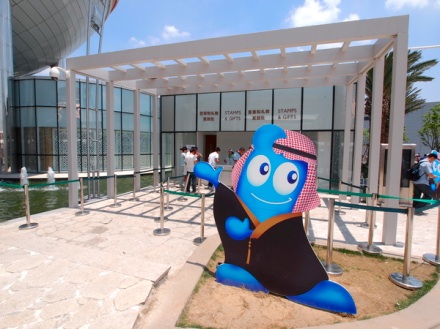
The Saudi pavilion at Shanghai’s World Expo has proven very popular, some people who want get in started faking disabilities in order to avoid waiting time that could reach up to nine hours. “While the opening weeks at Expo saw surprisingly low attendance, Saudi Arabia’s pavilion has emerged as among the most popular,” WSJ’s China Realtime Report blog said. One of the main attractions in the Saudi pavilion, nicknamed the “moon boat,” is its 1,600-square-meter movie screen. Considering that movie theaters are not allowed in the country, this is actually pretty ironic. But hey, that’s Saudi Arabia for you: full of contradictions and paradoxes your head will start uncontrollably spinning. You’re welcome.
Bonus: Suzanne Seldess visited Mada’in Saleh in April, and she came back with some really nice pictures. Check them out.
MOE news, colorful abayas
- The Ministry of Education has started investigating a school incident where a public high school teacher made his students play a theatrical scene representing detailed postmortem procedures like how to wash a dead person, cover him, and then laid him to rest. In other news, the ministry issued on Wednesday a circular to all schools in the Kingdom ordering that no music or dancing be allowed during upcoming graduation celebration, which must take place in the morning within the last three weeks of the academic year, and that no cameras should be allowed in schools. Last week I attended my brother graduation ceremony from intermediate school (that’s junior high for you American folks). The celebration took place at night, there was no dancing, and the music was “Islamic” aka nasheed. There were hundreds of cameras, including a video crew brought in by the school itself. Below is a video I took during the graduation:
- Out of the 198 members of FIFA, only 32 countries can play in the World Cup in football (that’s soccer for you American folks) every four years. Saudi Arabia did not make it to the tournament that will take place in South Africa and starts on Friday. This, of course, will not stop business owners of trying to make money on the occasion anyway they can, including selling World Cup themed abayas. Non-black abayas was one of the topics which appeared in that now infamous MTV video. Speaking of such nonconformist abayas, Khalaf al-Harbi wrote a hilarious article earlier this week on Okaz about the Blue Abaya Controversy.
MTV, beauty queen camels, flirting with books, and more…
- As part of their True Life series, MTV has broadcasted a one-hour documentary on Saudi youth last Monday. Even before it was aired, Resist the Power, Saudi Arabia has attracted big attention. Over the course of last week, I have received many emails asking me to watch it, and more emails later asking what I think of the episode. I have not watched it yet. I will probably watch it, but only after this silly hoopla dies off. Local media, as expected, jumped in with the usual mixture of conspiracy theories and anger caused by the documentary. Very typical. There are rumors that some people who appeared in the show could be prosecuted, but nothing is confirmed at this point. Many bloggers reacted, and most of what they said have been balanced and well worth a read: here, here, here, here, here, and here.
- Forget about MTV, and watch this short video by local artist Abdulaziz al-Muzaini which pokes fun at Riyadh rains:
- Remember the guy who was suing Aramco over the death of his beloved beauty queen camel? He has actually won case. Saudi Gazette reports that the General Court in Khobar has ordered the oil giant to pay 1 million riyals to the heartbroken owner. Aramco’s lawyer said they intend to appeal the verdict with the Court of Cassation.
- Based on her experience with a public library where she lives in Dubai, Badriya al-Bisher believes that opening more public libraries will encourage Saudi boys and girls to flirt with the books instead of flirting with each other. That’s an interesting theory which I would love to test in Riyadh. It will make for one hell of an experiment.
- The first patch of graduates from private medical colleges in Jeddah were previously told their can intern in university hospitals. Now they are told they can’t, and that if they want to intern then they have to pay SR60,000. Unbelievable. Shada Ahmadi, a student who is yet to start her internship, told me “it’s a big frustrating issue in our college.” UPDATE: Intern doctors graduating from government universities, who had their monthly reward cut in half by a decision from the Council of Higher Education five years ago, have launched an online petition asking the government to reconsider that decision.
Women’s Driving: Standstill
Abdulrahman al-Rashed confirms what I have been saying for the past few months: Saudi women will not start driving their cars in the Kingdom anytime soon. Al-Rashed heads al-Arabiya news channel and is usually described as pretty close to decision makers in the country.
In his column in Asharq al-Awsat last Wednesday, al-Rashed dismissed the idea of petitioning the government to allow women to drive, arguing that women’s driving simply does not enjoy enough public support. Without such public support, the government would never push for a change to the status quo. The government will not take it upon itself to do this because “governments all over the world tend to avoid adventures,” he says.
But today another columnist in the same newspaper expressed his disagreement with al-Rashed’s viewpoint. Mishari al-Thaidy argues that without any practical way to measure public opinion in the country, it is difficult to tell where the majority stands. “Where is this public opinion? How is it made? Where can you see it? Who represent it?” al-Thaidy asked.
Women’s driving, he says, is just like girls education, radio, television, satellite dishes, and combining the administrations of boys and girls together into one governing body. All of these changes were faced with fierce opposition by some elements in society. However, the government did not bow to this opposition. They stood their ground, and these changes were eventually accepted.
Where does that leave us when it comes to women’s driving?
Pretty much in the same place where we were five years ago.
Now some people like to say that women’s driving is not an important issue, and that there are far more important issues for women, and the country at large, to tackle at the moment. It is not a priority, they say. But I call BS on the “priorities” talk.
If you a are a woman who can’t go to work because you can’t drive and you can’t afford a driver then it is an important issue for you. It becomes your priority. I agree with those who think issues like male guardianship and fixing the judicial system to become more women-friendly are probably more important in the long term.
But here is why I think women’s driving matters: I believe that this issue has become a symbol for all other reform issues in the country, especially the ones related to women status. It has become like a psychological barrier. If we can overcome this, then we can cruise into our other challenges with more confidence and determination. I still believe that we need a brave, courageous political decision to make it happen. Without such courage, our society will keep running slowly in the same devoid vicious circle.
Bogus Trends
Trend stories are some of my least favourite kind of stories in the media. Even worse, many of these trend stories tend to be bogus. “The bogus trend story thrives thanks to the journalists who never let the facts get in the way when they think they’ve discovered some new social tendency,” says Slate’s Jack Shafer.
It is said that one is an exception, two is a coincidence, but three is a trend. However, when it comes to Saudi Arabia and its infamous religious police two is more than enough to make a trend, apparently. During the last week, international media went crazy over two little stories about attacks on the members of Commission for Promotion of Virtue and Prevention of Vice (CPVPV) aka Haia.
 Many reporters who worked on these stories from abroad called their sources in the Kingdom asking them the same question: Does this incident (and later these two incidents) indicate a shift in attitude by the public towards the religious police? Regardless of the answers they got, they somehow came out with pieces along the line that Saudi people have had it and are finally rising up against Haia.
Sorry to disappoint you guys, but I really do not think this is the case. The talk about a revolt against Haia is a gross exaggeration. What these stories suggest is not an anti-Commission revolution but rather a change in the press. Few years ago these kind of stories won’t make headlines; now they do. Local media cannot be blamed for hyping up Haia stories because, well, they sell. It is outside observers and self-appointed experts that should be blamed for falling for bogus trends.
Jeddah, Jeddah, Jeddah
- The King has received the board of directors of Jeddah Chamber of Commerce and Industry. The JCCI delegation included 3 women. National newspapers made sure to show that in the pictures. During the reception, Saleh Kamel, chairman of JCCI, promised the King to create jobs for new university graduates. Last week, an official from the minister of labor said there are 200,000 unemployed Saudi women; 78% of those women hold a college degree. The official described this as a “sad matter.”
- File this under good news for transparency and fighting corruption. Saudi Gazette says, “As the Control and Investigation Board (CIB) begins Saturday its investigations into the case files of over 70 persons facing charges related to the Jeddah flood disaster of November 2009, sources told Okaz that the accused would be put on trial publicly. Construction contractors found guilty may also be liable to pay blood money.”
 Saudi Jeans
You must be logged in to post a comment.