Mixup

For many outsiders, I think the current debate over gender mixing in Saudi Arabia can either be seen as a) a fascinating change to a very conservative society, or b) a sign for a society that is stuck in the 19th century. Nevertheless, I think it is a good thing that we are having this debate, for I have always said that as long as they are not killing each other, people should be allowed to talk.

What is more interesting this time around is that the debate is playing out amongst conservatives in contrast to the usual conservatives vs liberals bickering. Ahmad al-Ghamdi is not just a shiekh; he is a senior official at the Commission for Promotion of Virtue and Prevention of Vice, a bastion of orthodox conservatism in the country, and the institution which seems to believe it has a duty from God to enforce their moral code on society, including segregation of men and women.

To have one of its loyal sons attacking some of the basis on which they operate daily is nothing short of astonishing. Al-Ghamdi has been working in the Commission for the past fifteen years. He said he has had these opinions for almost ten years but he never had the courage to publish them. Why now? Obviously because the atmosphere has changed. The opening of KAUST and its aftermath made the needed room for this debate to expand enough that even a shiekh like al-Ghamdi can now publicly speak out without fear.

Most conservatives were outraged. Many of them denounced al-Ghamdi and his ideas. Even the grand mufti, who typically stays out of similar debates, weighed in heavily to criticize al-Ghamdi in his sermons, though without naming him. Last week a group of young religious men stood at the door of al-Ghamdi’s house demanding to mix with his wife and daughters. It was a pathetic attempt to embarrass him. They were later arrested, but the disturbing thing is that some people who disagree with him, including a professor of Islamic studies in Makkah, saw nothing wrong in what these young men did.

When confronted that his opinions contradict the field work of subordinates in Hia’a, Ahmad al-Ghamdi prefers to avoid details. Instead, he says the Commission needs to be reformed, and that they have been working in that direction. But is this true? Is Hai’a reforming? Or should I ask, can it be reformed?

Reform is the promise that came with the new chief of CPVPV shiekh Abdulaziz al-Humain, who has been absolutely silent on this whole al-Ghamdi controversy. Where does he stand in all of this? What does he think about this saga?

The rumors of sacking al-Ghamdi made this all more fascinating, but provided little concrete conclusions. Earlier this week, the state news agency distributed a statement from the Commission about four new appointments in Hai’a, including a replacement for al-Ghamdi. But few hours later, SPA withdrew the item and asked newspapers not to run it. A spokesman for Hai’a told al-Hayat daily the news about new appointments were inaccurate.

So what happened here exactly? We can think of few theories. It could be that the old guard in Hai’a wanted to get back at al-Ghamdi for what he said about them, and did this without al-Humain’s knowledge. When al-Humain knew about this he cancelled it. Another theory is that it was al-Humain’s decision to get rid of al-Ghamdi who has become too hot to handle, but then someone high above reversed the decision. You can never underestimate the powers to be in Saudi Arabia, especially that al-Ghamdi is riding the new liberal wave in the country that Prince Saud al-Faisal talked about.

We probably will never know the truth. But what we know for sure is that Ahmad al-Ghamdi and his opinions are here to stay. At least for the time being. A picture is worth a thousand words, it is often said.

Another question: is this debate really changing how the general public feel about gender mixing? I would say: No. Socio-religious beliefs are very difficult to change. Even more difficult in a conformist society like ours. I think that people who are pro-mixing would feel validated as someone from the other side jumped the ship, while anti-mixing people would simply dismiss it as an individual case that can’t shake their long held convictions.

For examples, look at hospitals which have always been some of the few places in the country where men and women work side by side. I currently train at a hospital pharmacy in Hofuf. The pharmacy has separate windows to serve male and female patients, but from the inside pharmacists and technicians of both sexes work together without segregation. To reduce dispensing errors, a new policy has been recently implemented where some female pharmacists work on the male window while some male pharmacists work on the female window.

I asked a female colleague, let’s call her Zainab, what is it like to work on the male window. “Work is work,” she said, “it’s the same for me here or there.” A male colleague who was in earshot, let’s call him Basheer, turned to me and asked, “would you let your wife work in a place like this?” I was shocked by the question, but I calmly replied that I certainly would. I said it is a respectful and professional work environment, so what’s the problem? I glanced quickly at Zainab who was standing next to me, then asked him: do you find anything dishonorable or disgraceful about working here?

Basheer said that some guys are jealous and can’t let their wives mix freely with men. “I’m that kind of guy,” he added. I was struck by the hypocrisy of what he said. He finds it acceptable for him to be here and work with other women, but apparently the same rules don’t apply to his wife. This kind of hypocrisy, however, is nothing new. It is a typical symptom of the double standards many Saudis practice in their lives everyday.

It will take time for the general public’s perception of gender mixing to change, and nobody knows how long it will take. Probably a very long time. As with everything else in Saudi Arabia, I’m not holding my breath.

Haia Joins the Modern Age

When did the Commission for Promotion of Virtue and Prevention of Vice (Haia) launch their “Precrime Unit,” a la Stephen Spielberg’s Minority Report? I must have missed the announcement in the middle of this deafening debate over gender mixing.

In a decision that was justified by claiming it was doing the women a favor, the Haia’s branch in Al-Mujaradah has banned women from jogging and other physical exercise in certain areas of this Asir town, south of the country. The decision was based, according to an anonymous Haia source, on records from the commission that described one particular street in the town where women were banned as lonely, poorly lighted, and frequented by drug addicts and other anti-social people. However, this was disputed by one jogger, R.S Al-Shahri, who claimed that the street was safe and well-lit, while almost 30 women would walk there between sunset and Isha prayers.

You can say that this decision by Haia is part preemptive strike, part blaming the victim. Instead of watching these so-called unsafe areas and protect the women by arresting people who attempt to harass them, they go and prevent women from exercising there. Now of course this kind of behavior is not at all new or surprising on the part of Haia, but it happens that we are finally at a time when the Commission can get questioned over some of their actions. What used to be taboo in the past i.e. criticizing the CPVPV, is now a daily practice in the local media.

One of the latest examples comes from al-Madina daily, written by none other than a granddaughter of the Kingdom’s founder. Princess Basma bint Saud, who blogs here, wrote a scathing column calling the Haia to get their act together, telling them that fighting corruption starts from within, and that they should spend their time investigating the theft of public money instead of chasing women and men in barbaric fashion that was not ordered by God or his messenger. Interesting by her royal highness, so very interesting.

Royal Mixing

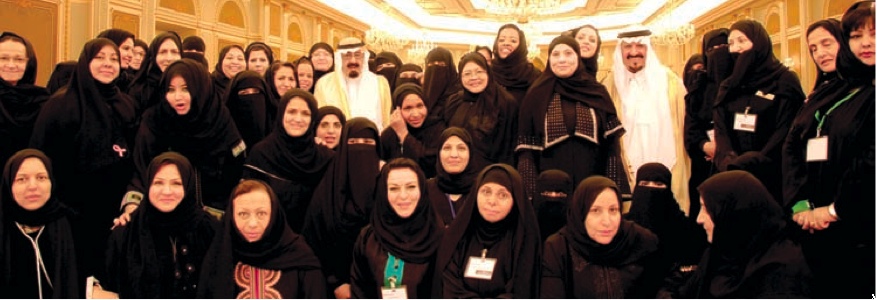
King and Royal Prince with women

Amidst the current debate and controversy over gender mixing that is taking place in the country, this picture made it to the front pages of some local newspapers today. The picture shows King Abdullah and Crown Prince Sultan surrounded by female participants at the National Dialogue in the southern city of Najran. Although the photo was taken on April 11, it was only published today which may indicate the green light to publish it was only obtained recently. Al-Watan daily published what they called the story of the picture, along with the full names of the women who appear in it.

CPVPV in KSU, Discrimination at KAUST, Limits on Lashing

  • During a meeting between KSU female students and the spokesman of the Commission for Promotion of Virtue and Prevention of Vice, an attendant asked the all important question: “When are we going to see female hai’a inside KSU?” It’s not like KSU is already dominated by hai’a sympathizers or anything. Let’s remember, the aforementioned meeting was conducted through the closed tv circuit of the university. The CPVPV spokesman was in one place, the students were in a different place, far far away from him. They could see him, he could not see them.
  • Nathan has a disturbing blogpost about discrimination at KAUST. “[T]he injustice and prejudice against foreign workers runs deep here,” he says. I agree. Saad Al Dossari has a good follow up.
  • I somehow missed this quote by Mufleh al-Qahtani, head of NSHR, who said there is a need to set minimum and maximum limits for lashing sentences. Obviously he is taking the typical Saudi approach of trying not to offend anyone. How about going 300 steps further and stop lashing once and for all, except for those very few cases explicitly specified in Quran?

Ahmad al-Ghamdi sacked (or maybe not), Quarter to Nine news cast

  • Ahmad Qassim al-Ghamdi, the head of CPVPV in Makkah was sacked. No, he wasn’t. Yes, he was. No, he wasn’t. Well, apparently nobody knows for sure. The grand mufti came out with a strong statement few days criticizing al-Ghamdi, practically telling him to keep his mouth shut. Confusion is still dominating this matter. Will update you as things clear up. UPDATE: a spokesman for CPVPV sent a message to al-Hayat daily saying the news are inaccurate.
  • Arab News reports on Sah, a local internet channel that has gained some more attention lately. I have been following their satirical news show “Quarter to Nine,” and I have to say that I find it pretty nice. I think they could do a better job finding bizarre stuff in Saudi newspapers to make fun of, but for now they are doing okay. It’s a good example of what good content the new generation of Saudis can create using new media tools.

Women’s driving, woman ambassador, a pretty happy girl

  • Elaph quotes unnamed sources saying Saudi women will start driving their cars within two months. Watany mobile news service also quoted unnamed sources saying a meeting took place last week between a senior decision-maker and the Grand Mufti indicates that women’s driving is imminent. Also last week, al-Riyadh daily published a feature discussing how to implement women’s driving, which marks a transition from the typical “is it time for women to start driving or not?” Last month, Prince Saud al-Faisal, the minister of foreign affairs, told NYT columnist Maureen Dowd to bring her driving license next time she visits the country. However, Dowd told me in an email that she knows he was being sly and that driving is not going to be forthcoming.
  • Abdullah Aboul-Samh praises the Republic of Georgia for appointing a woman ambassador to Saudi Arabia. “It is a clear evidence on our civic advancement,” he adds. I’m sorry dude, but Georgia appointing a woman ambassador says nothing about us. Please wake me up when Saudi Arabia appoints a woman ambassador in Georgia.
  • Sabria S. Jawhar: “Like all Saudi women I appreciate the efforts by American and European human rights organizations to protect us from bad Saudi men and to help grant us the freedom we deserve. Without the help of Americans and Europeans my life would have no future. Okay, I’m lying. If Western do-gooders minded their own business I’d be a pretty happy girl.”

Watch this

Okay, so here are three videos that have been making the rounds on the local interwebs lately:

This is a commercial for the Saudi teleco giant Mobily. As with most of their ads, it is of high production quality. But that’s not what make it interesting. What makes it interesting is the fact that it stars Prince Abdullah bin Meteb, the grandson of King Abdullah. This is the first time a prince appears in a commercial, and some people think such thing signifies a change in the way members of the Saudi royal family conduct themselves. I don’t know. I mean, can’t this be just a sports sponsorship deal? Prince Abdullah is a professional rider who could use a sponsor for such an expensive career, and Mobily is a for-profit company who wants to improve their image and make more money. I, for one, did not raise an eyebrow when I saw the tv ad.

In this video, a man who allegedly belongs to the Commission for Promotion of Virtue and Prevention of Vice, is seen ambushing a jalsa which is basically a small gathering where people entertain themselves with music and dancing. The bearded man snatches the oud from the singer’s lap with a swift move, and then smashed it to the ground in a scene more commonly associated with rock concerts. So much for calling to the way of thy Lord with wisdom and beautiful preaching, and argue with them in ways that are best and most gracious.

The Cube is a popular British game show. For some reason, the Saudi state TV thought it was a good idea to bring it to their screen. The Saudi version is the same as the British one, except that our version has a nutty host who keeps on screaming. This video was put together by fellow blogger Raed al-Saeed, who previously produced Schism and Why Gaza children don’t deserve to be killed. I wonder if what he did is legal under the new e-media law proposed by MOCI :P