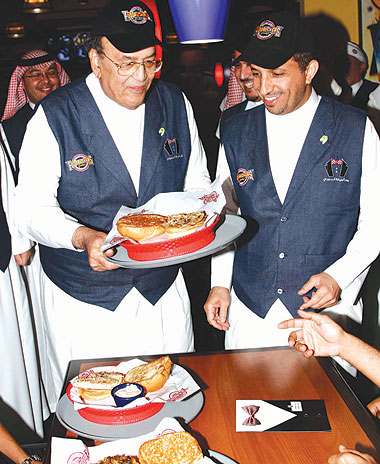
Ghazi al-Gosaibi, the Saudi Minister of Labor, is seen here wearing a waiter uniform and serving food at Fuddruckers in Jeddah. The minister criticized those who look down on some jobs saying they do not understand the spirit of Quran.
Ghazi al-Gosaibi, the Saudi Minister of Labor, is seen here wearing a waiter uniform and serving food at Fuddruckers in Jeddah. The minister criticized those who look down on some jobs saying they do not understand the spirit of Quran.
 Human Rights Watch has urged courts in Jeddah to dismiss a case against Rai’f Badawi, founder of Saudi Liberals forums. On May 5, the prosecutor charged Badawi with “setting up an electronic site that insults Islam,” and referred the case to court, asking for a five-year prison sentence and a 3 million riyal fine.
Badawi no longer owns or controls the website. After unknown hackers, who probably think they were doing some sort of electronic jihad, attacked the website several times and threatened him and his family, he sold the website and fled the country two weeks ago. A new owner announced a while ago that he took over the website, which has been offline for more than a week now.
It is understood that Badawi will be tried according to the E-Crimes Act that has been issued in March 2007. The act, which can be found here (Arabic PDF), contains some laws that seem to target free speech such as Article 6 which incriminates “producing content which violates general order, religious values, public morals or sanctity of private life, or preparing it, or sending it, or storing it via the network or a computer.”
The questions is: who defines and specifies what are those religious values and what are those public morals? I don’t know if this act has been approved by the Shoura Council or not, because I think it is unacceptable for the Council to approve such act that contains these vague laws and articles which contradicts international conventions and accords on which Saudi Arabia is a signatory.
 On a related note, Amnesty International are appealing for Muhammad Ali Abu Raziza, a psychology professor at the University of Um al-Qura, who has been sentenced to 150 lashes and eight months’ imprisonment for meeting a woman in a coffee shop. There has been a lot of controversy surrounding this case and the reports on it in the local press has been full of contradictions. Therefor, I can’t make up my mind on who is at fault here.
However, I think the Commission should seriously reconsider how to define and deal with this whole “khulwa” thing. When a man and a woman meet in a public place like a cafe, a restaurant, or in the street where they are surrounded by people and others can see them, does it constitute a khulwa? I doubt that they will ever think this through but I guess it’s worth asking anyway.
Five days before Fouad al-Farhan was detained, he posted a list of ten least favourite Saudis that he does not wish to meet. At the end of that post, he wrote: “Coming soon: top ten Saudis that I love and wish to meet.” As a tribute to Fouad, I decided to give it a shot.
I thought it would be a piece of cake; and oh boy I was wrong! I was unpleasantly surprised that I could easily come up with 3, 4 or 5 lists like Fouad’s, but I could not find 10 Saudis that I really would like to meet. It did not help that I’ve already met some people who would otherwise have been on my list.
After borrowing the brains of few friends and several attempts to write and rewrite this list, I present you with my list of the ten Saudi personalities that I would like to meet in person:
1. King Abdullah bin Abdulaziz
Although I’m pretty sure that his majesty’s schedule for the coming four years is totally full, I would really like if I get a chance to meet him, and if I ever get this chance, it would be one of the rare occasions where I’m looking forward to meet someone in order to talk to him more than listening.
2. Abdul-Rahman Al Lahim
A fellow blogger once called the human rights lawyer an “angel,” and I think that her description is not far from truth. Despite all the hardships that he has had to go through, including jail and travel ban not to mention being severely attacked by some ignorant idiots, he stood firm to defend the defenseless.
3. Khalid Al Dakhil
I’ve been a fan for the sociopolitics professor for a long time. When he was having a chat with Washington Post readers I was lucky to get to ask him a question, and I even have had a chance to talk with him on the phone last year, but I’m still waiting for the right time to have the pleasure of meeting him in person.
4. Sheikh Hasan Al Saffar
After spending some time as a dissent in exile in the 80’s, he returned home in the early 90’s and emerged as one of the most prominent Shia leaders in the country. Today, he represents one of the few voices here calling publicly for tolerance, moderation and a greater role for civil society.
5. Ghazi Al Gosaibi
You can say whatever you want about his performance in his different ministerial positions, but my admiration of Al Gosaibi has more to do with his writings as a novelist and a poet than his work for the government.
6. Maram Meccawy
Our newspapers are filled with aging editors and writers, the kind of people Fouad used to call “dinosaurs.” This is not the case with this young columnist and, I’m glad to say, fellow blogger who represents a breath of fresh air and gives the rest of us hope that the future of this nation may not be completely dark after all.
7. Buthaina Al Nassr
After being the first Saudi female news anchor to welcome viewers on Al Ekhbariya, she left the deteriorating channel and now works with Al Hurra. We spoke on the phone a couple of times and because she know that I’m constantly consuming junk food in Riyadh she was nice enough to invite me to try her cooking; something I’m looking forward to as she is also known for being a good cook :-)
8. Samia Al Amoudi
A brave, courageous woman who fought breast cancer and then made it her mission to raise awareness about this disease that kills hundreds of women in a society where talking about such issue is usually surrounded with shame.
9. Ebtihal Mubarak
The Arab News reporter has been described by CNN as “fearless” and her work on many stories during the past few years is simply groundbreaking. Ebtihal comes from a conservative background but that did not stop her from becoming one of the leading female journalists in Saudi Arabia.
10. Abdullah Al Hamed, Matruk Al Faleh and Ali Al Dumaini
The three reformists who were jailed for demanding a constitutional monarchy and later pardoned by King Abdullah soon after he ascended the throne are some of the most courageous political activists in the country. Al Hamed, and his brother Eisa, are now jailed in the aftermath of the women’s demonstrations in Qassim last summer, while Al Faleh and Al Domaini continue their efforts to promote human rights in the country.
Honorable Mentions: Turky Al Hamad, Badria Al Bisher, Wajiha Al Huwaider, Dima Al Azem, Othman Al Omair, Sami Al Jaber and Hatoon Al Fassi.
How about you people? Who’s on your list?
 Abdul-Rahman al-Lahem, the brave Saudi lawyer and human rights activist, has received the International Human Rights Lawyer Award from the American Bar Association (ABA). He said this award “values the work of a large group of activists in Saudi society who are defending human rights.”
Al-Lahem’s name has become associated with a series of high-profile cases in the country where he volunteered to defend people against the government and the official religious establishment. He has been a vocal critic to the judicial system and this has gained him many enemies among the conservatives.
He certainly deserves to be awarded, but here comes the sad part: he will not be able to receive the award in person during a conference held in Vienna in July unless a four-year-old travel ban imposed on him by the authorities here is lifted.
I think the ban has been imposed on him following his defense for the the three so-called “constitutional reformists” back in 2004. At the time, he was jailed for defending their right in a fair trial. He later was pardoned along with the reformists and a fifth activist shortly after King Abdullah ascended the throne.
This was the first thing I saw when I entered my college building this morning:

Few hours later, someone decided to give them a piece of his mind:

P.S. I’m not in the mood to translate but if you can read this and want to volunteer to translate, please do in the comments.
UPDATE: I guess someone didn’t like what the first someone did:

 Abdul-Rahman al-Barrak is a cleric who can be described as “extreme” but that I guess would be a nice way to put it. Earlier this week he released a fatwa against two columnists in Al Riyadh newspaper saying they should be tried for apostasy for their “heretical articles” and put to death if they don’t repent. Abullah bin Bejad and Yousef Abal-Khail, the two writers, are understandably terrified. Bin Bejad asked the government to protect him, and Abal-Khail said if this was allowed to pass, “it will be chaos.”
This incident is disturbing and sickening, but it is nothing new for extremists in this country to try to intimidate and terrorize those who have different views of religion, society or any other matter in life. They have done it in the past with intellectuals like Turky Al Hamad and others, and luckily no one got killed, at least till now.
However, what is more worrying to me is the fact that the likes of Abdul-Rahman al-Barrak and Nasser al-Omar are still able to get away with fatawa like this one. Al-Barrak in his most recent fatwa said the government should hold the newspapers and publishers to account, when in fact he is the one whom the government should hold to account for his calls to hate and violence.
Moreover, I believe that the official religious establishment, as the highest religious authority in the country, should take a clear position on this issue, and if they are not willing to do that because, as I may expect, some of them might agree with the fatwa, those who belong to the establishment and disagree with the fatwa should denounce and reject it.
I can imagine that neither the government nor the official religious establishment would speak out on this issue, but if they fail to address this properly then they should stop whining about extremism and how terrorists are simply a “misguided group.” It is this kind of dangerous messages that feed extremism and donate fuel to terrorists to continue their lethal destructive acts. Keeping silent and later blaming “external influences” for what happens here will be a hard sell, and hey, I got some news for you, we are not stupid. No more.
After my past experiences at Riyadh International Book Fair, and considering that I have recently visited Beirut and Cairo, you can expect that I’m not so enthusiastic about our annual cultural bonanza this year.
The truth is, organizing this event for the first time in 2006 was a bold move by the Ministry of Information (MOI) and was groundbreaking on some levels: temporary amnesty on banned books, interesting speakers and heated debates about pressing issues at the other activities accompanying the fair.
Unfortunately, it did not last long. MOI have been obviously intimidated by the aggressive reaction of the conservatives and decided to opt for the path of least resistance: to avoid provoking the anger of conservatives (who are easily provoked by many, many things, btw) they chose to organize an ordinary book fair with conformist speakers discussing noncontroversial topics. Actually, I have read that some people this year were cruising the fair collecting books they don’t like in trolleys!
I am disappointed to see MOI intimidated this way because I thought they were up to something really good. But my lack of enthusiasm should not stop you from paying a visit to the big show. I think it is still a good chance for Saudis to get exposed to this wide spectrum of ideas offered by thousands of books at one place.
Although I wasn’t planning to buy any books, I ended up with a few good ones. As usual, Lebanese publishing houses have many interesting titles to offer, and you may also want to stop at the booth of the National Society for Human Rights and grab a copy of their excellent first report on the state of human rights in the Kingdom.
The Riyadh International Book Fair is open until Friday, March 14, at the Riyadh International Exhibition Center in Morouj Dist. up north the city. Parking spaces of the Center are reserved for VIP’s so I recommend you use the HyperPanda/Azizia Mall parking lot next to the Center. Consult this schedule to before going: the fair is open at different times for professionals and general audience men and families, and believe me you don’t to go at the wrong time.
 Saudi Jeans
You must be logged in to post a comment.