- When the Saudi cabinet was reshuffled on Valentine’s Day last year, I said let’s not be overoptimistic. I thought the new ministers will need time before we can evaluate how they performed. About one year later, the minister of education asked today for three more years in order to “turn our ideas and visions for education development into reality.” I would happily give him these three years and then some more if he can really fix the education system, because if he could that would be the best thing to happen to Saudi Arabia since sliced bread.
- Asharq al-Awsat has a short piece about the bisht, the cloak men wear over the white thobe in Saudi Arabia. Particularly, the Hassawi bisht that is made here in my hometown of Ahsa. It used to take about ten day to sew one of these by hand, but new technology allows you know to make 10 of them in one day. However, some people still prefer the handmade ones. Oh yeah, and the prices can go from $260 to $7000.
- The ministery of health is studying a proposal to allow women to work in community pharmacies and optics shops. Currently, female pharmacists and optics technicians are only allowed to practice their jobs inside hospitals. The proposal was made by Jeddach Chamber of Commerce, who said they will keep pushing this proposal over the next three years. Aysha Natto, member of the Chamber, denied that this proposal is challenging the social norms in any way. Natto says the men who deal with women inside hospitals are the same men who will deal with them in community pharmacies. “It doesn’t make sense to continue viewing men in our society as wolves that look for women in every place,” she added.
Category Education
Why KASP is Flawed?
King Abdullah Scholarships Program (KASP) is an impressive undertaking. More than 70,000 Saudi students have been sent to many different countries around the world to continue their education. The program is fully paid for by the government, and it is said to be designed in a way to cover the demands of the job market in the country. Although it has been deemed mostly successful, the program has some issues. These issues, however, are usually dismissed by officials at the Ministry of Higher Education (MOHE) as minor.
For example, 1073 students on KASP have been recently sent home for reasons related to their behavior, religious observance, or academic performance. And there is a fourth reason related to the nation that I don’t quite understand. The ministry says this is such a small number compared to the overall number of students who study abroad, but I think the fact that they had to return more than a thousand students indicates a problem with the selection process.
A friend of mine was recently traveling to the US. On the plane, he met with 15 Saudi students going on scholarships. Only one out of the fifteen could actually read English, and was able to fill out the customs form.
I think some of the problems with KASP have to do with the philosophy behind the program which I believe is flawed. Limiting the program to a small set of technical and medical majors just to supply to the demand of the job market is not the right strategy to develop a modern state. Yes, our country needs engineers and doctors. But we also need artists, philosophers, linguists, sociologists, and graphic designers.
Unfortunately, MOHE is highly allergic to criticism. When a student wrote a blog post about the Saudi Cultural Commission in Canada last year, he had to take it down few hours later. Mohammed al-Khazem, who wrote a book about higher education in the country, says MOHE is seeking attention at the expense of doing what is really important. That is, to help the 20 universities in the Kingdom to become better institutions.
There are high hopes that KASP will transform Saudi Arabia. The students who studied abroad are expected not only to come back with degrees, but also with a change in mindset that will push the country to the next level economically, socially, and culturally. But there is also fear that these high hopes might turn out to be false. We sent thousands of students in the ‘70s and ‘80s to study abroad and when they came back they did not change much. Is it going to be any different this time?
Today’s Links
- Saudi novelist Abdo Khal has won the International Prize for Arab Fiction, aka the Arabic Booker, for his novel ‘Tarmi Besharar’ or ‘Spewing Sparks as Big as Castles.’ The novel was withdrawn from Riyadh Book Fair yesterday by the censorship committee, but half an hour later was returned to the publisher. An official from MOCI said the book was withdrawn “for inspection.”
- King Abdulaziz University (KAU) students launched an online campaign against a number of university’s regulations, including a ban on electronic equipment that have cameras and wearing pants or on abayas on the women’s part of the campus. Way to go. I wonder what the kids at KSU think about this…
Today’s Links
- CITC has blocked islamlight.net, the website which hosted the infamous fatwa by Shaikh Abdul-Rahman al-Barrak. Although the fatwa can be considered hate speech and a call to violence, I’m generally against such censorship. CITC should stop this practice of making decisions on our behalf on what we should, or rather should not, read on the web.
- Corinne Martin is an artist who lives in Saudi Arabia and makes these awesome paintings based on vintage pop culture icons.
- Music concerts are rare in this country. Music concerts in universities are super rare. But hey, what do you know? Jeddah Legends, the band of which Qusay is the lead singer, have recently performed a concert in KAUST. Why oh why KSU never hosted any concerts?
Norah and Adela
Norah al-Faiz says she has been misquoted. She does not say she was misquoted on what exactly: her Najdi niqab, introducing sports to girls schools, that she can’t appear on TV without permission, or the news that she started her talk with the reporters by saying “ya mama…” Alas, she said she will no longer speak to the press directly and will conduct all her interviews from now on via fax or email. I hope the new approach of the deputy minister would stop her from uttering nonsense like that she is more influential than Barack Obama. Al-Faiz has retracted her statements about introducing sports to girls schools, saying she is not against it and that “an integrated plan is being worked out to introduce PE in girls schools.” This actually could be true, not necessarily because al-Faiz said so but because someone who is far more influential than her is pushing for it.
Princess Adela bint Abdullah, the King’s daughter, told al-Riyadh daily yesterday that “it’s high time to look into the matter of introducing sports at girls schools seriously, following the teachings of Islam.” Princess Adela does not work in the government, but she is married to the minister of education. A friend of mine who met the princess says she is offering a new image for the women of the royal family. She is highly-motivated and very determined, and she is playing an increasingly assertive role in public life here. Since she is standing behind this, I think that female students might start enjoying their sports classes when the new school year begins this fall.
Roots
Something is bothering me about Norah al-Faiz, the deputy minister of education. Sure, as the first Saudi woman to be appointed in such a senior position, she has come under a lot of attention, and maybe a lot of scrutiny. But I’m not talking about her performance as an official; I believe it is still early to evaluate her work, probably in the same way she thinks it is too early to talk about introducing sports to girls schools (it’s not, btw).
What is bothering me is this: Why does she keep referring to her Najdi roots every time someone asks about her allegedly “leaked” picture and the niqab? I believe she has every right to be proud of her roots, but I don’t think this is the right context to highlight them and associate the niqab with them. She serves in the ministry of education, she should be a role model. What kind of message does her statements send to teachers and students? Why can’t she just say that it’s a personal choice and that she expects others to respect it?
Now I could easily find her picture and put it in this post, but I’m respecting her wish in that she does not want her picture to be published. Is it too much to ask her to respect the rest of us who put their nation’s interests above their regional affiliation?
Al-Faiz in the TIME 100
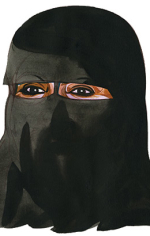 In their annual TIME 100 issue, Time magazine named Norah al-Faiz, the new Saudi deputy minister of education, as one of the 100 most influential people in the world. I have nothing against al-Faiz, but I think that the magazine is overestimating her influence. The woman has been in office for less than 3 months. Her most talked about decision was a directive she sent to schools warning the students of the perils of reality TV shows. I’m not trying to pick on her, but I think it is way too early to try to assess her performance or influence.
Now the selection of al-Faiz by Time might be questionable, but how the Saudi media handled the news is just laughable. They reacted orgasmically, saying she came ahead of Obama and his wife! Does it really take a genius to realize that the list published on the website is not ordered according to influence? Probably not, but it is exactly this kind of idiocy that makes me despise Saudi media.
Again, I want to repeat that I have nothing against al-Faiz, but I believe that a critical analysis for the performance of her department could be much more useful than celebrating a fake victory.
 Saudi Jeans

You must be logged in to post a comment.