One month ago, when I wrote Tunisia is free, I hoped for a domino effect to sweep the Middle East. I didn’t really expect that to happen, but that was my hope anyway. And oh boy, how little did I know. What followed Tunisia was Egypt. If what happened in Tunisia was huge, then what happened in Egypt was is enormous by all standards. I don’t think anybody even imagined any of this few months ago. This country is the most populous Arab country, the cultural heart of the Arab world. And it was the youth of Egypt who did it. We are in for some interesting times in the Middle East, and I can’t wait to live them. Before I leave you with this brief video that I shot of Egyptians and Arabs celebrating in Queens, allow me to say that I’m extremely proud of my Egyptian friends: Alaa, Manal, Mona, Wael, Sandmonkey, Noha, Shahi, Eman, Ahmad, Wael, Gamal, and all the heroes of this revolution. You have given the world a great example for peaceful protest and nonviolent resistance, and you have been inspiration for all of us.
Category Blogging
Egypt uprising, Wahabi numbers, Khashoggi, women in municipal elections, and other stuff
- The uprising continues in Egypt, where protesters in Tahrir Square remain defiant. Sandmonkey, one of the demonstrators, has two good blogposts that you should read. Many people have been asking me if what happened in Egypt could happen in Saudi Arabia. The short answer is no. Saudi Arabia, and the other five GCC countries, are politically and economically more stable. That doesn’t mean things are not happening in the magic Kingdom. With more than 3.5m people on Facebook, and a rise of Twitter usage by more than 400%, young Saudis are becoming more engaged than ever in the effort to reform.
- Blogger Saeed al-Wahabi has this really interesting post about the generational divide in Saudi Arabia between the leadership and the population. Al-Wahabi did some simple math to calculate the average age for officials in different parts of the government, and these are some of his findings: the average age of ministers is 65; the average age of governors is 61; and the average age of Shoura Council members is 61. Similar numbers are found when we try to see the ages in the Supreme Judicial Council, the Supreme Ulema Council, and even members of King Abdul-Aziz Center of National Dialogue. Now compare the aforementioned numbers with these two numbers: 70% of the population is under 30, and average age of Saudi citizens is 19 years old.
- Arab News reports that a group of Saudi women has launched a Facebook campaign calling the government to allow women to participate in the upcoming municipal elections. Arab News, being the dead tree paper that they are, failed to link the group. Here is a link. This is not the first time we hear of such calls. Problem is, the elections that were originally scheduled for 2009, have been indefinitely postponed. The paper says the elections will be held this year. I see no signs of that happening.
- Jamal Khashoggi, the former editor of Al Watan daily, is working with Prince Al Waleed bin Talal, the Saudi billionaire and country’s richest man, to launch a news channel. No word on when the new channel will start, but from what I heard they are still in the very early stages of planning and they have not hired anyone yet. Contrary to rumors that surfaced earlier, there won’t be a partnership with Fox News. That makes sense. A source close to Khashoggi told me that they are seeking to partner with Bloomberg, but no deal has been signed yet.
- New Scientists: “Almost two thousand potential archaeological sites in Saudi Arabia have been discovered from an office chair in Perth, Australia, thanks to high-resolution satellite images from Google Earth.” I wonder what Sultan bin Salman and his friends at SCTA have to say about this.
Having your first name as your handle on Twitter, like I do, is cool. But it comes with a cost: you get a lot of random replies that are not necessarily directed to you.
Egypt: Domino Effect in Action?
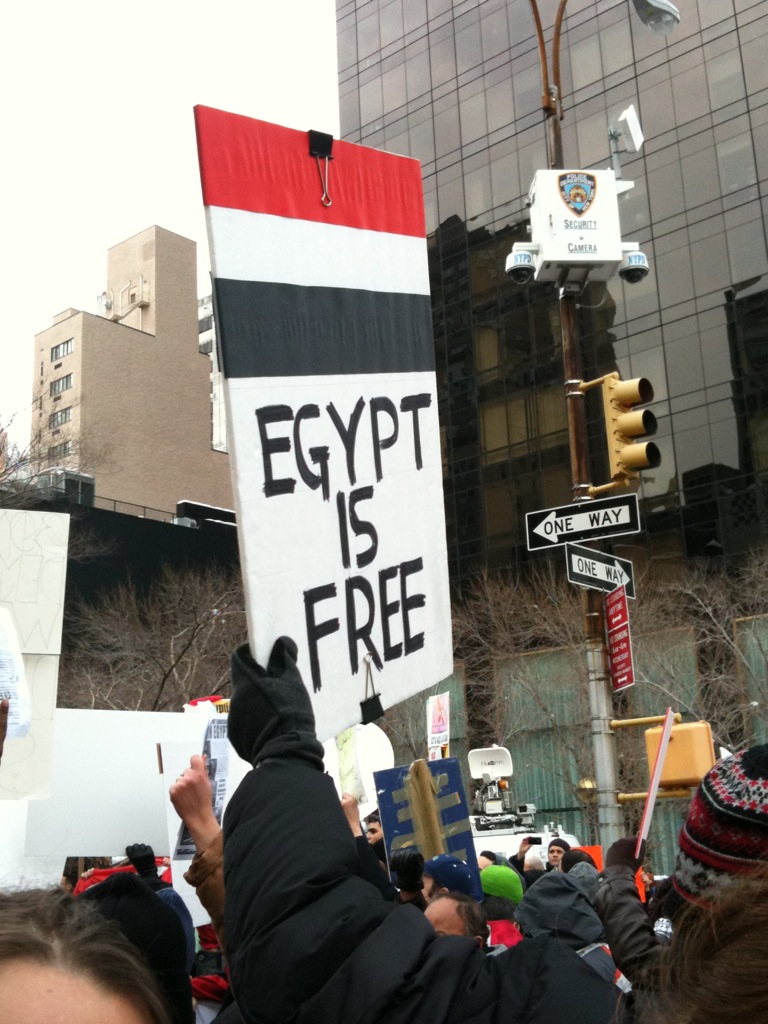
I have been glued to the TV (and the laptop, the iPad and the iPhone) over the past few days, closely watching the events unfolding in Egypt. Thrilled to see Egyptians uprise against Mubarak, and concerned over the safety of my friends in the streets of Cairo. The regime has been trying to cut off the country from the rest of the world by shutting down the internet and mobile telecommunication. Obama statement was very disappointing, but I guess that doesn’t matter now. What matters is that the Egyptian people are standing up for their rights, and I hope that they won’t stop until they get them. Al Jazeera English is providing a great coverage, and CNN International is also doing a decent job, but I pay most of my attention to what people are saying on Twitter. This is the domino effect in realtime. Below are some pictures that I took during a demonstration held near the UN here in New York earlier today:


Jeddah is Sinking
The heavy rains on Jeddah has paralyzed the city, once again. Obviously, none of last year’s lesson has been learned. The situation is beyond disastrous, with many losses in souls and property. Watch these videos and pray for the safety of people in Jeddah.
More videos and photos can be found here and here. Follow the latest news on Twitter: #JeddahRain
Tunisia is Free
Today was a huge, huge day for Tunisia. After four weeks of street protests, president Zine el-Abidine Ben Ali fled the country. This is probably the first time we witness an Arab leader toppled by his own people. Very happy for the Tunisian people, and very proud of them. I’m especially thrilled for my friends Sami bin Gharbia and Slim Amamou, who worked tirelessly for years to see this day. The only thing that annoyed me was that Saudi Arabia welcomed the ousted dictator to find refuge in our homeland. But for now, let’s just live this historical moment. Here’s to a domino effect all over the Middle East.
PS. This is my favorite video of the day. I don’t know what’s more amazing: the man screaming “Tunisia is free” in the middle of the street, or the woman crying while shooting the video with her phone.
The Arab World Demographic Dilemma: Young, Unemployed, and Searching for a Voice
Arab youth confront daunting challenges, including a lack of economic opportunities, constraints on their freedom of expression, and the complex and shifting nature of their own Arab identity. How the Arab world meets these challenges will have significant ramifications for the Middle East and the world. This special panel discussion marks the release of America Abroad’s three-part public radio series on youth in the Arab World.
Moderator Deborah Amos, foreign correspondent of NPR News who has covered the Middle East extensively, started by saying that as a reporter in the region you notice the young population, but most of the people she interviews are usually over 30. “If you overlook this generation, you miss something essential about the Middle East,” she said.
Marc Lynch, aka Abu Aardvark, Director of the Institute for Middle East Studies, George Washington University, believes that one thing is clear: sheer magnitude of the crisis facing youth in the Middle East. Lynch said many in the West focus on a small group of activists and bloggers, but miss the silent struggle of tens of millions of people. Those people are and their issues are also ignored by their own governments, who seem to think that as long as they can keep these young people off the street then they are doing a good job. Lynch said the recent events in Tunisia and Algeria is particularly interesting because it could have a domino effect all over the Arab World. But when it comes to political ramifications of these events, he wonders if it is going to lead to a substantial change in policy, or just to more repression and bloodshed. This kind of spontaneous uprising and dissent has no place to go because there are not political or social movements involved in it. Lynch said the greatest single thread that combines what is happening in the Arab World right now is the failure of the system to deal with systematic problems, as well as the failure of outside intervention plans. “The tools we have might not be appropriate, and the dynamics are don’t look familiar,” he said. “It’s exciting and troubling.”
Christine Capacci-Carneal, is the Education Development Officer of USAID, and she works primarily with USAID-funded programs in Egypt, Jordan, Lebanon, Morocco, West Bank/Gaza and Yemen. Based on her experience in youth development programs, Capacci-Carneal said that youth are a sophisticated group with many subgroups, and that’s why a problem-based approach is less effective than a comprehensive approach. “Problem free is not fully prepared,” she said. As an example for working with that approach, Capacci-Carneal talked about Youth:Work Jordan, which tries to engages youth directly, but also tries to solve systematic issues by targeting youth in poor districts and working with local organizations. She commended the efforts of the program, but admitted that one of the problems they faced is that they have had a hard time building political will and institutional capacity to sustain that effort. Other challenges facing such programs include how to address building a stronger youth voice and a stronger sense of identity then let local organizations join in that effort. Also, how do ensure that your using the available funding efficiently? Capacci-Carneal said USAID is working to develop better research tools to know what works best.
Lina Khatib, who runs the Good Governance and Political Reform in the Arab World at the Center on Democracy, Development, and the Rule of Law in Stanford University, wanted to focus on youth and freedom of expression in the Arab World. She said that social media has opened up further space for views on many topics that were considered once taboo such as politics, sex, and religion. “No doubt interactive media pushed the boundaries for what’s permissible,” she said, and that young people are no longer willing to accept the status quo as the norm. Khatib has also given the recent example of Tunisia, where Mohamed Bouazizi set himself on fire in what she described as “a desperate plea for the issues of arab youth.” But she added what gives her hope is that young people have not given up and continues their struggle, and thanks to the fact that we live in a world of globalized media, and no authoritarian regime in the Middle East can fully stop the circulating of information. “Youth need a strategy to reach goals,” she concluded, “not just enough to say what they want, but also a way to find what to do.”
Diane Singerman, the associate professor at the American University School of Public Affairs, decided to focus on a slightly different angle on the issues facing Arab youth today. This issues, she said, was extremely ignored: the question of marriage. In the Arab World, adulthood equals being married. However, it is very expensive to get married, and because of the high unemployment rate it is difficult for young people to work and save for marriage. This leads to what she called “wait-hood,” the stage between childhood and adulthood that can only be reached by getting married. Signerman cited the example of Egypt, which has the latest age of marriage anywhere in the world outside china. According to studies, 50 percent of men in Egypt are unmarried, and when they do get married they get married later and later. That’s why youth unemployment should be seen in the lens of getting married, Singerman said. Young men are political excluded because of repression, economically hurting because of unemployment, and because they can’t make money to get married they become socially excluded.
Apologies for posting much later than expected due to some technical difficulties.
48+ hours in Riyadh, crazy fathers, Khalid Alnowaiser, Saudi Starbucks
- Reuters does Riyadh. If you want to read more about what to do and where to go in the Saudi capital, please refer to the Riyadh favorites category on this blog.
- gulfnews: “A Saudi groom cancelled his wedding ceremony at the last minute after the bride’s father insisted on getting half of his daughter’s salary as long as he lived and on writing a clause to the effect in the marriage contract.”
- I’m not sure how I missed this when it was published in December, Saudi lawyer Khalid Alnowaiser has a really, really good piece in Arab News. He know what he is doing. He begins, “I realize I am taking up a very sensitive subject. I also understand that I would be stereotyped as liberal or secular, but I don’t care as long as this article provokes readers to consider thoughtfully the future of our country.” Do read the whole thing.
- One of my fav expat blogs is this photo journal by Laylah, a Scandinavian nurse working in Riyadh.
- Starbucks has a new logo. Fellow blogger Roba Assi has a funny infographic comparing the evolution of the Starbucks logo in Saudi Arabia vs the rest of the world.
 Saudi Jeans
You must be logged in to post a comment.