( Thx Sami T)
( Thx Sami T)
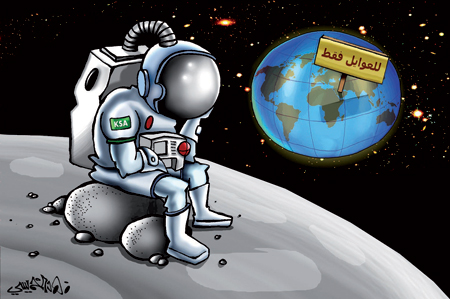
Before KAUST, segregation was the norm and mixing was haraam. Then KAUST happened, and suddenly mixing turns out to be okay. Al-Shethri opened his mouth. He was sacked. The others got the message.
The new Minister of Justice explained in detail how segregation is a foreign concept and mixing is actually cool. Sheikh Ahmed al-Ghamdi, head of haya’a in Makkah, gave a lengthy interview to Okaz where he basically said that there is nothing wrong with mixing and those who oppose it are opposing Sharia. Meanwhile, his organization continue to terrorize people in other parts of the country.
Clown Mohammed al-Nujaimi before KAUST was inaugurated stressed the importance of segregation in education, something he described as one of the fundamentals on which the Saudi state was built. Few weeks later, after al-Shethri was sacked, he took a full U-turn.
Problem is, apologists like Jamal Khashoggi now have to make up lies to make this sounds normal. Mixing at KAUST is very restricted, he says, that a Venezuelan student can’t have his Mexican female friend over at his place.
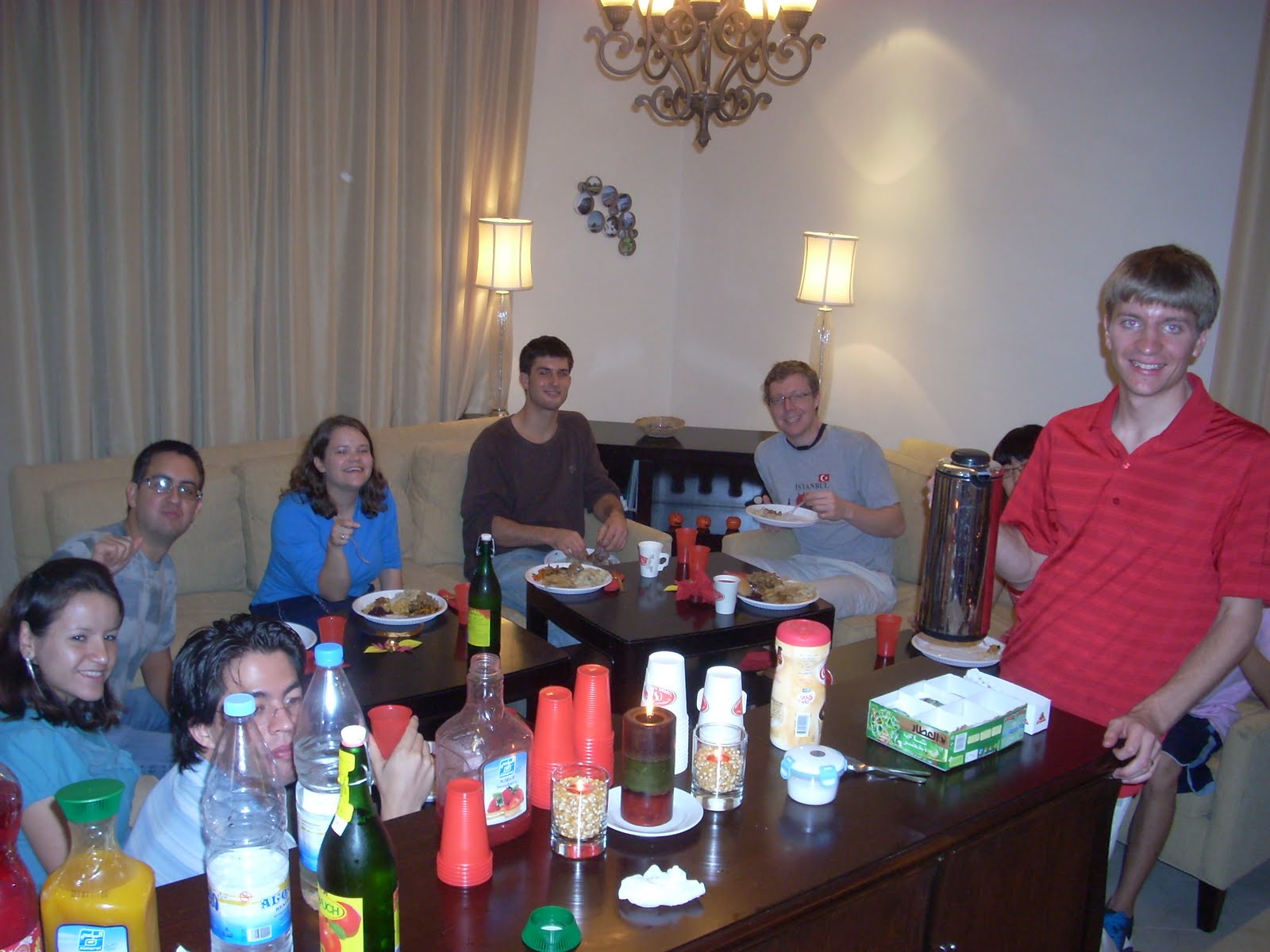
Is that true, Nathan? I know you threw a nice Thanksgiving party earlier this year, and from the pics I can see you had some girls over. I hope you didn’t get any trouble after that party.
So confusion prevails. In the past we were told mixing is sinful. Now we are told it is alright. Those who don’t want to appear contradicted talk about good mixing and bad mixing. Are we supposed to believe the “mixers,” the “segregationists,” or the “hypocrites”? Such a dilemma…
Three weeks have passed since the Jeddah catastrophe. People now are eagerly waiting for the verdict of the investigation commission. While we are waiting, it might be useful to look back and reflect.
The heavy downpour has exposed some nasty things such as the nonexistent infrastructure and the abundant corruption. But like what happens with many other things in life, sometimes we need to see the ugliness before we see the beauty. There are at least two good things I saw coming out of this disaster: the great spirit of the people, and the power of social media.
In the days and nights following Black Wednesday, we have seen more than 7,000 persons who volunteered to help in any and every way they can. I’m proud of Ibrahim al-Kushi who opened his house to shelter the displaced. I’m proud of Bassem Kurdi who decided to stay at the hospital when everybody else told him to go home. I’m proud of so many young men and women who, despite the harassment of some self-appointed guards of morality, rolled up their sleeves and spent countless hours at al-Harthi Exhibition Center to organize, distribute, and deliver the donations to those who need them in the most damaged areas of the city.
The relief efforts have been largely coordinated using the internet and social media tools. One Facebook group in particular was central to these efforts as it acted like an umbrella and a gathering point for volunteers. The group is called Rescue Jeddah, and it boasts more than 9,000 members. The content there is all in Arabic but you don’t need to read anything to see what they have been up to. Just look at the pictures and the videos and you will get a good idea on what they have done so far.
Beside Facebook, people were using blogs, Twitter, and SMS to circulate the latest news. They were also using Flickr and YouTube to document what was happening in real time. Some of the pictures, like the one of the dead little girl covered with mud, were really disturbing. But I think that in crises you need shocking images to make others understand the gravity of the disaster.
As for videos, estimates say more than 400 videos have been uploaded over the past three weeks. Most of these were taken by citizens using their mobile phones, but I have also seen some well-produced videos like this one by Mohammed al-Rehaili. In the end, I will leave you with this short film by Bader al-Homoud, who captures the tragedy but instead decides to focus on the bright human side of the story:
Read more:
While the sky keeps raining dogs on Jeddah, we finally have an official reaction to the disaster. On Monday, King Abdullah ordered the setting up of a high-level committee that will study the extent of the damage due to the calamity. It will also study the causes of the crisis and recommend ways to make ensure that it does not happen again.
The royal decree was particularly interesting because it featured a strong language that is rather unusual for government communications. Many officials in Jeddah, including Makkah Governor Prince Khaled al-Faisal, stressed in their statements that this was a natural disaster and there was not much they could have done about it. However, the royal decree made it clear that the devastation has more to do with the performance of the government than the amount of the rains.
“It is painful that many countries, some with even less potential than the Kingdom, experience similar rainfall almost every day, but there are no devastation of the magnitude we witnessed in Jeddah,” said the decree. “We cannot ignore the fact that there were mistakes and failures on the part of some departments and it is our duty to identify those responsible and take action against them.”
By Saudi standards, this is not normal. Some people even think the whole point of the royal decree and the investigation is to defuse the public anger over the catastrophe. But the firm language of the decree makes me believe that it is going to be different this time.
I certainly hope that this committee will hit hard on the widespread corruption that led to this disaster. Money alone is not enough to compensate the families of those who lost their lives. We must make sure that those responsible for the tragedy are taken to task because this is the only way to make sure that it won’t happen again.
At least 44 people were killed in Jeddah after a heavy downpour. The rains caused a major infrastructure failure and the results were disastrous. My heart goes out to all Jeddawis.
This would not have happened if the people of Jeddah had a say in how their city is run. This would not have happened if there was transparency and accountability in how our country is governed.
I’m beyond angry and disgusted.
UPDATE 27/11/09 2:40: The death toll reaches 83. Keep in mind this is the official number announced by the Civil Defense. The actual number might be higher. More rains are expected on Jeddah tomorrow.
In my previous post I mentioned Dr. Fawzia al-Bakr as one of the people who told their stories to Robert Lacey in his new book. Al-Bakr is one of the 47 women who defied the ban on women’s driving and drove their cars in the middle of Riyadh’s busiest streets in a rare demonstration to demand their rights. That was in 1990. How things have changed since then? I will leave it to al-Bakr to tell you. This strong article was published in the conservative Al-Jazirah daily two weeks ago and slipped seemingly unnoticed when everyone was busy with the attack on Al-Watan website.
Can you put yourself in a woman’s shoes for one day?
By Dr. Fawzia Al-BakrI was standing in front of the cashier as I was returning some of the garments, which I tried yesterday evening at home, but none did fit me properly. I had to go home and return to the shop just to use the fitting room. I suddenly realised how many things there are we are so used to do that we forgot how they are done in the first place. Our life has been stolen from us by forcing us into small details, without us even being aware.
Fitting rooms have disappeared from shops; there are only very small windows to allow us to talk to tailors. Limited television broadcasting of lectures at universities, rude male guards with specific characteristics and age requirements at the entrance of every official institution for women to regulate going in and coming out; the only exception being cars of the institution that pick up young women according to the type of cloak and the amount of skin showing at the moment that a woman happens to come out of her work, university or shops. Explicit signs in hair salons, video shops and every place of entertainment or thinking, which ban women from entering. Restaurant that resemble inquisition courts checking if women are chaperoned by unmarriageable men.
It is a world of fear, anxiety and doubt where woman born here or happened to come here, live. They have put all of us a cloth of the original sin and begun chasing us and held the entire society accountable to the extent that we lost the ability to distinguish between what is right and just and what is part of the unjust and unfair traditions, which the militias of the Awakening movement (or better said, “dormancy”) have institutionalised in our life, our schools, our universities, our markets and our hospitals to the extent that it looks as if this is how our life should be while it should no. Even going to mosques is subject to specific traditions and clothes.
Even our relation to the Grand Mosque Alharam has been modified according to their point of view; so they have restricted us to limited areas. Also, the oblivious women in our mosques, schools, workplaces and wedding halls have begun implementing men’s policies which are based on one thing: women are different creatures: intellectually inferior and incapable of controlling and protecting themselves from their owner, the man. We can use less cruel expressions and avoid using words with connotations to slavery, which human civilisations have since long rejected and which have not been used in Saudi Arabia since the Sixties when the Kingdom officially abolished slavery.
However, the men of the Awakening movement have managed, with an exceptional social ingenuity, to replace these expressions with complexly regulated and institutionalised forms of enslavement. The visible shackles might have disappeared, but the official enslavement and restrictions still exist, so do the documents women need to go anywhere in this ugly world of trivialities.
I wish any man could experience these restrictions just for a while so that he can understand what it means to be enslaved by another man who dominates him and controls his destiny, his study, his work, his children, his subsistence and his documents as he wishes. Women’s destiny is dependent on the man’s goodness and generosity; if he is good and decent, she is they are protected; but if he is morally sick or of unsound mind, then they have no consolation.
Today we are waking up and we have to wake up because there is no room for the dichotomy between owner and owned, the capable and the powerless, and master and slave. Saudi Arabia has ratified the CEDAW Convention which rejects all forms of discrimination against women, and King Abdullah bin Abdul Aziz, Custodian of the Two Holy mosques,has yesterday announced the start of an official campaign to raise awareness of human rights and implement this philosophy in different institutions such as schools, universities, the workplace and amusement places. So, here we are, and we want the men and society who are looking for the truth to know that women are more entitled to these rights which Islam has granted them a long time ago; until the Awakening militias came and deeply eroded this society and distorted our lives and roles, and locked us into a vicious cycle.
Every woman and every honorable man, who believes in human and religious rights of women, should become aware of these small details affecting every aspect of women’s lives and treat them as an inferior species. So, they are continuously confronted with male chauvinism despite claims of newspapers that Saudi women have achieved great progress.
However, putting oneself in a woman’s shoes for even one day to experience the males’ injustice at work (be it educational, financial or commercial institutions) will reveal just how flagrant these small details are and how women are treated as an inferior species. This male’s injustice is not necessarily an intentional act, but is the result of a year-long conditioning of a sick mentality of how men and women see each other and what they expect from each other in terms of roles and capabilities.
These expectations have distorted the way they see each other: they caused men to see women according to certain stereotypes based on women being mentally deficient and incapable of controlling themselves, and caused women to see men as a superior rational being, capable of taking the right decisions because women are seen as emotionally incapable. This distorted way men and women conceive each has prevented women from recognizing their real potential as human being; the result is that they believe they are inadequate. On its turn, this belief has created these twisted female psyches, which are incapable of functioning normally and without preconceived judgments.
Everyone who is concerned with the sanity of this country should investigate these trivialities that treat women as an inferior species and govern women’s institutions. This in order to dismantle them and see the extent to which they affect women’s chances of education and jobs at all levels, and start thinking about the psychological and mental damage caused to women by this dark and gloomy life that prevented them and men from seeing the truth about life and themselves as a complete and competent human beings, capable, all human beings, of good and evil, knowledge and ignorance and right and wrong.
The damage caused by this inferior view of women and the way this view has been turned into and accepted behavior by social institutions, does not only affect women but the entire society. This society is now paying the toll for enslaving women, who, on their turn, produce masters and slaves in the magic factory that is the family and distribute the roles between boys and girls, thinking they are doing the right thing, but they are unaware of the danger of the reproducing factories where they are contributing to their enslavement.
It is time for women to raise their voices and break free from this big prison by adhering to this good leadership which is ahead of its time and which tresses the right of all people to live as equal citizens having full competence, regardless of gender.
Special thanks to the good people at Meedan for translating the article.
“The most important thing you need to know about Saudi Arabia is this: it is full of bizarre contradictions and stark contrasts, it basically lives on paradox.” This is something that I frequently tell to foreigners who come to our country and find it difficult to understand.
It is this paradox that brought Robert Lacey to Riyadh for the first time in 1979. Two years later, he published The Kingdom, a 631-page book that tried to examine how a society which insists on tradition was trying to embrace modernity. In 1982, the book was banned by the Saudi government who had many objections on its content, which resulted, as you may expect, in high sales in region. I was born a couple of years later.
 In late 2006, I met Robert in the fancy lobby of Faisaliyah Hotel. Twenty-five years after his first visit, he told me, he has come back to write a sequel. Inside The Kingdom: Kings, Cleric, Modernists, Terrorists, and the Struggle for Saudi Arabia was released last month in the US and the UK. The book is not yet available here, and at the end of his preface Lacey wondered if this one will banned too. Bahrain has already banned the book, a usual case of GCC counties being more Saudi than Saudis themselves.
“In theory Saudi Arabia should not exist,” Lacey writes at the beginning of his new book. Let’s face it, there is so much to be criticized about this country. But the writer was obviously careful not to fall in the trap of easy criticism. It is a place based on extremes, and it is hard to keep a balanced view when you look at it. That being Saudi, I think Lacey has done a good job by choosing to be more journalistic than analytical, and the alternating between history and personal anecdotes makes for a vivid, strong story and an enjoyable read.
The book looks back at the past 30 years of Saudi life, starting with the Juhayman uprising, going through the first Gulf War and 9/11, and ending with King Abdullah’s effort to reform the country. What I especially liked about this book is how Lacey elegantly incorporated many voices of Saudis that you don’t typically hear from: regular men and women who often made history, whether they were aware that was what they have been doing or not. People like Fawzia al-Bakr, Mansour al-Nogaidan, Tawfiq al-Saif, and others. These people have interesting stories to tell, and their stories tell the history of this country.
For anyone curious about Saudi Arabia, I highly recommend this book. It probably won’t be enough to give you a full understanding of the Kingdom, because I believe nothing and nobody can give you that, but it certainly offers an honest attempt at making sense of what the country has gone through shaping it into what it is today. What about the future? Only God knows.
 Saudi Jeans
You must be logged in to post a comment.