Saudi Unflagger and Blocking Twitter

Public demonstrations are banned in Saudi Arabia. We don’t have codified laws, so you will not find any official text that explicitly says it, but everybody knows it. What do we do when we want to protest publicly? We go to the internet and start a campaign online. Back in 2006 I wrote, ”Online campaigning is appealing to many people because most of the time it doesn’t take much resources.” Most of the time it takes little more than starting a freely hosted blog, design a few banners, maybe add a mailing list, and viola! you have a campaign.

This year alone, we have seen a plethora of campaigns that goes from the useful to the useless, and everything in between. We had the Khalooha… series, which covered topics like greed of car dealerships, women’s rights, and marriage expenses among other things. Most recently we had two confusing, similar but apparently opposing campaigns on the issue of male guardianship. But what I want to talk about today is a campaign called SaudiFlager (sic).

SaudiFlager’s goal is to clean up YouTube of videos offending to Saudi Arabia by flagging them. In addition to the unfortunate misspelled name, I believe this campaign has two main problems. First, what is an offending video? What are the criteria for such thing? I mean, what is offending to you can be quite harmless to me, right? So who gets to decide which videos are offending? Second, YouTube is already heavily censored by CITC. Do we need another layer of censorship?
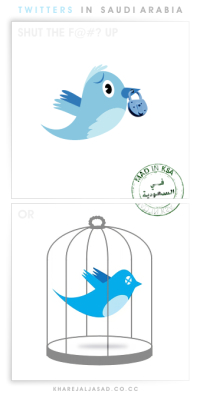
twitter_cageI’m all for free speech, so don’t get me wrong. If you feel strongly offended by a video on the website, go ahead and flag it. Knock yourself out, I’m not going to stop you. Actually, I can’t stop you. But I think that organizing a campaign for such purpose is a just a waste of time and effort. What is worse, it is enforcing yet another form of censorship and that is the last thing we need. CITC is already doing a great job at it that I find myself occasionally amazed by how dedicated they are to this job.

This dedication is shown clearly in their latest blocking spree, which included Twitter profiles like those of @Mashi97 and @abualkhair. Blocking @Mashi97 was particularly strange because it came after he tweeted about having fried eggs for breakfast, which made him think that maybe someone at CITC does not like eggs. Also, what CITC don’t seem to realize is that blocking profile pages on Twitter does not prevent the users from updating. Go figure.

Which brings me back to online campaigns: should we start one to unblock these guys? I think we should, but currently I’m busy with another campaign of mine: Saudi Unflagger. Who is in?

Killjoy

Add this to their list of achievements: interrupting a nasheed concert for kids in Dahran Mall. Just look at how the policeman stole the mike from the performer’s hand. Impressive.

UPDATE: For those who asked about context, here is a story from yesterday’s al-Watan. The Commission spokesman said they interrupted the concert because the families area was very crowded. The concert was later continued. Does that change how you feel about the incident?

Petty Victories

Sabq talks about an email that has been circulating over the past few days. I have been trying to get a copy of this email with no luck so far. The email allegedly contains a list of what some conservatives consider achievements they have gained in the last six months. According to Sabq, the list includes:

  • Canceling movie screenings in Jazan, Taif, EP, and Abha.
  • Canceling the summer music concerts in Abha.
  • Canceling scholarships for talented female highs school students.
  • Canceling Onaiza cultural festival.
  • Canceling events for liberal thinkers Turki al-Hamad and Abdullah al-Ghathami.

There is no question that the conservatives have been enjoying a powerful push lately, and they are trying to take full advantage of this period by flexing their muscles as much as they can and in every direction. But seriously guys, this is pathetic. What’s next? Celebrating that you managed to cut the afro of three young men in Tahlia?

Untouchable

This YouTube video has been making the rounds online lately. The video allegedly shows a group of SABB employees dancing to a song in what looks like a party held by the bank. The short clip has caused an uproar on some blogs and forums, between those decrying the deterioration of morals and those who deemed it insensitive to thousands of people who lost their money in the stock market crash.

Reasonable people may ask: so the bank was having a party, what’s the big deal? Frankly, it is not a big deal, except for one problem that my friend Abdul-Majeed eloquently put here: a party like this shows that we have two different sets of rules in this country, one for the poor and commoners, and one for the rich and powerful. “It is only the poor and commoners who get watched, monitored and prosecuted by the Hay’a, while the others have their own places that the Hay’a don’t dare to even get near them,” he said.

Let me be clear, I have nothing against such parties. I am not social by any stretch of the imagination, but I enjoy a good party, and as we can see in the video apparently the guys were having loads of fun. Good for them, but the question is: why they can shake their bums freely in a fancy hotel like it’s 1999, but those who want to enjoy a concert of acoustic rock get raided by the Hay’a?

It is this kind of hypocrisy and double standards that I can’t stand.

Craving Driving

Craving is one of the common symptoms of pregnancy. Usually, women during pregnancy tend to crave certain foods not normally considered a favourite. Those cravings are not completely understood, but many doctors think they are related to hormonal changes. However, they are not limited to foods, and in our local culture pregnancy cravings are taken very seriously due to the belief that if a craving is not satisfied the baby will be born with a skin mark that resembles the craving.

Now, why am I talking about this? Well, this is why…

A policeman was patrolling the ring road in Hofuf, east of Saudi Arabia, when he noticed a car that was being driven in a strange manner. He asked the driver to pull over. To his surprise, the driver was a woman, and her husband was in the passenger seat. The husband tried to convince the policeman that he had to let his wife drive because she is pregnant and has been craving driving the car for days. The husband said he knows it is illegal for women to drive, but he allowed her to do so because she was craving it so badly and he was afraid his baby would be harmed. The policeman handed a ticket to the husband and warned him not to repeat the offense.

Moral of the story? Pregnant or not, Saudi women should not crave driving because they will simply be asking for a ticket. Unless, of course, they have a big fat wasta, but that’s another story…

Nothing Changed

In November 1979, Juhayman al-Otaibi and his fellow zealots occupied the Grand Mosque in Makkah. After a bloody siege that lasted for two weeks, they were eventually captured and shortly beheaded. Following this event, Saudi Arabia experienced a scary rise of conservatism and the social liberalization that had begun in the 60’s and 70’s was halted or even rolled back. Women were no longer allowed on national TV, and restrictions on their employment and participation in public life became so harsh.

It is July 2009, more than 900 suspects were charged with participating in terrorist attacks in the country over the past few years. In landmark trials, more than 330 people in 179 cases had been tried and one given the death sentence. While these trials are still in progress, several restrictions to a freer access to culture and entertainment have been put in place, including a ban on cinema and cancellation of the Jeddah Film Festival.

What a difference 30 years make?

Aramco the Builders

When King Abdullah University of Science and Technology (KAUST) was announced about two years ago, one of the interesting aspects about the project was the way it was planned to be developed and built. From the beginning it was clear that KAUST will be independent and not under the umbrella of the Ministry of Higher Education, and instead of relaying on a real estate or a construction company to build the university, the project was handled by Saudi Aramco, the national oil company.

Choosing an oil company to build a world class university seemed strange to many people, but to me it made some sense. The King’s bold vision meant things must be done differently. There are only two construction companies in the country that can handle a huge project like KAUST: Saudi Oger and Saudi Binladen Group (SBG). Both companies are already developing major megaprojects, and both companies have been linked to corruption allegations related to government contracts before.

To turn the King’s vision into a reality in the short time span that was announced, he needed people who are efficient and trustworthy. Many of those people can be found in Saudi Aramco, the largest oil company in the world. Now that the KAUST development model has been a success, I guess the King wants to use the same model to pull off another megaproject that has been delayed for years.

I previously wrote about King Abdullah Stadium. The Ministry of Finance repeatedly refused to allocate a budget for the project because proposals made by the General Presidency of Youth Welfare seemed so exaggerated and so… fishy. Rumors have been flying during the past few weeks that Aramco will build the new stadium, but honestly I found that hard to believe. I know that they have done an impressive job with building KAUST, which should be ready to receive students this fall, but I thought that was an exception. Well, I was wrong.

Aramco distributed a statement last week saying the Ministry of Petroleum and Minerals have entrusted them to build the new King Abdullah Sports City in Jeddah. According to the statement, the project will include a big stadium, an 18-hole golf course, a hospital and a sports academy.

Is it right to hire an oil company to build a university and a sports city? It is probably not the most conventional approach, but from a pragmatic point of view it is effective and working. This way of thinking says that if this is what it takes to get the job done, then we will go for it. I really don’t mind such approach, but I think it should not make us overlook the problems and circumstances that got us here. Also, this makes me remember some questions and concerns that I have about Aramco, but that’s another post for another day.