Saudi Women Driving: Shifting Gears

The campaign for women driving has slowed down almost to a halt since the big push last June, but the issue is now making a comeback as activists seek a different route. On Saturday, two women filed lawsuits against the government for refusing to issue them driver’s licenses and banning them from driving a car.

If you have been following this story, you will probably remember one of these two woman: Manal al-Sharif was detained last year for her leading role in the driving campaign. Her lawyer is prominent human rights lawyer Abdulrahman al-Lahem who told al-Hayat daily that the court, aka the Board of Grievances, has accepted to look into the case.

The lawsuits represent an interesting shift in strategy by women rights activists who in the past preferred to petition the government rather than to confront it.

It is still way too early to predict how this case would play out in the court or how the government will choose to react, but it is definitely worth watching. Also worth watching is to see if other women decide to follow the same steps and file more suits against the interior ministry over the driving ban. More on this story in the upcoming few days…

Riding the Wave

For some reason, the government here finds itself compelled to get involved in organizing cultural events even when they suck at it. Why? Maybe because they don’t allow non-governmental organizations that usually play such roles in other countries. Or maybe because they want to keep the matters of arts and culture under control. Anyway, they keep organizing these events and it is very rare that anything good comes out of them.

Recently, the Ministry of Culture and Information (MOCI) organized in Riyadh what they called the second intellectual forum. The word ‘intellectual’ here is a vague term used to describe a diverse group of people who work in the fields of arts and culture: writers, novelists, columnists, artists, journalists, etc.

This forum that took place in the Marriott hotel included discussion panels and meetings with senior government officials. It was also a chance for these so-called intellectuals, many of them have known each other for years, to meet and talk. Like most of these events, the forum almost passed unnoticed. That is, until al-Watan daily columnist Saleh al-Shehi tweeted this:

Translation: What happened in the Marriott lobby on the margins of the intellectuals forum is a shame and a disgrace.. I believe that the so-called cultural enlightenment program in Saudi Arabia is centered on women

That tweet generated some angry responses by other people who attended the forum. Author Abdo Khal, winner of the International Prize for Arabic Fiction aka the Arabic Man Booker, tweeted: “Your allegation has crossed the line. Either you prove it or face trial for libel. You should apologize before things get there.”

Abdul Aziz Khoja, the minister of information and culture, and whose this event is happening under his auspices, also took to Twitter to make his feelings clear:

Translation: For criticism to cross its goals and ethics and reaches the stage of libel and slandering, that is what’s shame. And I will say no more.

Al-Shehi was unapologetic. He insisted that as a good Muslim there was no way he could remain silent about what happened at the Marriott lobby. He also said that he plans to sue Khoja. This kind of talk struck a chord with the conservatives, who took his tweet and ran with it because it reaffirms their view of the so-called liberal intellectuals as a group of immoral men and women.

During a talk show on Rotana TV, Khal pressed al-Shehi to say what did he see exactly that he deemed too scandalous. The latter kept refusing to answer, but at the end of the show he agreed to provide one example: some women there did not cover their hair.

The horror. Seriously? All this fuss over a few strands of hair? People thought al-Shehi saw some orgy going on or something. I mean look at these photos: some really hardcore stuff, no?
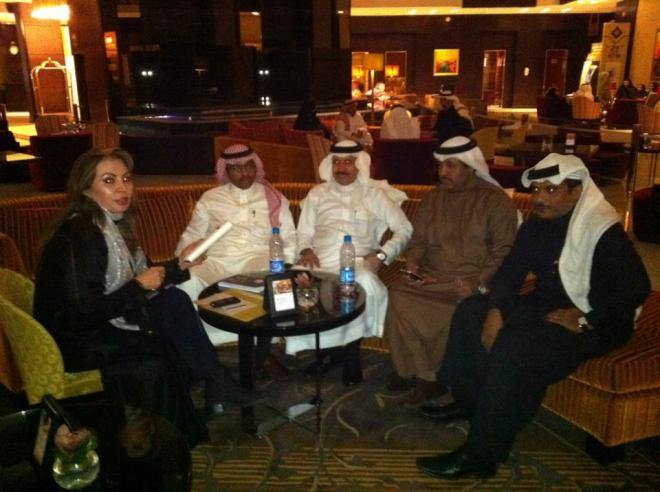
Some people think the government must be thrilled to see the elite of society bickering over trivialities like this instead of demanding political reform. For a government that paid billions in money handouts and made some merely symbolic concessions to prevent the Arab Spring from reaching their shores, a controversy like this one is certainly a welcome distraction.

The past few months have seen a wave of conservatism that al-Shehi and his supporters seem more than happy to ride. Hardliners are on the rise, and that shows in the heavy-handed manner in which authorities are dealing with recent calls for reform.

Earlier this week, the interior ministry ordered the arrest of 23 citizens wanted in connection to last October’s unrest in the city of Awwamiya in Qatif in the eastern part of the country. The ministry held a press conference to make the announcement and released a list of names and photos in a way that eerily similar to how the government dealt with Al Qaeda cells few years ago.

Few days later, the organizers of an event for arts and culture in Riyadh were ordered to cancel all the musical segments in their program, and two days ago long-time activist Mohammed Saeed Tayeb was stopped at the airport when he tried to board a plane to Cairo to attend his daughter’s wedding there.

In July 2010, Saleh al-Shehi wrote about meeting Abdo Khal in a Parisian cafe, where “girls of all nationalities and ages were flying around us like butterflies in the Spring season.” Why is he now all worked up about some Saudi women not covering their hair? Halal in Paris, haram in Riyadh?

Saleh al-Shehi kept repeating the word “shame” to describe what he saw at the now-infamous lobby, but failed to provide any specific examples except for the uncovered hair of some women. If some free strands of hair offend his sensibilities that much, then he probably should not be there in the first place. However, there are many other things in the country that he, and all of us, really, should be ashamed of like injustice, corruption and discrimination.

For shame, Saleh. For shame.
Are We Fine? Two Saudi Men Detained over YouTube Video

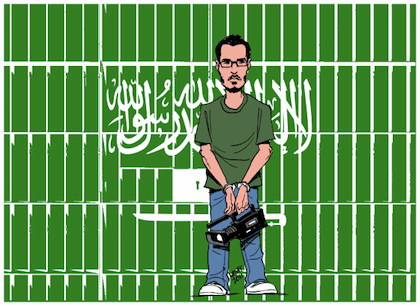
Two Saudi men were detained Sunday in relation to a YouTube video they produced about poverty in Riyadh, colleagues said. Feras Bughnah and Hosam al-Deraiwish were called by the police for questioning Sunday afternoon, and they are still in authorities custody in the police station in Sahafa district in northern Riyadh.

“We asked the guard at the police station if Feras and Hosam were inside the cell and he said yes,” said Asem al-Ghamdi, a reporter for the local news site Sabq who tried to visit the two men in prison yesterday. “The guard agreed to give them food that I brought for them, but he did not let us talk to them.”

Al-Ghamdi said he spoke with an officer at the police station who told him the issue is “simple” and that Feras and Hosam would be released Tuesday morning. However, as of Tuesday evening, the two men remain in detention.

Coincidentally, Monday, October 17, is when the world celebrates the International Day for the Eradication of Poverty.

While the detention appears related to the video, it is still unclear what was the exact reason for the detention, said one source who is following the case but asked not to be named for fear of retribution from authorities.

“One theory is that they have been detained because their YouTube video was shown on a TV channel owned by the opposition abroad,” he said. “Another theory is that authorities did not like the strong tone of the video and wanted to make an example out of these guys.”

Saudis online took to Twitter to comment on the issue and express their support to the two detained men. Using the hashtag #Mal3ob3lena (which is the name of the YouTube show), users posted more than 17,000 tweets in less than 24 hours since Monday.

“Those who say the truth are detained, while those who steal billions are free,” tweeted Sara Nasser.

Yasser Almisfer said he could never imagine that these two men would be detained because he knows them and he knows how much they care about the country.

“The idea of interrogating the creators of Mal3ob3lena is nauseating,” he tweeted.

UPDATE 10/20/2011 15:50 ET: It’s Thursday, close to 11pm Saudi time and no word on the release of #mal3ob3lena team yet. I spoke to another person familiar with the matter who told me he expects that Feras and his friends will be released in the coming few days.

“Police are waiting for the release order from the governate,” he said. Knowledgeable on the legal process in the country, this person described the detention as “strange,” adding that probably the reason for delaying their release is to send a message to bloggers and activists that there is a line that they should not cross.

“Come on!” he said, “where are we now? Why are these old ways making a comeback? Why are they trying to strangle the future of this country?”

UPDATE 11/1/2011 2:30 Istanbul: After two weeks in detention, Feras and his crew have been released.

MOCI Failwhale

The Ministry of Culture and Information (MOCI) is at it again. There is a new directive signed by Ahmad al-Hout, (get this) the acting assistant undersecretary for domestic media affairs, that bans journalists from pretty much doing anything without getting permission from the ministry first.

Al-Hayat daily reports that, based on the new directive, Saudi journalists cannot accept invitations or attend events or training organized by foreign parties working in the Kingdom or abroad. The directive also says that journalists must not do any interviews with these parties or invite their members without coordinating with the ministry and getting their approval first.

I have never heard of Mr. al-Hout before, but a quick search on Google reveals that he probably should not be in this position. He did not go to regular schools: he attended the Scientific Institute, a religious school, starting from seventh grade to the end of high school, and then went to study Sharia at Imam Mohammed bin Saud Islamic University in Riyadh.

His dream, he said, was to become a football referee. But somehow he started his career at the censorship office of Riyadh airport and then made his way up at the ministry to reach the office where he is today. He recently gave an interview on a site called Tareeb News (with some shots of his house), in which he revealed some juicy bits of information such as: what is his speciality (boiled eggs) and what is his favorite holiday destination (northern Italy).

However, the most interesting statement in this interview came when Mr. al-Hout was asked about how he deals with his family. The principle in his dealings with the family, he said, is “sharing in decision-making” and that “freedom of speech is guaranteed to all.”

I’m not sure why Mr. al-Hout seems to think that the democratic principles he says he practices at home do not apply to journalists. Double standards much?

UPDATE 9/2/2011 9:30 ET: when al-Hayat contacted a source at MOCI about how did this new directive, the source simply said: “the directive is based on instructions from higher authorities.” I have asked the minister Abdulaziz Khoja on Twitter about this but he never replied. That’s not surprising, though, the man has not tweeted in six weeks.

The Diplomatic Cables, Saudi Edition (2)

As many people pointed out before, most of the US diplomatic cables released by Wikileaks are boring. In the this huge pile of documents, shocking discoveries are rare. Today, I will continue what I began yesterday by looking into the some of the interesting cables from the US mission to Saudi Arabia.

Some of the best cables are those describing diplomatic visits to different parts of the country where diplomats rarely go like Abha or Tabuk. This cable for example details the observations made by US officials during a visit to that northern city. The last paragraph reads, “Tabuk is described as a very conservative Muslim community. This was apparent during the drive from the airport and meetings and tour of the city, when not a single women was seen on the streets, in the hotel, or employed in the government offices. The few men passed on the streets during the afternoon tour glanced at the passing motorcade with looks of surprise and curiosity.”

Photo by Jay-c 2011 on Flickr

Another good cable comes under the title: “MUST LOVE DOGS.” The cable tries to explain the attitudes of Saudis toward pets, especially dogs. It goes into history, religion and culture in its attempt to understand the relationship between Saudis and animals, and finally reaches the conclusion that: It’s complicated! “This contrast between the words of the Qura’an and the Prophet Mohammad, which imply that kindness must be shown to animals, and the general distaste that most Muslims have for dogs is yet another of the many contradictions in Saudi society,” reads the last paragraph, followed by a joke.

Back to serious stuff, here is a cable about a meeting between the US Ambassador and the late minister of labor Ghazi al-Gosaibi. During the meeting, al-Gosaibi told the Ambassador about his efforts to limit the country’s dependence on cheap foreign labor, and admitted that some of the measures he took to achieve that goal were “draconian.” But the most depressing part of this cable comes at the end, where al-Gosaibi sounded pessimistic about enacting laws to cover and protect domestic workers. “He stated that “no one” is interested in passing such a law because everyone is satisfied with the status quo,” it said.

Speaking of laws, this cable from December 2007 attempts to gauge the likely effects of King Abdullah’s plan to overhaul the judicial system of the country that was announced in October of that year. The conclusion in the last paragraph reads, “Overhauling the judicial system is one of the primary ways of any society to achieve progress and modernization. However, Saudi society changes slowly, and the judicial system is no different.” They were right. Years after the plan was made public, we still hear about bizarre cases in our courts like child marriages and detaining people indefinitely without a trial, access to lawyer or even family visits.

But it’s not all doom and gloom in these cables. This cable from April 2008 about the Embassy’s participation at Riyadh Book Fair is overflowing with happy adjectives. I remember that I was not exactly enthusiastic about the book fair that year, but obviously I did not pay a visit to the American booth. Worth noting here that the US Embassy had to go through difficult negotiations with the Ministry of Culture and Information (MOCI) which has a ban on embassies participation at the book fair. Eventually, the Americans did a little trick that worked perfectly: the Embassy would brand itself as the US Information Resource Center (IRC). The cable described the impact of this participation as “huge!” and the largest outreach event of that year. “In a closed society and security-restricted environment,” it concluded, “the book fair underscored the need to continue to identify new and creative opportunities for traditional people-to-people diplomacy.”

The infamous al-Sahat internet forum is the subject of this cable that came out of the Jeddah consulate in May 2006. The cable details controversies surrounding the forum and accusations populated on its pages about American diplomats in the country. “ConGen Jeddah and its officers are regular subjects of commentary, criticism, and the occasional threat from al-Sahat contributors,” it said. Liberal Saudi writers are usually accused of having close relations with the US mission and conservatives use these accusations to smear their liberal opponents. My favorite part of this cable? Using the word “fora” as the plural form of “forum” in the second paragraph.

In addition to these detailed but concise cables, there are other brief ones that caught my attention, like this one listing names of influential women with their contact information. And since we are nearing the end of Ramadan, it is only apt to end the post with this cable in which the Saudi Ministry of Foreign Affairs tells the Embassy that Saudi officials do not receive visitors during the holy month:

The MFA would like to advise all diplomatic missions in the Kingdom that the holy month of Ramadan is nearing. As you know, it is a month of fasting and intensive worship and there is no room during it for visits and meetings. As in previous years, it is not possible for the Custodian of the Two Holy Mosques and all other officials in the Kingdom to meet official visitors during this holy month.

On Being Hashtagged

Adhwan al-Ahmari seems to think that there is some kind of war raging between Saudi journalists and activists. He said the revolution in Egypt has produced a divide between the two groups. This war is taking place in Twitter and in newspaper columns.

First, let’s get some facts straight. There is a lot of broad-brush statements and sweeping generalizations being thrown around here.

For example, Adhwan says activists are demanding the immediate release of all detainees and apply the criminal procedures law to them even for terrorism suspects. This statement is not entirely true. I never heard any activist say they want all detainees released. What most activists want is simply to have the criminal procedures law applied to all detainees, because indefinite detention is illegal and violates their basic human right to a speedy and fair trial.

The activists I have been talking with tell me that keeping detainees in prison for prolonged periods will backfire because these individuals who feel they have been locked up unfairly will leave prison — if and when they do — with a good reason to hate the government, and to act on it. The government needs to respect the law and present the detainees to a court of law, activists said, where they would get charged or acquitted.

Adhwan disagrees. He thinks that activists are exaggerating the numbers of detainees and their grievances, and even lying to promote their cause. Moreover, Adhwan thinks terror suspects should not enjoy the legal protections provided by the criminal procedures law because terrorists have killed innocent people, bombed buildings, and attempted to overthrow the government. That’s why the government, he argues, is not bound by the law when dealing with them.

Of course Adhwan is not the only one of this opinion. Other people, in the media and outside it, agree with him. Recently, some journalists who share this opinion have grown fed up with the activists rising calls on the government to respect the law. Since such topics are still sensitive for mainstream media in the country, activists have turned to social media and the international press to make their voices heard. This did not set well with some local journalists like Adhwan, who seems to have a lot of pride in his profession.

Adhwan’s colleagues, as I have written earlier this week, decided to take on what they called the “New Activism.” Activists, and their supporters, don’t have newspaper columns. They have Twitter. There, they denote their tweets about a specific topic using a hashtag. When someone says something controversial and what they said becomes a topic of discussion on Twitter, we commonly say that he has been hashtagged.

However, because we as a society are not used to critical thinking and open debate, this practice makes some people uncomfortable. I’m not saying Twitter is perfect for every kind of discussion. Sometimes people will use the hashtag to attack the person instead of discussing his ideas. Is that good? No, but I think it comes with the territory and I can live with it. Plus, in a country where frank debate of our most pressing issues is still laden with political, religious and social mines, Twitter is providing a great window into the psyche of the nation where people can freely talk about these issues

Again, I’m not saying that unchecked personal attacks are okay. All I’m saying is that if you decided to publish an opinion then get ready to be not just criticized but to take whatever you get. If you are too sensitive and can’t take criticism then you probably should not put your opinions out to the public.

If getting hashtagged hurts your feelings.. well, tough shit. Grow up. Welcome to the Internet.

Some people downplayed the role of social media in the Arab Spring. Now some local columnists like Salman al-Dossary are trying to do the same. But even if the number of Saudi users on these sites is still not very big, I think tools like Twitter and Facebook have become mainstream enough to offer a good representation of society.

Al-Dossary says it is “laughable” that anyone would take Twitter seriously when there is only 115,000 Saudi users of the service. However, when you consider that many of these users have more followers than the daily circulation of his paper, you wonder who should be laughing.

The New Activism

It is rather sad that at a time when peoples are toppling dictators and changing regimes, we are still stuck talking about women driving, underage marriage and the right of prisoners to get a speedy, fair trial. I’m not saying these issues are unimportant, but let’s face it: their importance pales quickly when compared to other countries’ struggles to change their reality.

So, what’s up in Saudi Arabia?

The latest Saudi story to make international headlines was about a proposed anti-terror law that the interior ministry has been aggressively pushing through the Shoura Council. Amnesty International somehow obtained a copy of the draft and published it on their website.

Amnesty said the proposed law would strangle peaceful protest, and asked the King to “reconsider this law and ensure that his people’s legitimate right to freedom of expression is not curtailed in the name of fighting terrorism.”

The draft, probably leaked by a member of the Shoura Council, contained comments made by the Council’s security committee. Based on the copy, they seem to have made very few and minimal changes on the text prepared by the ministry. These changes, however, do not touch on the articles that caused concern to Amnesty and activists in the country like Article 29, which says: “Anyone who doubts the king or crown prince’s integrity will face punishment of at least 10 years in jail.”

The Saudi embassy in London responded to Amnesty’s leak by saying the concerns of the human rights organization were “baseless and mere assumptions.”

Local media did not report much on the news, but newspaper columnists made a point of attacking Amnesty and activists who raised their concerns about the proposed law on social media sites. “Amnesty have committed a crime by interfering [in a domestic matter] and publishing confidential documents,” wrote Ahmed al-Towayan in Okaz daily. “They proved that they are an organization that includes a group of ignorants, rebels and people who have interests; an organization morally and financially bankrupt seeking money any way they can.”

But the most severe and sinister attacks were saved for local rights activists, who have gotten increasingly vocal in their criticism of some government practices lately. In the same week, the Saudi edition of Al-Hayat daily carried two columns calling activists “erotic dancers” and outlaws.

“There is no doubt that the new activism has become a dangerous phenomenon,” Saud al-Rayes wrote, “because it aims to challenge the state and its organizations.” Al-Rayes linked local activism to the Iranian influence in the region, a bold statement for which he did not bother to provide any evidence, then called activists to support the National Society of Human Rights instead of questioning government policies.

The article understandably angered activists who turned to Twitter (where else?) to release their fury. Al-Rayes, as we now say in Saudi Arabia, has been hashtagged.

His fellow columnist in the same paper Hani al-Dhaheri could not just stand their while his colleague gets ripped up by the kids in social media. Few days later, he penned this column in which he called rights activists khawarij who use social media to incite people against the government.

After getting a slap on the wrist for signing one of the reform petitions earlier this year, al-Dhaheri has learned his lesson and conformed.

“How could a whiner in Twitter, Facebook or YouTube assert that someone is innocent or oppressed unless they have an ulterior motive beyond this cause which they use to cover their agenda,” al-Dhaheri wrote today. He kept repeating a line about targeting the “legitimate leaders” of the country, despite the fact that none of the local activists actually question the legitimacy of the royal family.

After writing 457 words, al-Dhaheri concludes in the last paragraph that this “suspicious project run by activists ‘from their homes’ is not new,” and that those activists will either end up distracted by fame and money or leave the country to join the opposition in London. Again, al-Dhaheri does not bother to tell us how he reached that definitive conclusion. Maybe he has a magic ball?

Mohammed Fahad al-Qahtani, co-founder and president of the Saudi Civil and Political Rights Association, noted what he called an “attack campaign” on human rights activists.

“My message to all #saudi columnists who ridicule and humiliate people that one day you will be held accountable in people’s court,” he tweeted.

One day.