Why KASP is Flawed?

King Abdullah Scholarships Program (KASP) is an impressive undertaking. More than 70,000 Saudi students have been sent to many different countries around the world to continue their education. The program is fully paid for by the government, and it is said to be designed in a way to cover the demands of the job market in the country. Although it has been deemed mostly successful, the program has some issues. These issues, however, are usually dismissed by officials at the Ministry of Higher Education (MOHE) as minor.

For example, 1073 students on KASP have been recently sent home for reasons related to their behavior, religious observance, or academic performance. And there is a fourth reason related to the nation that I don’t quite understand. The ministry says this is such a small number compared to the overall number of students who study abroad, but I think the fact that they had to return more than a thousand students indicates a problem with the selection process.

A friend of mine was recently traveling to the US. On the plane, he met with 15 Saudi students going on scholarships. Only one out of the fifteen could actually read English, and was able to fill out the customs form.

I think some of the problems with KASP have to do with the philosophy behind the program which I believe is flawed. Limiting the program to a small set of technical and medical majors just to supply to the demand of the job market is not the right strategy to develop a modern state. Yes, our country needs engineers and doctors. But we also need artists, philosophers, linguists, sociologists, and graphic designers.

Unfortunately, MOHE is highly allergic to criticism. When a student wrote a blog post about the Saudi Cultural Commission in Canada last year, he had to take it down few hours later. Mohammed al-Khazem, who wrote a book about higher education in the country, says MOHE is seeking attention at the expense of doing what is really important. That is, to help the 20 universities in the Kingdom to become better institutions.

There are high hopes that KASP will transform Saudi Arabia. The students who studied abroad are expected not only to come back with degrees, but also with a change in mindset that will push the country to the next level economically, socially, and culturally. But there is also fear that these high hopes might turn out to be false. We sent thousands of students in the ‘70s and ‘80s to study abroad and when they came back they did not change much. Is it going to be any different this time?
7

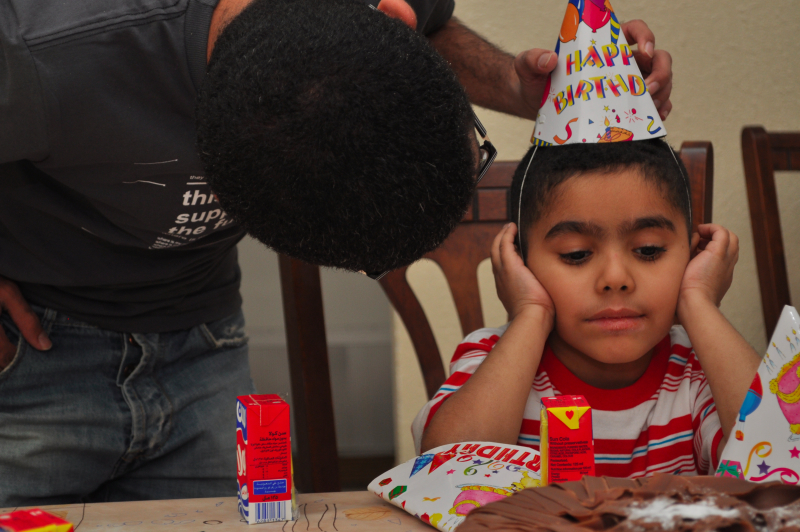
Last night we celebrated the seventh birthday of my little brother Mohammed. Don’t let the picture fool you, it was really fun :P

birthday

God, I love this kid.

Today’s Links

  • Saudi novelist Abdo Khal has won the International Prize for Arab Fiction, aka the Arabic Booker, for his novel ‘Tarmi Besharar’ or ‘Spewing Sparks as Big as Castles.’ The novel was withdrawn from Riyadh Book Fair yesterday by the censorship committee, but half an hour later was returned to the publisher. An official from MOCI said the book was withdrawn “for inspection.”
  • King Abdulaziz University (KAU) students launched an online campaign against a number of university’s regulations, including a ban on electronic equipment that have cameras and wearing pants or on abayas on the women’s part of the campus. Way to go. I wonder what the kids at KSU think about this…

Today’s Links

  • Riyadh Book Fair was opened yesterday. I’m not planning to go this year, but today I got one more reason not to go: Prince Naif issued a decision banning men and women from mixing at the book fair, as well as banning books deemed incompatible with religion and values. The news was carried by Lojainiat, a conservative website.

Today’s Links

  • This is awful: after Michael reposted the abaya pictures, he received death threats via his BlackBerry. The phone calls did not shake him, but later he later received an email with a link to an extremist website that had his images. He had to take the pictures down, again. That’s a real shame, but I can’t blame him. I recently received some hate mail as well after my post on al-Barrak’s fatwa.
  • As I said before, Maureen Dowd was here. I don’t know what to say about her column. Today I don’t feel particularly optimistic. Hell, I don’t feel optimistic at all, actually. It seems that Dowd met only the fancy people. Also, what’s up with this: “He has encouraged housing developments with architecture that allows families, and boys and girls within families, to communicate more freely.”?

Today’s Links

  • CITC has blocked islamlight.net, the website which hosted the infamous fatwa by Shaikh Abdul-Rahman al-Barrak. Although the fatwa can be considered hate speech and a call to violence, I’m generally against such censorship. CITC should stop this practice of making decisions on our behalf on what we should, or rather should not, read on the web.
  • Corinne Martin is an artist who lives in Saudi Arabia and makes these awesome paintings based on vintage pop culture icons.
  • Music concerts are rare in this country. Music concerts in universities are super rare. But hey, what do you know? Jeddah Legends, the band of which Qusay is the lead singer, have recently performed a concert in KAUST. Why oh why KSU never hosted any concerts?

Today’s Links

  • Prince Abdul Aziz bin Bandar has been appointed as deputy chief of the General Intelligence at the rank of minister. The Prince’s previous positions include heading the Anticommunism Department of the GI.

  • NYT has a nice video on the evolution of Olympic pictograms. You don’t know what a pictogram is? Well, this a good chance to learn something new.

  • Speaking of the NYT, Maureen Dowd was (still is?) in Saudi Arabia. According this article in al-Watan daily, Dowd visited the southern town of Rejal Almaa’. I don’t know why she was not wearing the abaya.

  • Olivier Arvisais from the Université du Québec à Montréal in Canada is conducting a study on socials issues and labor market in Saudi Arabia. He recently launched website to obtain responses that could help him with his research. If you are a young Saudi, you can help him by answering the questions there.